A jet ski wrap typically costs between $500 and $3,800 depending on coverage and material grade, with most owners landing around $2,000 for a full professional install. DIY kits run far cheaper, usually $300 to $800, but demand real time and a steady hand on curved hulls.
If your budget is tight and you’re comfortable with a squeegee and a heat gun, a DIY kit is the smarter play. If you want a complex custom design or expect the wrap to last through several riding seasons, a professional install earns its premium.
- DIY kit (partial or full): $300–$800
- Professional install (standard, single-color): $1,200–$2,000
- Premium custom printed wrap: $2,500–$3,800+
Cost Insider’s pricing breakdown puts the average total project at $2,000, with materials alone running $400 to $1,200 depending on vinyl grade.
Key Takeaways
Jet ski wrap costs typically fall between $500 for a basic DIY kit and $3,800 for a premium custom professional install, with material grade and coverage level driving most of the variance.
| Point |
Details |
| Know your price band |
Budget $300–$800 for DIY kits, $1,200–$2,000 for standard pro installs, and $2,500–$3,800+ for premium custom work. |
| Material grade changes longevity |
Marine-grade cast vinyl costs more upfront but resists fading and lifting far longer than budget film. |
| Measure before you buy |
Calculate square footage per panel, add 15 to 20% for waste, then round up to full yards or a pre-cut kit size. |
| Ask for itemized quotes |
Breaking out materials, labor, and prep costs reveals which fees are negotiable. |
| Support your wrap with the right parts |
IPD Racing offers model-specific galleries and parts, like the Yamaha Squarenose Superjet gallery, to plan coverage and fitment before you commit to a design. |
Table of Contents
What Does Jet Ski Wrap Cost Actually Cover?
A jet ski wrap is a layer of adhesive vinyl film applied over the hull and body panels, either to change the color, add graphics, or protect the factory gelcoat underneath. The cost you pay covers three things: the vinyl itself, the printing or cutting of your design, and the labor to stretch, heat, and trim it around every curve of your PWC.
Vinyl comes in two main types. Cast vinyl is thinner, more conformable, and holds up better on the tight curves of a jet ski hull. Calendared vinyl is cheaper but stiffer, and it tends to lift or crack sooner on compound curves. Most reputable shops use cast vinyl from established manufacturers like 3M or Avery Dennison, both of which make marine-rated films built to handle UV exposure and constant water contact.
Finish choice moves price too:
- Gloss or matte: the baseline finish, included in most standard quotes
- Chrome or holographic: adds shine and depth, usually a $200–$300 upcharge
- Textured 3D or carbon fiber: mimics a molded surface, priced as a premium add-on
- Protective laminate overlay: adds scratch and UV resistance, often 15–20% to the material cost
Brand and grade matter because a $5 per square foot budget vinyl might look identical to a $15 per square foot marine-grade film on day one, but only one of them survives five seasons of saltwater and sun.
What Drives the Total Price of a Jet Ski Wrap?
Six variables decide whether your wrap lands at $500 or $3,800, and most of them are within your control.
Material quality and finish is the biggest swing factor. Marine-grade cast vinyl from an established brand costs more upfront but resists fading and lifting far longer than a generic film, according to ShunAuto’s cost breakdown.
Coverage level scales both material and labor. A partial wrap covering just the hood or trim panels might use one roll of vinyl. A full-hull wrap covering every visible panel can run three to four times the material and double the install hours.
Design complexity matters more than most people expect. A single flat color wraps fast. A multi-color printed design with pattern matching across seams requires careful alignment on curved surfaces, which eats labor hours and increases the risk of a misaligned seam that has to be redone.
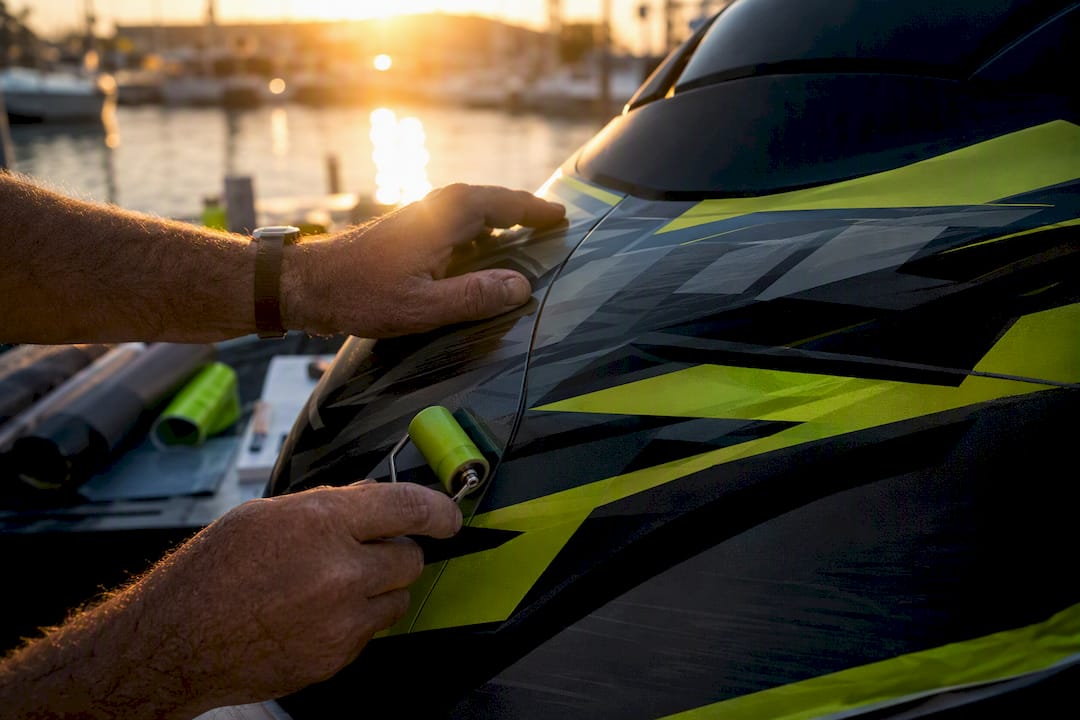
Surface prep and old-wrap removal are often the hidden line item in a quote. Stripping an old wrap, sanding rough spots, and repairing gouges or gelcoat damage typically adds $100 to $300 before a single sheet of new vinyl goes on.
Geography and shop skill level shift labor rates regionally, and rush jobs almost always carry a surcharge.
Labor hours for a mid-size jet ski typically run 8 to 20 hours depending on complexity, billed at $60 to $120 per hour in most markets. Do the math on a 15-hour job at $90 an hour and labor alone hits $1,350, before materials.
Pro Tip: Ask every shop for an itemized quote broken into materials, labor, and prep. A vague lump-sum number hides which line items you can actually negotiate down.
How Much Does a Jet Ski Wrap Cost in Real Scenarios?
Three example budgets show how coverage and material choice change the final invoice.
Scenario 1: Small partial DIY kit. You buy a pre-cut kit for the hood and side panels, install it yourself over a weekend. Vinyl and application tools run $300 to $600, per ShunAuto’s DIY range. No labor cost since you’re doing the work, but budget a few hours for mistakes on your first attempt.
Scenario 2: Standard full-hull, single-color professional install. A shop strips your old graphics, preps the surface, and applies a solid-color cast vinyl wrap across the entire hull. Materials run $400 to $700, labor lands at $600 to $1,200 for roughly 10 to 15 hours, and prep adds another $100 to $200. Total: roughly $1,200 to $2,000, matching the average project cost Cost Insider reports.
Scenario 3: Premium custom printed full-hull wrap with textured finish. This is the top end: a fully custom printed design, chrome or holographic accents, and a textured 3D finish. A base custom graphics kit alone can start around $610, with chrome or holographic base upgrades adding $260 to $290 more, before labor. Add professional installation with pattern matching across curves and total project costs commonly reach $2,500 to $3,800.
| Cost Component |
Low |
Average |
High |
| Materials (vinyl, laminate) |
$300 |
$700 |
$1,200 |
| Labor |
$400 |
$900 |
$2,000 |
| Design/setup (custom print) |
$0 (stock) |
$200 |
$610+ |
| Prep/old-wrap removal |
$50 |
$175 |
$300 |
| Total project |
$1,200 |
$2,000 |
$3,800 |
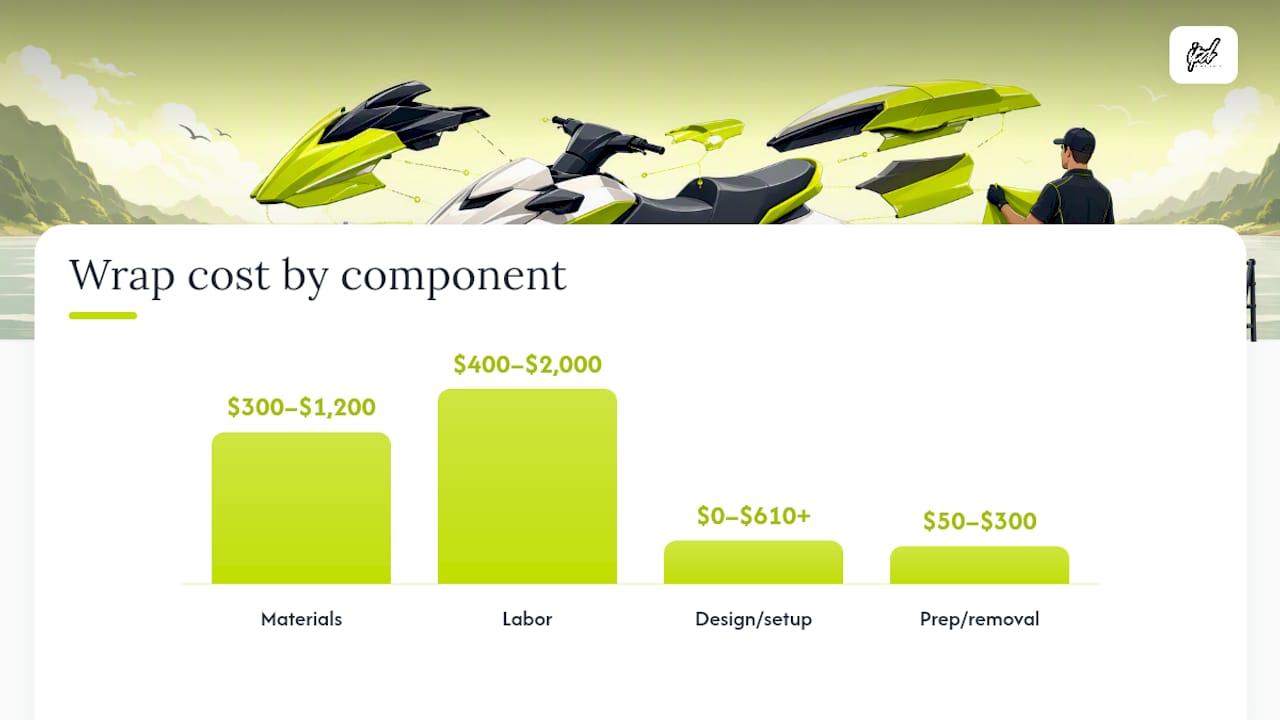
Figures reflect Cost Insider’s component ranges for a standard mid-size PWC; custom design fees vary by shop and complexity.
How Much Vinyl Do You Actually Need?
A standard 2 to 3 seat jet ski typically needs 30 to 50 square feet of vinyl to cover the full hull, hood, and side panels. Larger three-seat or tow-sport models can push that to 60 to 80 square feet. Partial wraps covering just the hood or trim panels usually need 10 to 20 square feet.
Measuring accurately before you order is the single biggest way to avoid a mid-project material shortage.
Materials checklist for a DIY install:
- Vinyl (cast, marine-grade recommended)
- Protective laminate, if not pre-laminated
- Application fluid (soapy water solution)
- Heat gun or propane torch for stretching around curves
- Squeegee with felt edge
- Precision blade or snap-knife for trimming
- Microfiber cloth for surface prep
Here’s a simple way to figure out how much to buy:
- Measure the length and width of each panel (hood, sides, rear) in inches.
- Convert each panel’s area to square feet, then add all panels together.
- Add 15 to 20% for waste, overlap, and mistakes.
- Convert total square feet to linear yards based on your vinyl roll’s width (most rolls run 24 to 60 inches wide).
- Round up to the nearest full yard, since most suppliers sell by the yard or in fixed roll lengths.
Pre-cut kits sized for specific PWC models eliminate most of this math. Rvinyl’s guidance notes that measured, pre-cut kits reduce both waste and the beginner errors that come with cutting your own patterns from a bulk roll.
Is DIY Jet Ski Wrapping Worth the Time Savings?
DIY wrapping saves real money, but it costs real hours, and the learning curve on a curved hull is steeper than wrapping a flat surface like a laptop or a car hood.
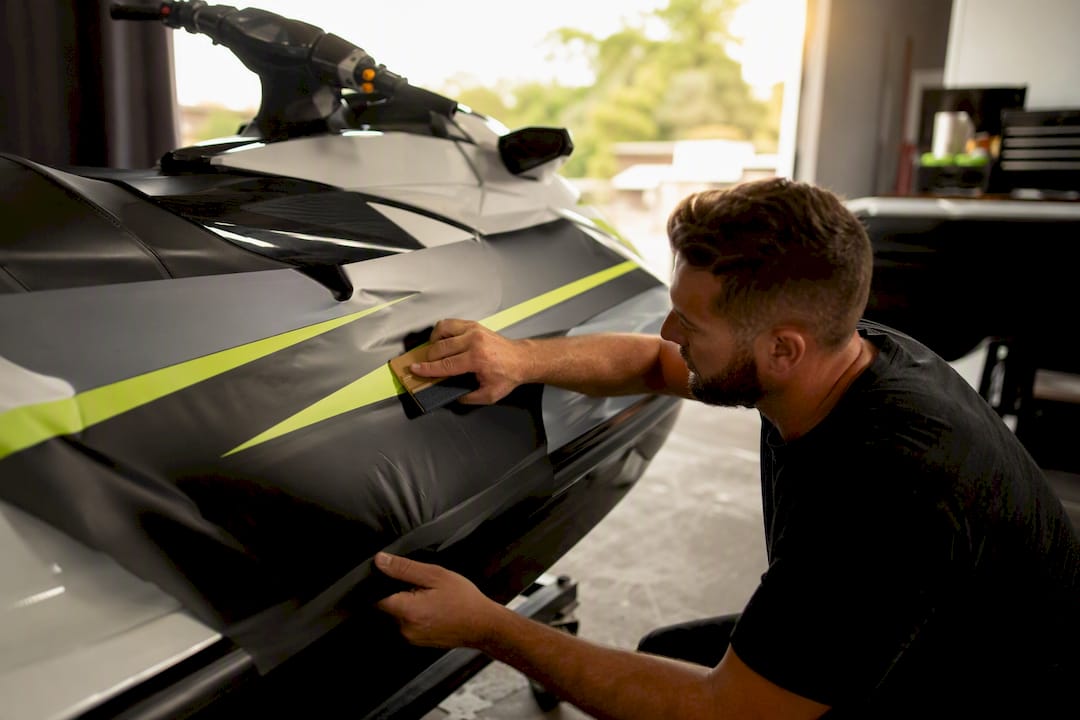
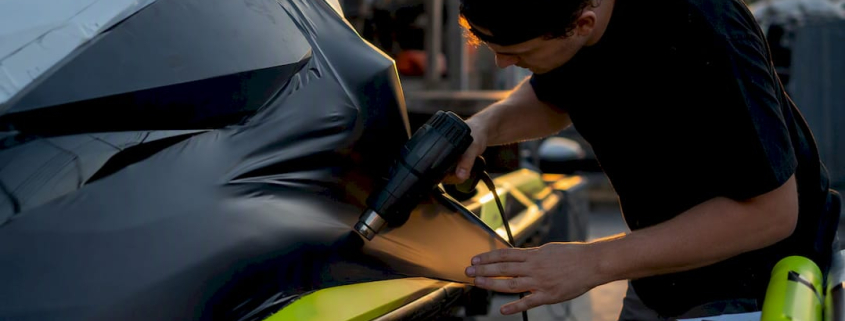
Expect a first-time DIY full wrap to take a full weekend, sometimes longer. The hardest part is stretching vinyl around compound curves near the nose and stepped hull sections without creating bubbles or wrinkles. A heat gun helps the vinyl conform, but overheating it can stretch the film past its printed registration, which ruins alignment on multi-color designs.
Tools you’ll need and rough costs:
- Heat gun: $20–$40 (or rent one for a single project)
- Precision squeegee set: $15–$25
- Snap-blade knife and extra blades: $10
- Surface prep solution: $10–$15
Professional shops charge more because their workflow includes steps most DIYers skip: creating a digital template of your exact hull shape, test-fitting panels before final application, and matching printed patterns precisely across seams. That precision is also why most shops back their work with a workmanship warranty.
The most common DIY failure mode is lifting edges from insufficient heat during application, or bubbling from trapped air. Both are fixable, but a redo eats into whatever you saved versus paying a pro the first time.
Pro Tip: If your design has any multi-panel graphics that need to align across a seam, hire a pro. Pattern matching on a curved hull is one of the hardest skills to get right without practice.
Wrap or Repaint: Which Costs Less Long Term?
A vinyl wrap generally costs less upfront than a professional paint job and offers more flexibility if you want to change your look again later. Professional marine paint jobs typically run $1,000 to $3,000 or more, while a full custom wrap lands in the $600 to $1,400 range for most installs.
- Durability: paint can last longer if properly maintained, but chips and scratches show immediately; vinyl resists minor scuffs but is more vulnerable to UV fading over years of direct sun exposure
- Maintenance: wraps need occasional cleaning with non-abrasive soap; paint may need periodic wax and buffing
- Reversibility: a wrap can be removed and replaced without touching the underlying gelcoat; paint is permanent unless you repaint again
Choose repaint when you want a permanent color change or need to cover structural gelcoat repairs. Choose a wrap when you want protection for the factory finish, a custom look you might change again, or a lower upfront cost.
Pro Tip: A wrap can actually protect resale value better than paint, since it shields the original factory gelcoat underneath rather than replacing it.
How Can You Lower Your Jet Ski Wrap Cost?
Small scheduling and material decisions can shave hundreds off a quote without cutting corners on quality.
- Book during off-season: shops often have lighter schedules in fall and winter, and some offer lower labor rates to fill open bays
- Choose partial coverage: an accent wrap on the hood and sides costs far less than a full-hull job and still refreshes the look
- Use a pre-cut kit: sized-to-model kits reduce waste and skip the design/setup fee a fully custom print requires
- Pick mid-tier marine-grade vinyl: it balances cost and longevity better than bargain films that fade within a season
- Bundle services: ask if prep, wrap, and a protective laminate coat can be quoted together for a package discount
- Request an itemized quote: breaking out materials, labor, and prep makes it easier to spot which fees are negotiable
How IPD Racing Supports Your Wrap Project
IPD Racing carries the parts and accessories that round out a wrap project beyond the vinyl itself, from traction mats to handle pole components that need to match your new graphics scheme. Browsing model-specific galleries like the Yamaha SuperJet graphics gallery or the Yamaha WaveBlaster gallery gives you a realistic sense of coverage levels and finish options before you commit to a design.
- Model-specific graphics galleries showing coverage and finish examples
- A shop by model catalog for finding compatible parts alongside your wrap
- Direct contact support for questions on fitment or compatible upgrades
Whether you’re doing a full DIY install or coordinating with a shop, having the right supporting parts on hand, matched to your PWC model, cuts down on delays and mismatched hardware once the wrap goes on. If you’re unsure what fits your specific model, reach out through IPD Racing’s contact page before you order.
Do Jet Ski Wraps Come With a Warranty?
Most professional shops offer a workmanship warranty separate from the material warranty, and the two cover different failures. A shop’s workmanship warranty, typically 6 to 12 months, covers lifting edges, bubbling, or seam separation caused by installation error. Material warranties from vinyl manufacturers like 3M or Avery Dennison typically cover fading or cracking under normal use, often for several years, but only when the vinyl was installed according to the manufacturer’s specifications.
DIY installs generally carry no workmanship warranty at all since there’s no shop backing the labor. If your DIY wrap fails from a heat-application mistake, you’re covering the repair or full re-wrap yourself.
Ongoing maintenance costs are modest but real. Rinsing with fresh water after saltwater exposure prevents salt crystal buildup that can dull the finish over time. Avoid high-pressure washers held too close to seams, since they can force water underneath the vinyl edge and cause premature lifting. A vinyl-safe UV protectant applied every few months extends color life, particularly on darker or printed finishes that fade faster under direct sun.
Budget for a re-laminate or partial touch-up around year three to four on a heavily used PWC, especially in high-UV climates. That’s typically far cheaper than a full re-wrap and can extend the life of your original graphics by another season or two.
A professional install earns its price when your design involves multi-panel pattern matching or when you plan to keep the PWC long enough that durability matters more than upfront savings. For a simple single-color accent wrap, a DIY kit gets you most of the visual payoff for a fraction of the cost.
The most common regret I hear about isn’t overspending. It’s underspending on vinyl grade to save $150 upfront, then redoing the whole wrap two summers later when the cheap film fades and cracks first. Marine-grade cast vinyl from a reputable brand almost always pays for itself before the wrap’s second season ends.
Ready to Complete Your Jet Ski’s Look?
A wrap changes your jet ski’s appearance, but the parts underneath it are what keep it running the way you want. IPD Racing stocks the performance and handling upgrades that pair naturally with a fresh graphics job, from hull and steering components to traction and footing products that hold up under the same conditions your new vinyl has to survive.
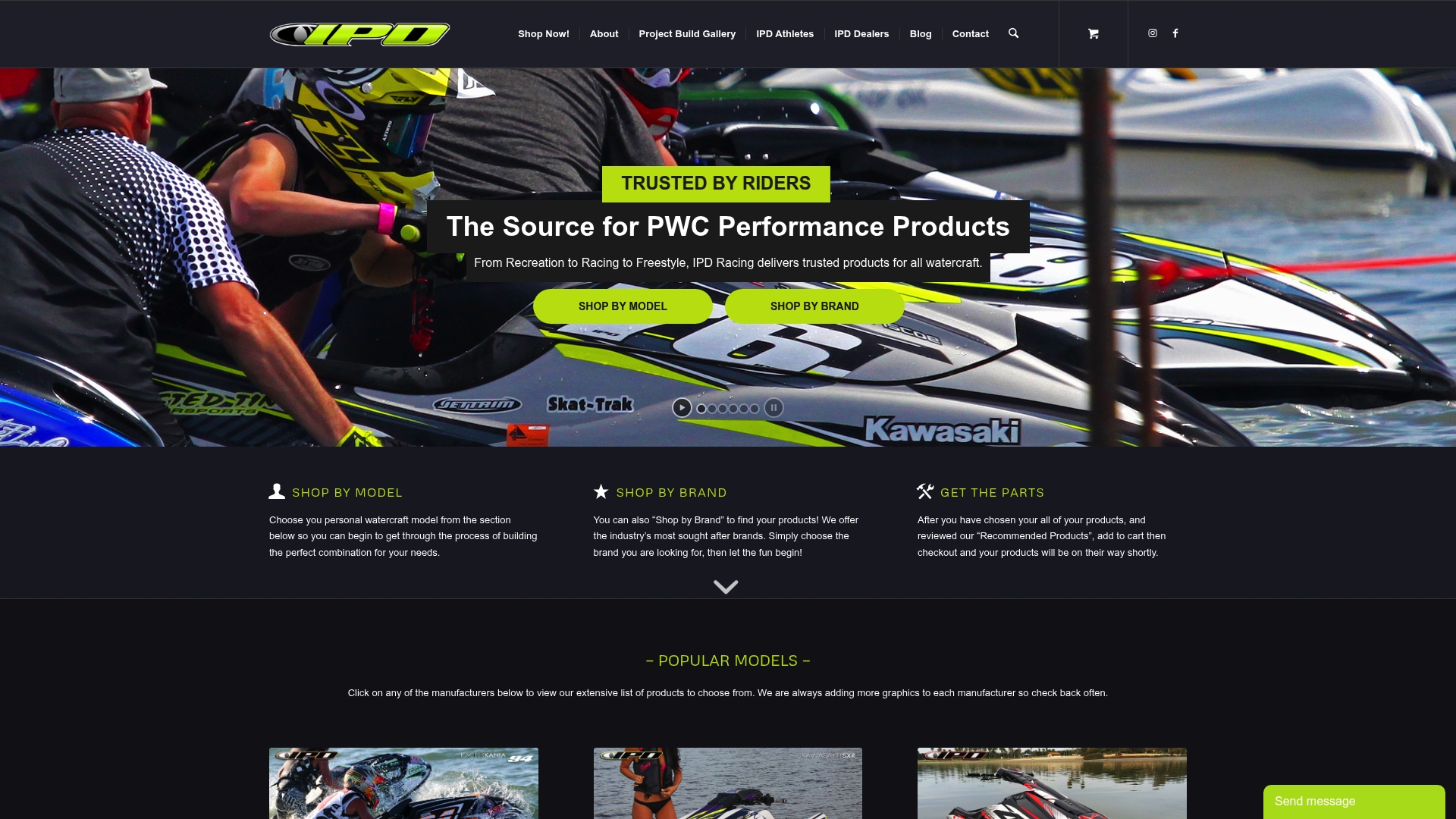
If you’re planning a wrap alongside other upgrades, browsing IPD Racing’s hot products performance parts page is a practical way to see what else riders typically bundle with a graphics refresh. For model-specific fitment questions or help finding compatible accessories before your wrap goes on, shop by model to find parts matched to your exact PWC.
Frequently Asked Questions
How much does it cost to wrap a jet ski?
Most full professional wraps cost between $1,200 and $2,000, though premium custom designs can reach $3,800 or more. DIY kits typically run $300 to $800.
Is it cheaper to wrap or paint a jet ski?
Wrapping is usually cheaper upfront, with full custom wraps running $600 to $1,400 compared to professional paint jobs at $1,000 to $3,000 or more.
How long does a jet ski wrap last?
Marine-grade cast vinyl typically lasts several years with proper care, though exact longevity depends on sun exposure, saltwater rinsing habits, and vinyl grade.
Can you wrap over an old wrap?
It’s not recommended. Old wraps should be removed first, which typically adds $100 to $300 to a project, since wrapping over existing vinyl traps imperfections and shortens the new wrap’s lifespan.
How much vinyl do I need for a jet ski wrap?
A standard 2 to 3 seat model typically needs 30 to 50 square feet, while larger models can require 60 to 80 square feet.
Do jet ski wraps come with a warranty?
Many professional shops offer a workmanship warranty covering installation defects, typically 6 to 12 months, separate from the vinyl manufacturer’s material warranty against fading or cracking.
Sources
Recommended