
Why Jet Ski Throttle Response Matters for Racers
Throttle response determines how quickly your jet ski converts wrist input into usable thrust. It is not the same as peak power. Throttle response is the rate at which power output changes after a rider requests acceleration, and on a PWC that rate is shaped by every component between your thumb and the water leaving the jet pump. IPD Racing and Jet Works both build parts that directly target this system, and the two mechanical chokepoints that matter most are the jet pump assembly and the electronic throttle control (ETC) or throttle position sensor (TPS).
Three rider impacts stand out:
- Launch and holeshot: Faster thrust delivery off the line shortens the time your hull spends in the water before it planes, directly affecting race starts and buoy turn exits.
- Corner exit and trim control: Crisp response lets you modulate power precisely on corner exit, keeping the bow trimmed through chop instead of hunting for grip.
- Emergency inputs: Predictable, immediate power is a safety asset. A soft or delayed response during a collision-avoidance maneuver can eliminate the reaction window you need.
Key Takeaways
Throttle response is a whole-system attribute controlled by the jet pump, throttle body, TPS, ECU mapping, and fuel delivery working together. Address pump hardware first before any ECU work.
| Point | Details |
|---|---|
| Response vs. peak power | Throttle response is the rate of power change after input, not the maximum power the engine produces. |
| Pump condition comes first | Worn wear rings and impeller damage cause most perceived hesitation; inspect these before chasing ECU or sensor faults. |
| Throttle body and TPS | Cleaning the throttle body and replacing a faulty TPS restores crisp response at low cost on any fuel-injected PWC. |
| ECU reflash trade-offs | A reflash sharpens the throttle curve and raises RPM limits but increases fuel use and may affect emissions compliance. |
| IPD Racing model fitment | Use IPD Racing’s Shop by Model pages to match impellers, wear rings, and throttle components to your specific platform. |
Table of Contents
- Why jet ski throttle response matters: the system mechanics
- How throttle response changes your riding and race results
- Why does throttle response go soft? Common causes and quick checks
- How to test throttle response on the water
- Upgrade options that sharpen response — and what you trade away
- The scenarios where throttle response really decides the outcome
- IPD Racing has the parts and support to get your response dialed in
- Sources
Why jet ski throttle response matters: the system mechanics
Throttle response is defined as the time-rate change of delivered power after a throttle request, distinct from the maximum power the engine can produce. A high-horsepower engine with sluggish response still feels slow off the line.
The signal path on a modern fuel-injected PWC runs like this:
Rider input → TPS/throttle cable → ECU mapping/ETC → throttle body/fuel injectors → engine torque → impeller → water thrust
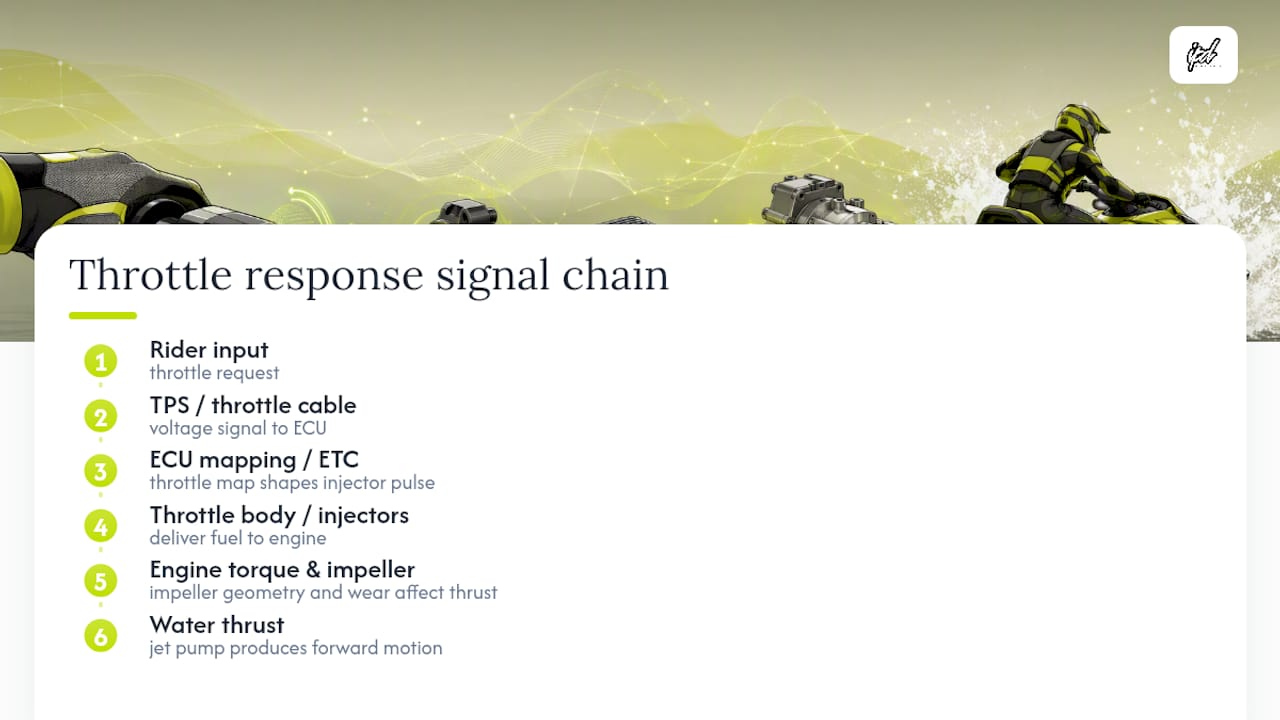
Each stage can add delay. The ECU applies a throttle table that shapes how aggressively it translates TPS voltage into injector pulse width. Factory maps often include deliberate damping for fuel economy and emissions compliance. After the engine produces torque, the jet pump translates that torque into thrust, and impeller geometry, wear ring clearances, and intake grate condition all affect how immediately that thrust reaches the water. A worn wear ring bleeds pressure before it ever becomes forward motion.
Research on adaptive throttle pedal mapping confirms that tuning throttle curve progression to rider preference measurably improves subjective performance feel, which is exactly why ECU reflash services target the throttle table first.
How throttle response changes your riding and race results
The gap between immediate and delayed response shows up most clearly at race starts. A rider with crisp response planes out faster, reaches buoy speed sooner, and carries more momentum into the first turn. A rider with soft response loses ground in the first 50 feet and spends the rest of the lap trying to recover it.
Corner exit behavior is where racing jet ski trim and throttle response intersect. A well-tuned response lets you feed power back in smoothly as the hull settles, keeping the bow from washing wide. A delayed or jumpy response forces you to either wait longer before rolling on the throttle or risk a bow-high push that loses the line.
| Riding Context | Throttle Response Priority | Key Concern |
|---|---|---|
| Racing (Watercross, offshore) | Critical | Holeshot, buoy turn exits, lap time |
| Recreational riding | Moderate | Comfort, fuel economy, predictability |
| Freestyle | High | Precise modulation for trick timing and recovery |
Safety scenarios deserve equal weight. In choppy water or a crowded course, a predictable throttle response gives you confidence to make quick, controlled inputs. A racer running a technical wave section reported that after addressing a worn wear ring and cleaning the throttle body, the craft felt “connected” again, with no hesitation between input and thrust. That consistency is what separates a manageable situation from a close call.
Why does throttle response go soft? Common causes and quick checks
Modern fuel-injected PWCs can suffer poor response from dirty throttle bodies, carbon buildup, or faulty TPS sensors, leading to rough idle, sluggish acceleration, and higher fuel consumption. Electronic throttle control systems and fuel-economy-oriented ECU maps also introduce deliberate throttle delay, and mechanical faults compound that factory damping.
Quick physical inspection checklist:
- Inspect the impeller and wear ring. Look for blade nicks, erosion, and visible gap between the impeller and wear ring. Excessive clearance bleeds thrust directly.
- Check the intake grate. Debris, bent bars, or heavy fouling restrict water flow into the pump and starve thrust delivery.
- Inspect the throttle cable. A frayed, kinked, or sticky cable introduces mechanical lag before the TPS even registers input.
- Check the throttle body and TPS. Carbon buildup on the throttle plate or a dirty TPS connector causes erratic signal and hesitation.
- Review ECU fault codes. A stored code for MAF sensor, TPS voltage out of range, or fuel pressure fault points directly to the cause.
- Check fuel delivery. A clogged fuel filter or weak fuel pump produces a lean stumble under hard acceleration.
Quick diagnostic checks:
- Throttle snap test (at dock): With the engine warm and in neutral, snap the throttle quickly. A healthy engine responds immediately with a clean RPM rise. Stumble or delay points to throttle body, TPS, or fuel delivery.
- Idle-to-WOT observation: On a calm water run, note whether RPM climbs smoothly and continuously or hesitates in a mid-range band.
- Check Engine light: Never ignore a stored fault code before a race or a long ride. Pull codes with a compatible OBD/dealer tool before diagnosing further.
Pro Tip: Always address pump-end issues before chasing ECU or sensor faults. A worn wear ring or clogged intake grate mimics engine hesitation almost perfectly, and replacing a wear ring costs far less than an ECU reflash that solves nothing.
How to test throttle response on the water
Run these steps on a calm, open stretch of water with no boat traffic.
- Warm the engine fully. Ride at moderate speed for 3–5 minutes before any test run. Cold engines produce inconsistent results.
- Establish a baseline run. From a standing start, squeeze to wide-open throttle (WOT) and note the qualitative feel: immediate, mild delay, or jumpy/sticky. Do this three times and average your impression.
- Time a controlled acceleration run. Use a handheld GPS unit or similar timing device to record 0–20 mph or 0–30 mph elapsed time. A stopwatch works as a secondary check. Log the water conditions, temperature, and fuel level for each session.
- Observe RPM rise behavior. If your craft has a tachometer or gauge display, watch how quickly RPM climbs from idle to WOT. A healthy system climbs steadily. A plateau or dip in the mid-range signals a lean condition or throttle body fault.
- Compare pre/post results. After any part swap or tune, repeat the same run under the same conditions. GPS data makes the difference objective.
What each response pattern likely means:
- Immediate, linear: Pump, throttle body, and ECU mapping are all healthy.
- Mild delay, then normal: Factory ECU damping or slight throttle cable drag. A candidate for ECU throttle table adjustment.
- Jumpy or surging: TPS fault, dirty throttle body, or impeller cavitation from a worn wear ring.
- Flat or stumbling: Fuel delivery restriction, fouled injectors, or a significant pump clearance issue.
When qualitative testing points to ECU mapping, ECU remapping can alter throttle tables to reduce gas delay and improve propulsion accuracy. At that stage, a wideband-backed dyno tune or a professional ECU log session gives you data to work from rather than guesswork.
Upgrade options that sharpen response — and what you trade away
| Upgrade | Effect on Response | Trade-off | Best For |
|---|---|---|---|
| Impeller swap (performance pitch) | Significant improvement in thrust delivery | Higher engine load, must match engine output | Racers, advanced enthusiasts |
| Wear ring replacement | Restores lost pump efficiency | Low cost, no real downside | All riders, first fix to try |
| Intake grate upgrade | Improves water flow to pump | Minimal, slight handling change | Racers, freestyle riders |
| Throttle body cleaning / TPS replacement | Restores crisp signal and idle quality | Low cost, no trade-off | All fuel-injected PWCs |
| ECU reflash / throttle table remap | Removes factory damping, sharpens curve | Higher fuel use, possible emissions impact, may void warranty | Racing, performance builds |
| Fuel system service (filter, injectors) | Eliminates lean stumble under load | Routine maintenance cost | All riders showing hesitation |
An ECU reflash typically improves throttle response, raises RPM limits, and increases top speed, but it affects fuel consumption and emissions. For competition use, that trade-off is straightforward. For a recreational craft used daily, the fuel cost and potential warranty impact deserve consideration.
For model-specific fitment on impellers and wear rings, the Jet Works performance tuning parts lineup covers fuel, carburetor, and cooling upgrades matched to specific platforms. Aggressive engine modifications, including turbo kits, require matching pump hardware to avoid reliability problems. The jet ski turbo kit overview covers what that matching process looks like in practice.
Pro Tip: Always address pump hardware before an ECU reflash. A worn wear ring or mismatched impeller will waste the gains from any remap and can mask whether the tune is actually working.
Upgrade sequence for racers:
- Wear ring and impeller first
- Intake grate and throttle body service second
- ECU reflash or throttle table remap only after mechanical issues are resolved
The scenarios where throttle response really decides the outcome
Watercross starts and buoy turns are where immediate response separates podium finishes from mid-pack results. At a Watercross event, the gap between a crisp response and a half-second delay is often the entire margin between first and third off the line. That is not an exaggeration. Factory ECU maps are calibrated for a broad range of riders and conditions, not for a competitive start gate.
Freestyle riders face a different version of the same problem. Trick timing depends on precise, repeatable power modulation. A throttle that surges or hesitates mid-maneuver disrupts the timing window for a backflip or a barrel roll entry. Recreational riders have the most tolerance for factory response, and for them, the fuel economy and reliability of a stock tune are genuine advantages worth keeping.
The practical question is whether the riding you do actually demands a sharper response. If you race or ride freestyle competitively, the answer is yes, and the pump-first upgrade sequence above is the right starting point. If you ride recreationally and your craft feels hesitant, a throttle body cleaning and wear ring inspection will likely restore the feel you expect without any ECU work. For anything beyond that, consult a professional tuner with dyno access rather than reflashing blind. The PWC tuning best practices guide covers when professional help is the right call.
IPD Racing has the parts and support to get your response dialed in
Riders who have worked through the troubleshooting steps above and know what they need will find impellers, wear rings, throttle components, and performance fuel system parts at IPD Racing. The catalog covers Sea-Doo, Yamaha, Kawasaki, and other platforms, with model-specific fitment guidance so you order the right part the first time.
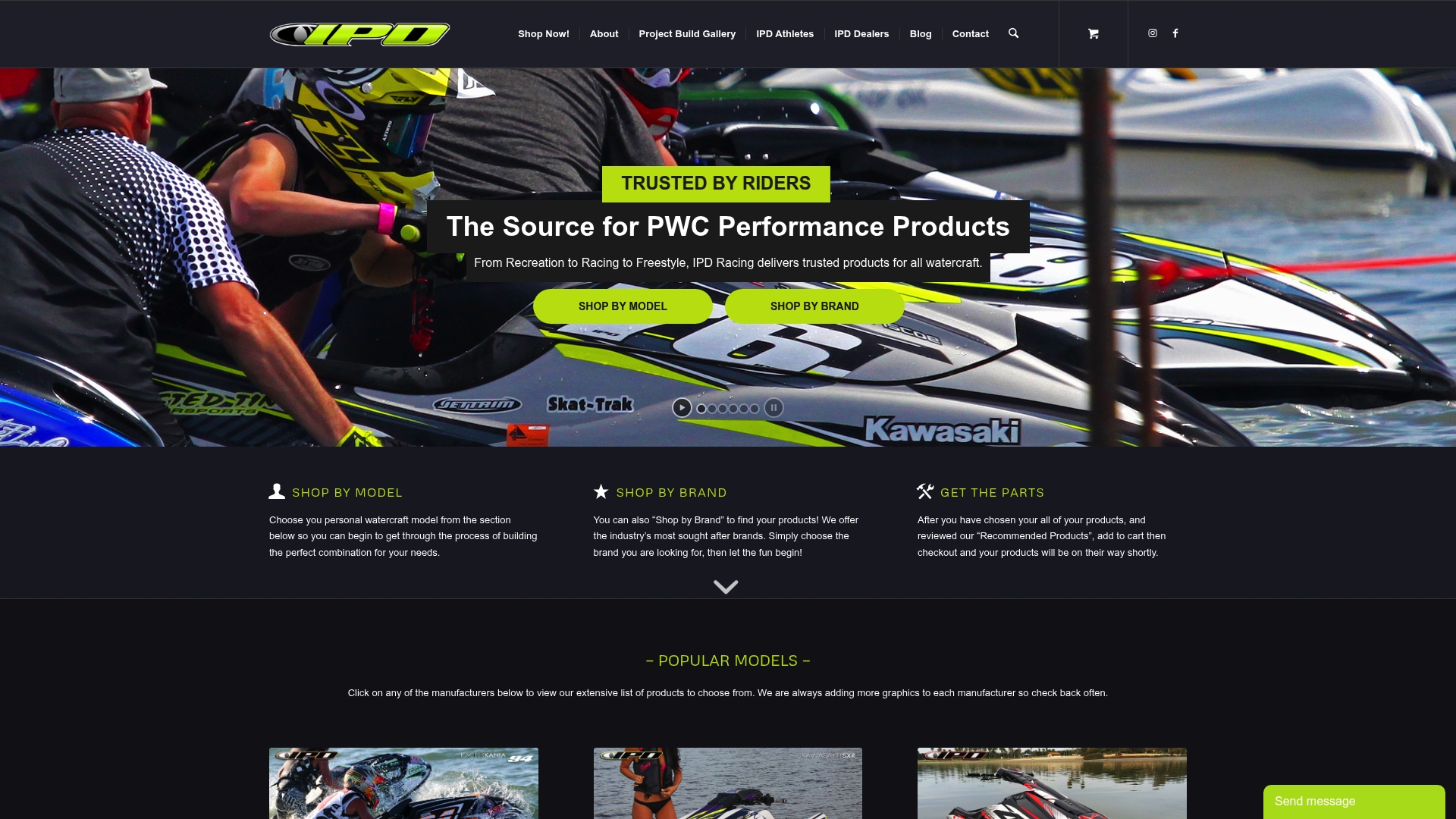
For racers building a competitive setup, the Hot Products performance parts lineup includes engine, exhaust, and PWC upgrade components proven in race conditions. Before ordering any pump or engine component, use the Shop by Model pages to confirm fitment for your specific hull and engine combination. Getting the right match between impeller pitch, wear ring clearance, and engine output is what makes the upgrade work. Browse by model now and build the setup your craft actually needs.
Sources
- Throttle response – Wikipedia
- Throttle Response & Jet Pump Tuning – How to Get the Most Out of Your PWC – BoatBlurb

