
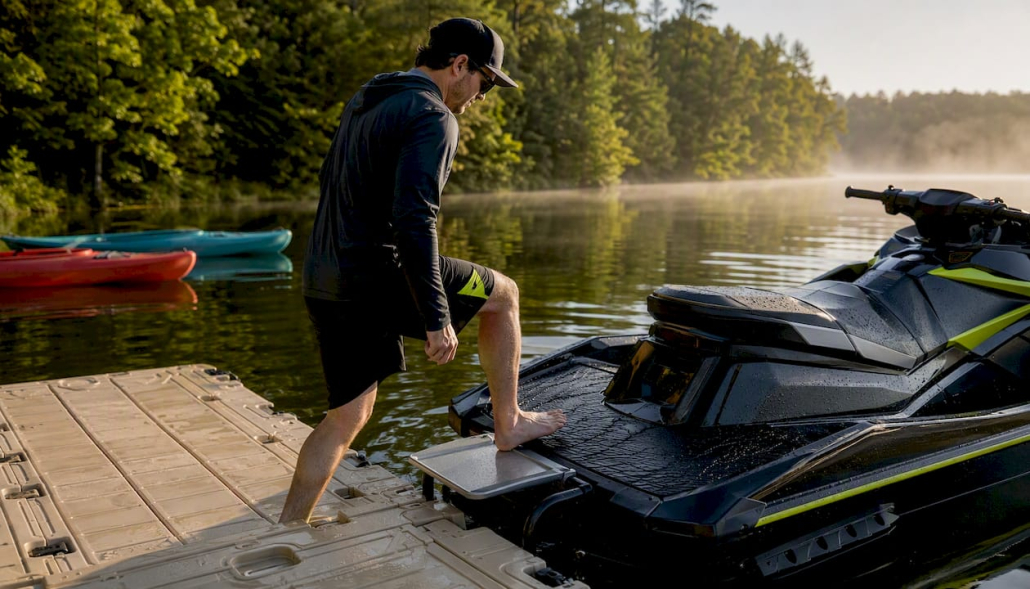
PWC Boarding Step Explained: Types, Use, and Fit
A PWC boarding step is a purpose-built platform or ladder mounted at the stern of a personal watercraft that gives you a secure foothold for reboarding from the water. The industry term you’ll see on OEM spec sheets is “boarding ladder” or “retractable boarding step,” and both refer to the same functional category. BoatUS Foundation notes that reboarding without one requires pulling your full body weight over the stern edge from a dead float, which is physically demanding and unstable. A step shortens that vertical lift and gives you a stable surface to push from, making reboarding faster and safer for riders of all fitness levels. IPD Racing carries compatible boarding hardware for Sea-Doo, Yamaha, Kawasaki, and other major PWC platforms.
Table of Contents
- What a PWC boarding step actually does
- Common boarding-step types and how they attach
- How to reboard a PWC from the water using a boarding step
- How to choose a boarding step that fits your PWC
- Maintenance and safety checks for boarding steps
- Where to buy a boarding step and what to expect on price and install time
- Key Takeaways
- Why boarding steps belong in every PWC owner’s toolkit
- IPD Racing boarding accessories for PWC owners
- Useful sources
What a PWC boarding step actually does
A boarding step mounts at the stern, typically on the swim platform or under-seat deck, and reduces the height you need to clear when pulling yourself out of the water. Without one, you grab the stern handle or platform edge, kick hard, and haul yourself into a kneeling position while the craft rocks. With a step, your foot finds a fixed rung or platform below the waterline, and you push up rather than pull up. That shift from a pull to a push uses larger muscle groups and keeps your center of gravity lower during the transition.
The three main form factors are:
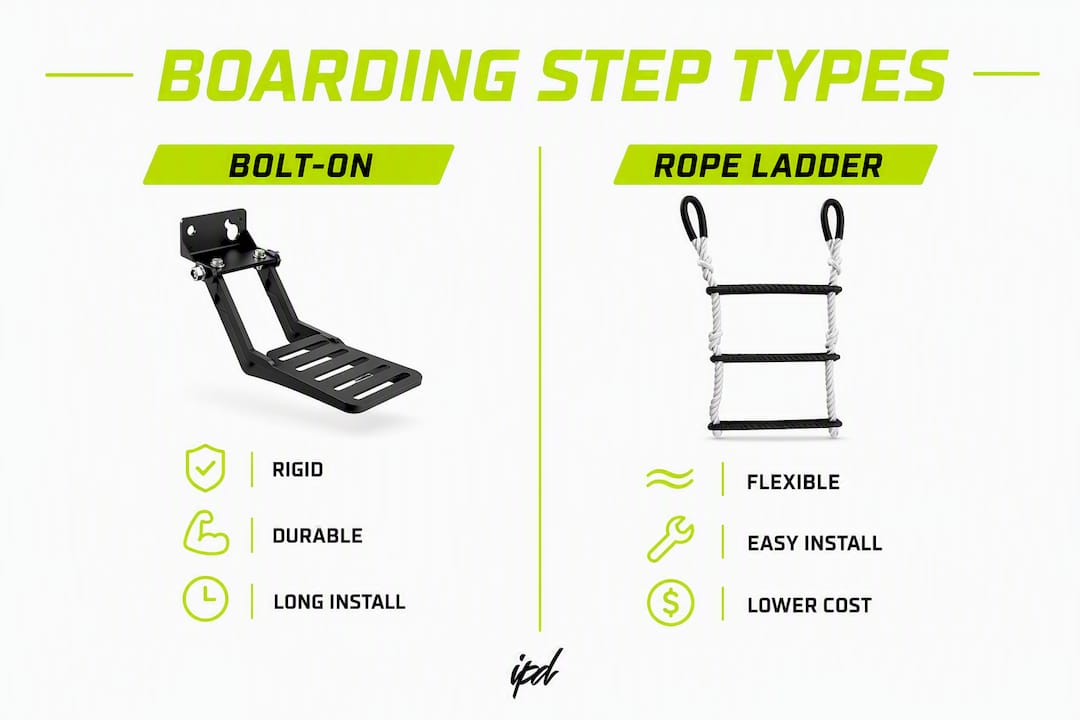
- Rigid bolt-on platform: A fixed step welded or bolted to the stern bracket, always deployed.
- Flip-up/retractable step: A spring-loaded platform that stays stowed flush when not in use and drops down for reboarding. Sea-Doo’s OEM retractable boarding step (part number 295100742, replacing prior part 295100552) uses exactly this mechanism.
- Rope ladder: A flexible nylon ladder that hangs from a cleat or tow eye when needed and stows flat when not.
Stern placement is deliberate. Boarding from the side increases capsizing risk, so every reputable boarding step design routes the rider to the rear of the craft, where the hull is widest and most stable.
Pro Tip: Visualize the step as a lever point, not just a foothold. Placing your foot on the lowest rung and pushing straight up keeps your weight centered over the centerline of the craft, which is the position that prevents roll.
Common boarding-step types and how they attach
| Type | Attachment Method | Typical install time | Durability/Maintenance |
|---|---|---|---|
| Bolt-on rigid step | Deck bolts, backing plate | Moderate install time | High; inspect fasteners annually |
| Flip-up/retractable step | Bolt-on to stern bracket | Moderate install time | High; lubricate hinge seasonally |
| Rope ladder (EZ Riser style) | Cleat or tow-eye strap | Quick install time | Moderate; inspect webbing each season |
| Portable strap-on riser | Rail hooks or strap loops | Quick install time | Moderate; UV degradation over time |
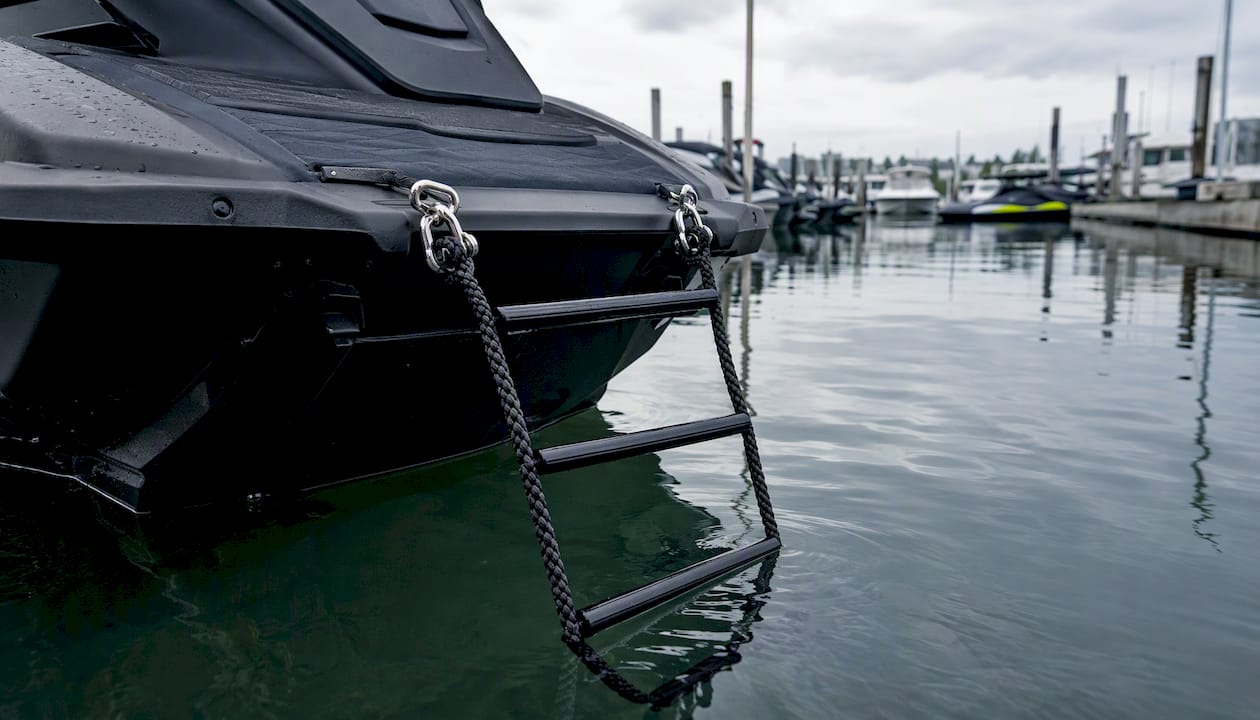
EZ Riser rope ladders from Hardline Products attach to cleats, tow eyes, or railings and fit most PWC hull forms without drilling. That makes them a practical first step for riders who want a boarding solution before committing to a permanent installation.
Bolt-on steps require drilling into the stern deck and using marine-grade fasteners with backing plates. Skipping the backing plate is a common installer error that leads to deck deformation and galvanic corrosion over time. Use stainless steel hardware and a proper bushing to isolate dissimilar metals.
Pro Tip: For bolt-on installs, dry-fit the step and check for clearance around the reverse nozzle and trim tabs before drilling. A step that contacts the nozzle during reverse operation can crack the housing.
How to reboard a PWC from the water using a boarding step
Before you approach the stern, run through these safety checks:
- Confirm the engine is off.
- Remove the safety lanyard from the craft so the engine cannot start accidentally.
- Verify the craft is stable and not drifting toward obstacles.
Then follow this sequence, adapted from Sea-Doo’s reboarding guidance:
- Approach the stern from directly behind. Never approach from the side.
- Deploy the step if it is a flip-up or retractable model. Rope ladders should already be hanging.
- Place one foot on the lowest rung or platform. Keep your body close to the hull.
- Grip the grab handles on either side of the seat or the stern handle. Do not grab the seat cushion.
- Push up with your foot while pulling with your arms, transitioning to a kneeling position on the platform.
- Swing one leg over the seat and sit down before reaching for the lanyard.
- Reattach the lanyard before restarting the engine.
If a passenger also needs to reboard, one rider boards first and stabilizes the craft from the seat before the second person uses the step.
Pro Tip: Practice reboarding in calm, shallow water until the sequence is automatic. Fatigue and adrenaline after a fall make the motion harder than it looks on a flat lake.
The BoatUS Foundation is direct on this point: if you struggle to reboard in calm conditions, avoid operating in strong currents or high waves, and treat a boarding ladder as a worthwhile safety investment rather than an optional accessory.
How to choose a boarding step that fits your PWC
Fit is not universal. A step that works on a Sea-Doo GTX will not necessarily clear the pump housing on a Yamaha FX Cruiser. Check these specs before ordering:
- Weight capacity: Always verify the published rating on the product spec sheet. Rope ladders and bolt-on steps carry different ratings; never assume.
- Step footprint: Width and depth of the platform or rung. Wider is more stable; deeper gives more foot support.
- Stowage clearance: For retractable steps, confirm the folded profile clears the trailer bunks and any hull graphics.
- Hinge/retraction clearance: Measure from the mounting surface to the reverse nozzle at full swing.
- OEM vs. universal fit: OEM steps use model-specific deck hole spacing and bracket geometry. Aftermarket universal steps often include adapter plates but require measuring the mounting surface width.
To verify model compatibility, locate the part number in your OEM parts diagram (available through your Sea-Doo, Yamaha, or Kawasaki dealer portal) and cross-reference it against the aftermarket product’s fit list. For PWC tuning and weight distribution considerations, a step that adds weight at the stern can affect trim on performance-oriented craft.
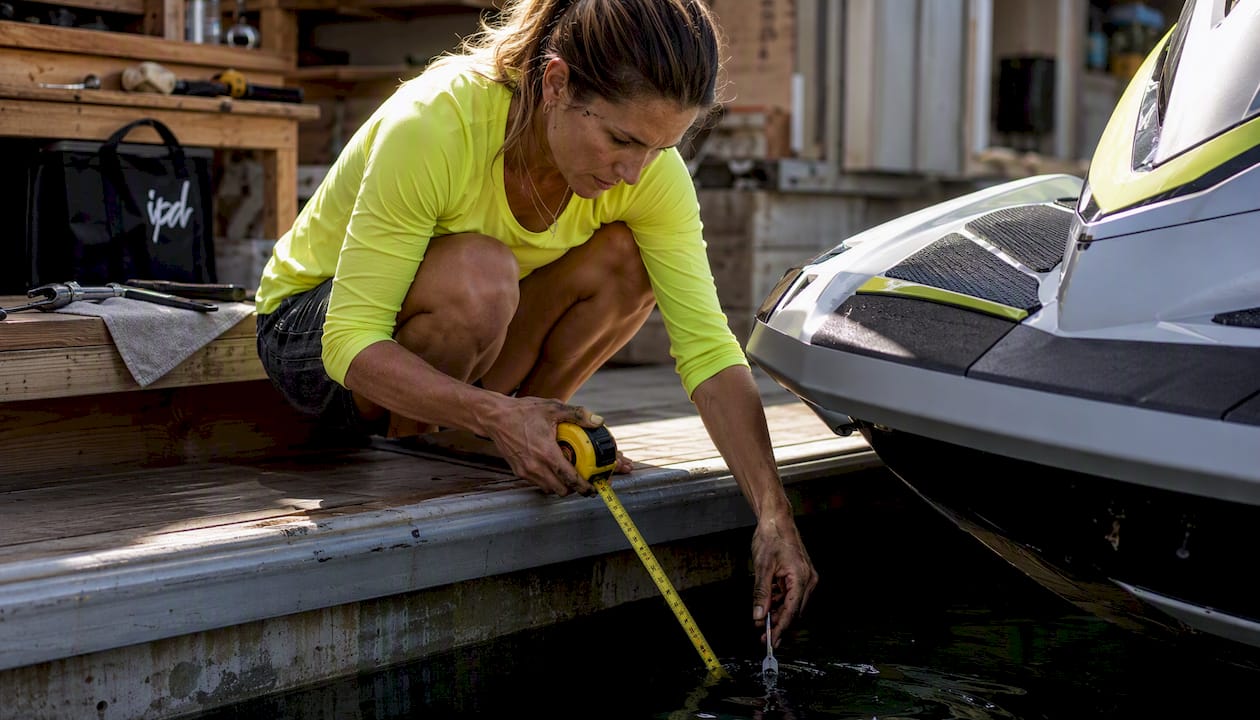
Pro Tip: Measure the distance from your platform edge to the waterline at rest with a rider seated. That number tells you the minimum step projection you need for a useful foothold.
Maintenance and safety checks for boarding steps
Routine inspection keeps a step functional and safe. After each season and before storage, check:
- Fasteners: Tighten any loose bolts and inspect for corrosion at the deck interface.
- Hinge smoothness: Flip-up steps should deploy and retract without binding. Apply marine-grade grease to the pivot point.
- Non-skid surfaces: Replace worn grip tape or textured pads; a slick step surface defeats the purpose.
- Webbing and straps: On rope ladders and strap-on risers, look for fraying, UV cracking, or stretched loops that no longer hold tension.
- Retraction latches: Confirm the latch engages fully so the step does not deploy unexpectedly at speed.
Remove bolt-on steps before trailering if they extend beyond the hull profile, and store rope ladders dry to prevent mildew on the webbing. For broader guidance on PWC safety gear and maintenance protocols, IPD Racing’s safety gear guide covers inspection schedules alongside protective equipment. Pairing good maintenance habits with the right boat insurance coverage is also worth considering for any PWC owner who rides in open water.
Pro Tip: A quick post-ride rinse with fresh water extends the life of both the step hardware and the mounting fasteners, especially in saltwater or brackish environments.
Where to buy a boarding step and what to expect on price and install time
OEM steps from Sea-Doo (such as part 295100742), Yamaha, and Kawasaki offer guaranteed fitment and factory warranty coverage. The trade-off is price and availability; OEM parts often cost more and may require dealer ordering.
Aftermarket options from specialty retailers and accessory stores offer more variety and often lower price points. Rope ladders like the EZ Riser from Hardline Products sit at the accessible end of the price range and install in minutes. Bolt-on rigid or retractable steps sit at the higher end and require tools and moderate mechanical skill.
| Option | Price Range | Install Time | Best For |
|---|---|---|---|
| Rope ladder (strap-on) | Lower price range | Quick install time | Riders wanting a portable, no-drill solution |
| OEM retractable step | Mid to higher price range | Moderate install time | Owners who want factory fit and warranty |
| Aftermarket bolt-on step | Mid price range | Moderate install time | Riders wanting a permanent, budget-flexible option |
Always check the published weight capacity on the spec sheet before purchasing. IPD Racing’s watercraft accessories guide is a useful starting point for riders comparing accessory categories.
Pro Tip: Buy OEM when your craft is under warranty or when the hull has a non-standard stern profile. Aftermarket universal steps work well on standard platforms but can require adapter plates that add install time.
Key Takeaways
A boarding step is one of the highest-value safety accessories a PWC owner can add, reducing reboarding effort and instability at the stern.
| Point | Details |
|---|---|
| Stern is the only safe entry point | Boarding from the side increases capsizing risk; all step designs route you to the rear. |
| Check weight capacity and fit specs | Verify the step’s rated capacity, footprint, and model-year compatibility before ordering. |
| Practice reboarding in calm water | Build muscle memory in flat conditions so the technique holds when you’re fatigued or in chop. |
| Inspect fasteners and non-skid annually | Tighten bolts, lubricate hinges, and replace worn grip surfaces each season. |
| IPD Racing carries compatible boarding hardware | IPD Racing stocks boarding steps and accessories for Sea-Doo, Yamaha, Kawasaki, and other platforms. |
Why boarding steps belong in every PWC owner’s toolkit
The conventional wisdom treats a boarding step as a comfort accessory, something nice to have for older or less athletic riders. That framing undersells it. Reboarding fatigue is a real safety variable. A rider who has fallen in open water, swum back to the craft, and is now tired and cold faces a genuinely harder reboarding task than the same rider on a calm lake during a practice session. A step does not just make reboarding easier; it makes it more reliable under the exact conditions where reliability matters most.
There is also a skill-development argument. Riders who practice the step-assisted reboarding sequence in calm water build a consistent motor pattern. When conditions are rough, that pattern holds. Riders who rely on brute strength and improvisation do not have that consistency to fall back on.
IPD Racing’s position is straightforward: a boarding step is a safety component, not a luxury. Treat it with the same attention you give to your life jacket or your engine cut-off switch.
IPD Racing boarding accessories for PWC owners
IPD Racing stocks performance and aftermarket parts for Sea-Doo, Yamaha, Kawasaki, and other major PWC platforms, including boarding hardware and stern-mounted accessories built for riders who take their equipment seriously. The selection covers both OEM-compatible fitment options and aftermarket upgrades, with fitment support available for model-specific questions.
Whether you ride recreationally, compete in watercross, or run freestyle, the right boarding solution keeps you on the water longer and safer. Browse the full IPD Racing shop to find boarding steps, ladders, and compatible accessories for your specific craft. For riders looking at race-proven hardware, the WCOT Watercross of Texas parts catalog is a strong starting point for performance-grade accessories.
Useful sources
The following resources back the guidance in this article and are worth bookmarking for further reading:
- BoatUS Foundation — Personal Watercraft Study Guide: The definitive safety reference for PWC operation in the United States, covering reboarding technique, ladder recommendations, and operating conditions.
- Maritime College — Personal Watercraft Handbook: Academic-level PWC safety handbook covering boarding, reboarding, and lanyard protocols.
For model-specific fitment questions, consult your OEM dealer’s parts diagram or contact IPD Racing directly through the shop.

