

PWC Rescue Sled Explained: Lifeguard and Responder Guide
A PWC rescue sled is a high-buoyancy platform that attaches to the rear of a personal watercraft to recover, stabilize, and transport victims during water emergencies. The industry term you will hear most often is “rescue sled” or “PWC tow sled,” though “rescue platform” appears in some agency procurement documents. Three operational advantages drive adoption: PWCs reach victims faster than conventional boats, sleds operate in surf zones and flooded urban areas where boats cannot go, and the deck sits at water level so rescuers can load unconscious or hypothermic victims without heavy lifting.
Typical rescue scenarios where these systems prove their value include:
- Ocean and surf rescues where wave action makes boat approach dangerous
- Flood and swiftwater operations in debris-filled channels
- Shallow inlets, sandbars, and tidal flats inaccessible to keeled vessels
- Ice rescues and disaster relief evacuations
- Dive support and equipment transport
The U.S. Coast Guard and municipal fire departments increasingly specify PWC-plus-sled systems for near-shore response. NOAA’s coastal data consistently shows that the environments where drowning incidents cluster, surf zones, tidal inlets, and flooded lowlands, are exactly the environments where a sled-equipped PWC outperforms a conventional rescue boat.
Table of Contents
- What makes a rescue sled structurally different from other platforms
- How rescue sleds attach to a PWC
- How to use a rescue sled: deployment and patient loading
- Common rescue sled types and representative models
- How professional rescue sleds differ from recreational tow sleds
- What to check before buying a PWC rescue sled
- Why agencies are moving to PWC-plus-sled systems
- Key Takeaways
- The detail most agencies overlook during procurement
- Useful sources and next steps
What makes a rescue sled structurally different from other platforms
Professional rescue sleds are built around rotomolded HDPE (high-density polyethylene) hulls. HDPE resists UV degradation, saltwater corrosion, and structural warping in ways that fiberglass and laminated bodyboard-style constructions cannot match over a multi-year service life. Monolithic mold construction eliminates the delamination risk that plagues layered foam-core boards under repeated impact loads.
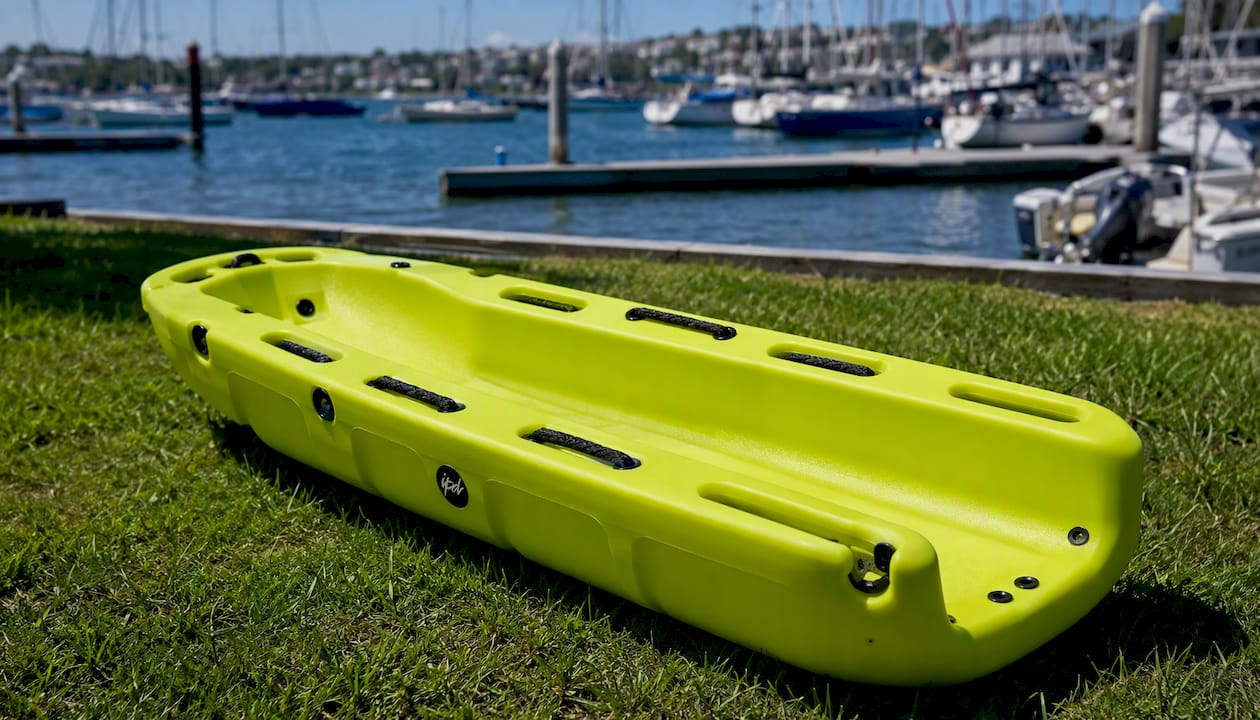
The design features that matter most to patient safety are often the ones that look purely cosmetic on a spec sheet.
| Feature | Purpose | Spec Example |
|---|---|---|
| HDPE hull | UV/chemical resistance, no warping | Rotomolded, monolithic |
| Tapered tail | Water-level patient loading, planes at speed | ~2.5 in tail thickness |
| Deck padding / traction | Non-slip surface, patient comfort | EVA foam or textured deck |
| Nose guard | Impact protection at approach | Reinforced polymer bumper |
| Drain ports | Self-bailing under load | Multiple hull ports |
| Attachment hardware points | Secure 3-point hookup | Stainless U-bolt mounts |
| Bright color / reflective markings | Victim and sled visibility | High-vis orange or yellow |
Typical professional sled dimensions align closely with industry standards in length and width, with a tapered tail designed for patient loading and a rated capacity suitable for single-victim scenarios with gear. Dry weight is light enough for a single operator to load onto a trailer or dock without assistance.
Grab handles, multiple drain ports, and shock-absorbing construction round out the survivability features. Bright colors and reflective markings improve victim and sled visibility in low-light or rough-water conditions.
Pro Tip: Flexible linear low-density polyethylene, urethanes, and EVA copolymers at the connection points dampen vibration transmitted from the PWC hull. That cushioning is what allows a rescuer to perform CPR on the sled while the craft is underway, a capability no rigid hard-mount system can replicate.
How rescue sleds attach to a PWC
Professional rescue sleds ship with a universal 3-point attachment system that requires no factory-installed mounting points on the PWC. The center connection uses nylon webbing with a stainless spring clip; two outboard bungee points provide lateral stability and shock absorption. A U-bolt or transom adaptor plate completes the rear anchor.
Non-invasive vs. drilled mounts
Most agencies choose non-invasive installation to preserve the PWC’s warranty and allow the sled to transfer between craft. Permanently drilled mounts offer a marginally more rigid connection but require hull penetration and are typically reserved for dedicated rescue vessels that will never return to recreational use.
Attachment hardware checklist
- Center nylon webbing strap with stainless spring clip
- Two outboard bungee cords with stainless hooks
- U-bolt or transom reinforcement plate
- Quick-release buckles for rapid sled detachment
- Spare strap kit (agencies should carry one in the field kit)
- Stainless hardware for corrosion resistance in saltwater environments
- Jet ski collar or bumper pad to protect the PWC transom
Compatibility notes before you purchase
- Confirm the PWC’s transom geometry allows U-bolt or plate placement without obstructing the jet pump outlet.
- Check hull draft: sleds are designed for sit-down PWC platforms, not stand-up models, in most configurations.
- Verify transom access clearance, particularly on Sea-Doo models with rear storage compartments.
- Review the PWC model specifications for your specific craft before ordering a sled or attachment kit.
Pro Tip: Operators should physically trial the attachment kit on their specific PWC before a deployment scenario. Real-world rigs often differ from vendor photos, and a loose bungee point discovered during a live rescue is a serious liability.
How to use a rescue sled: deployment and patient loading
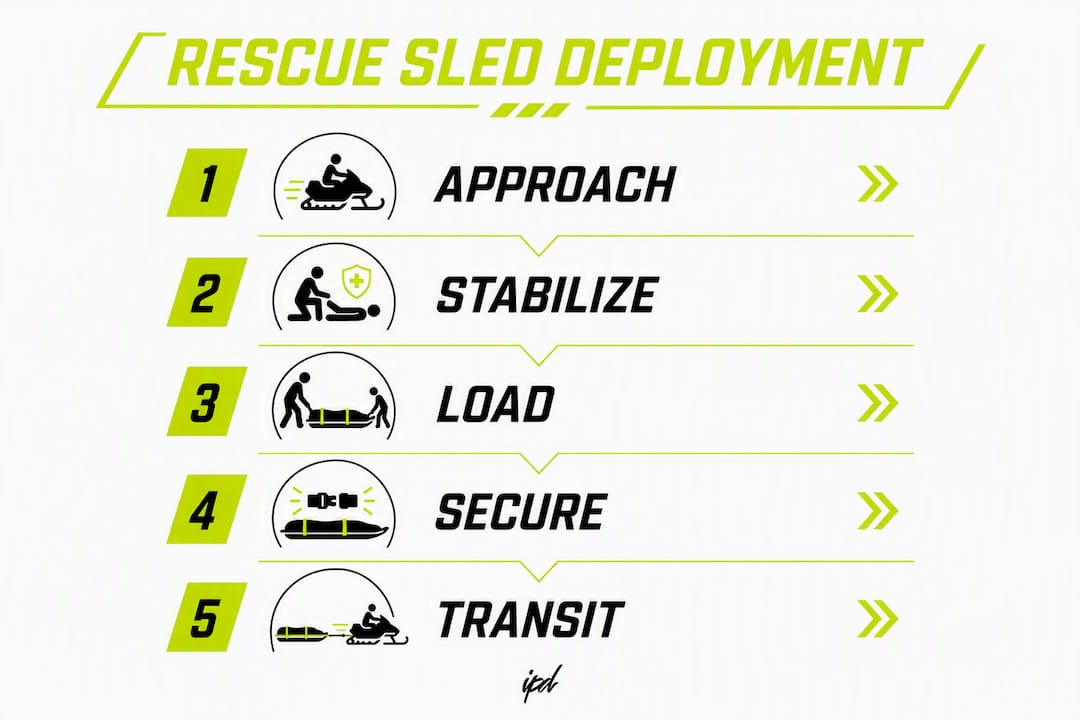
A standard rescue sequence follows five steps: approach, stabilize, load, secure, and transit.
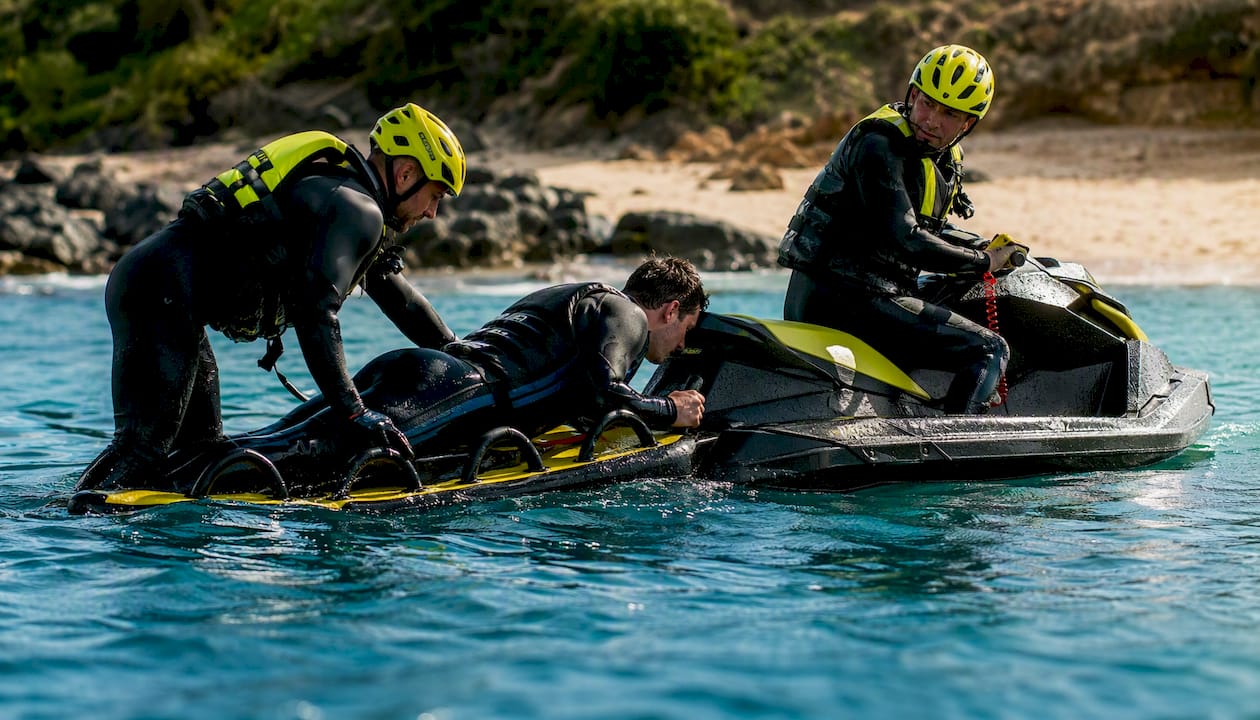
Approach. The PWC operator brings the craft in at low speed, positioning the sled downwind or downcurrent of the victim to reduce drift onto the patient.
Stabilize. The operator holds idle throttle. At idle, the tapered tail sinks slightly, bringing the sled deck close to water level. This is the geometry that makes the system work: a 2.5-inch tail taper allows the deck to meet the victim rather than requiring the rescuer to lift them up and over a high freeboard.
Load. The rescue swimmer or second operator slides the victim onto the deck from the water. Unconscious and hypothermic patients can be moved this way without the spinal-load risk of a vertical lift.
Secure. Grab handles and deck straps hold the patient during transit. The non-slip traction deck prevents sliding in rough water.
Transit. Once underway, the tail planes and drag drops. The vibration-dampening connection points allow CPR to continue en route to shore or a waiting ambulance.
Rescue sleds reduce rescuer physical strain and allow critical interventions like CPR to continue during transport, two capabilities that conventional rescue boats and paddleboards cannot match simultaneously in surf or flood conditions.
Key safety callouts
- Maintain operator-rescuer separation: the PWC driver focuses on navigation; the rescue swimmer manages the patient.
- Keep loading speed at idle. Attempting to load a victim at any throttle above idle risks pulling the sled under or destabilizing the patient.
- In surf, approach from the channel side, not through the break, when possible.
- Abort the PWC approach if debris density, wave height, or victim entanglement creates a secondary drowning risk for the operator.
Sleds also handle two-person rescues, equipment transport for dive teams, and flooded urban go-downs where a flat-bottomed rescue boat would ground out.
Common rescue sled types and representative models
Three product classes appear most often in agency procurement discussions: LifeSled, P2P Rescue Sled, and JetTech (PWC Tow Sled). Each represents a distinct design philosophy.
| Model / Class | Primary Material | Best Use | Mounting | Capacity | Price Band |
|---|---|---|---|---|---|
| LifeSled | Rotomolded HDPE | Ocean / surf rescue | 3-point universal | ~397 lbs | Professional tier |
| P2P Rescue Sled | Reinforced polymer | Inland / flood response | Strap-and-clip kit | Varies by model | Mid-range professional |
| JetTech (Tow Sled) | Laminated / foam core | Utility / light rescue | Tow rope / hitch | Lower rated | Entry-level |
LifeSled is the class most associated with surf lifesaving organizations. Its monolithic HDPE construction and certified 3-point attachment system make it the reference point for agency procurement specs. Length and width dimensions align closely with the 63–67 inch by 37.5 inch professional standard.
P2P Rescue Sled targets inland and flood-response teams. The design prioritizes maneuverability in tight channels and compatibility with a wider range of PWC platforms, including models with non-standard transom geometry.
JetTech occupies the utility-sled category. Its laminated foam-core construction is lighter but lacks the impact resistance and vibration-damping properties of monolithic HDPE sleds. It works for equipment transport and light-duty towing but is not rated for patient transport in surf or swiftwater.
When reading vendor spec sheets, verify these four numbers: tail thickness (should be tapered, not flat), rated payload capacity, sled dry weight, and attachment hardware specification. Advertised features like “vibration damping” should be confirmed by asking whether the connection points use flexible polymer materials or rigid hardware.
- Prioritize monolithic HDPE over laminated construction for patient-transport applications.
- Confirm payload capacity covers the heaviest likely patient plus equipment load.
- Ask vendors for agency reference contacts, not just testimonial copy, during procurement trials.
How professional rescue sleds differ from recreational tow sleds
The difference is not cosmetic. Professional rescue sleds and recreational tow sleds are built to different standards, and using the wrong one in a rescue operation creates measurable risk.
Construction differences:
- Professional sleds use monolithic rotomolded HDPE; recreational tow sleds typically use laminated foam-core or injection-molded plastic that can delaminate under impact.
- Vibration-damping flexible polymers at connection points are standard on professional models and absent on most recreational products.
- Tapered tail geometry is engineered specifically for patient loading; recreational sleds have flat or squared tails designed for rider stability at speed.
- Reinforced nose guards protect against collision during approach; recreational sleds prioritize hydrodynamic shape over impact resistance.
- Certified attachment hardware (stainless spring clips, load-rated U-bolts) is specified on professional models; recreational tow sleds often use plastic clips rated for recreational loads only.
Operational risks of using a recreational sled in a rescue:
- Delamination under repeated impact loads can cause structural failure mid-rescue.
- Flat tail geometry makes water-level patient loading difficult or impossible for non-ambulatory victims.
- Absence of deck padding and grab handles increases patient injury risk during transport.
- Non-rated attachment hardware can fail under the combined dynamic load of a victim plus wave action.
For agency procurement officers: specifying a recreational tow sled as a rescue platform creates liability exposure if the equipment fails during a documented emergency response. Mission failure and patient injury in that context are foreseeable outcomes of an improper equipment decision.
What to check before buying a PWC rescue sled
A structured checklist prevents the most common procurement mistakes: buying a sled that does not fit the PWC, underestimating payload requirements, or missing accessory costs.
- Confirm PWC compatibility. Match the sled’s attachment system to your craft’s transom geometry. Check transom access clearance and hull draft. Review compatible PWC models before ordering.
- Define the operational environment. Surf and ocean operations require monolithic HDPE and certified attachment hardware. Inland flood response may allow a wider range of construction types.
- Calculate payload capacity. Add the heaviest likely patient weight, rescue equipment load, and a safety margin. A 397 lb rated capacity covers most single-victim scenarios with gear.
- Verify attachment hardware is included. Some sleds ship without a complete attachment kit. Budget for straps, bungee cords, stainless clips, and a spare strap kit.
- Assess durability and maintenance requirements. Ask about replaceable wear parts: nose bumpers, deck pads, and attachment hardware. HDPE hulls require minimal maintenance but hardware should be inspected after each saltwater deployment.
- Budget for accessories. Jet ski collar, traction pad replacement, carabiners, rope kits, and reinforcement plates add to the base sled cost.
- Factor in training. Most professional sled manufacturers and agencies recommend scenario-based on-water training before operational deployment. Certification programs through organizations like the United States Lifesaving Association (USLA) cover PWC rescue operations including sled deployment.
- Review warranty terms. Professional-grade sleds typically carry longer warranties than recreational products. Confirm coverage for hull integrity and hardware failure.
For agencies adding PWC rescue capability, marine insurance coverage should be reviewed and updated to reflect the new equipment and operational scope before the first deployment.
Why agencies are moving to PWC-plus-sled systems
The operational case is straightforward. PWC-plus-sled systems access shallow, debris-filled, and surf environments where conventional rescue boats cannot operate. Maneuverability, shallow draft, and faster response times are the three factors most cited by lifeguard units, fire departments, and swift-water rescue teams when explaining the shift.
Sleds reduce rescuer physical strain by eliminating the need to lift victims over a boat gunwale. The vibration-dampening deck allows CPR to continue during transit, which matters in cardiac arrest cases where every minute of interrupted compressions affects outcome. In flooded urban environments, a sled-equipped PWC can navigate between buildings and through debris fields that would stop any conventional vessel.
Industry experts describe PWC rescue sleds as effectively required equipment for modern water rescue teams — not an optional upgrade, but a baseline capability for any agency operating near surf, flood, or shallow-water environments.
Training and certification expectations have kept pace with adoption. The USLA and similar organizations now include PWC rescue sled deployment in their advanced lifeguard and rescue swimmer curricula. Agencies typically require operators to complete scenario-based drills covering shallow pickup, tangled debris navigation, and two-person victim recovery before authorizing operational deployment.
Key Takeaways
A PWC rescue sled is the most operationally versatile victim-recovery platform available to lifeguards and rescue professionals working in surf, flood, and shallow-water environments.
| Point | Details |
|---|---|
| HDPE monolithic construction | Rotomolded HDPE hulls resist UV, saltwater, and impact without delamination risk. |
| 3-point universal attachment | Nylon webbing, bungee cords, and stainless U-bolt hardware mount without drilling the PWC hull. |
| Tapered tail patient loading | A ~2.5 in tapered tail sinks at idle so non-ambulatory victims slide onto the deck at water level. |
| Payload and compatibility first | Verify rated capacity (professional standard near 397 lbs) and PWC transom fit before purchasing. |
| Training before deployment | USLA-aligned scenario drills covering shallow pickup and debris navigation are standard practice. |
The detail most agencies overlook during procurement
The mounting hardware trial gets skipped more often than any other pre-deployment step. An agency orders a sled, confirms the model number matches the PWC brand on the spec sheet, and assumes the attachment kit will fit. In practice, transom geometry varies significantly even within the same PWC manufacturer’s lineup, and a bungee point that sits perfectly on one Sea-Doo model may foul the jet pump cover on the next year’s hull.
The fix is simple: mount the sled on the actual craft before signing off on the purchase order. Run it at idle, load a weighted dummy to the rated capacity, and verify that the tapered tail sinks as specified. That 20-minute field trial eliminates the most common post-purchase surprises.
Training frequency matters just as much as initial certification. Scenario-based drills, specifically shallow pickup in moving water and victim recovery near debris, should run at least quarterly for operational crews. Skills degrade faster than most agencies expect when the equipment sits unused between call-outs.
IPD Racing works with PWC operators across the performance and professional spectrum. The same attention to hull geometry, attachment hardware, and material quality that drives racing performance applies directly to rescue equipment selection. If you are evaluating PWC platforms or hardware for a rescue build, the ProWatercraft product line at IPD Racing covers professional-grade accessories and mounting components worth reviewing alongside your sled procurement.
Useful sources and next steps
The sources below support the specifications, operational techniques, and agency adoption evidence covered in this article. Use them for spec validation, fitting guides, and procurement research.
Rescue sled design details that appear cosmetic, tapered tails, deck padding, reinforced nose guards, are the features that most directly reduce patient injury and rescuer strain during actual operations. Verify them on the physical product, not just the spec sheet.
Rescue sled specifications and operational guidance:
- Essential role of a PWC rescue sled — definition, construction overview, and agency use-case context
- Extractor Pro Model specs and attachment system — tapered tail dimensions, capacity figures, vibration-damping hardware, and 3-point mounting detail
- Why PWC rescue sleds are critical for modern water rescue teams — agency adoption drivers and HDPE material rationale
- Why every modern water rescue agency needs a professional rescue sled — procurement rationale and operational environment evidence
- Personal watercraft rescue sled overview — multi-scenario use cases and survivability feature list
PWC platform and compatibility resources:
- Types of personal watercraft models: 2026 buyer’s guide — hull geometry and transom reference for compatibility checks
- ProWatercraft products at IPD Racing — professional-grade PWC accessories and mounting hardware
Agency and insurance planning:
- Marine insurance and sea tow services guide — coverage considerations when adding PWC rescue capability to an agency fleet

