
Blowback Reducer for PWC: Performance Guide
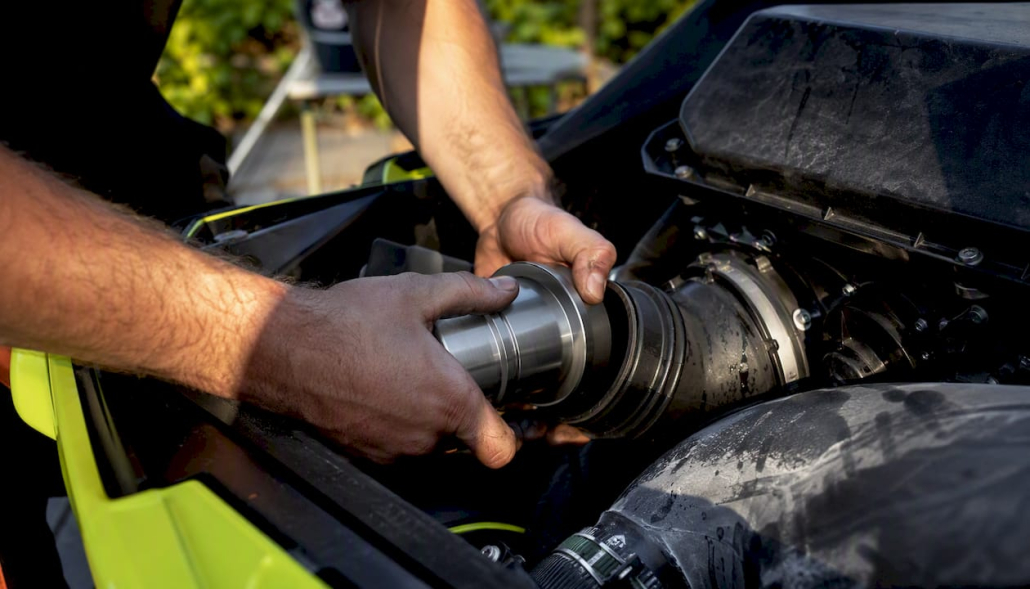
A blowback reducer is an aftermarket exhaust or intake component designed to limit reverse exhaust flow in a personal watercraft engine, prevent backfiring, protect the waterlock, and sharpen throttle response. On two-stroke PWCs especially, uncontrolled backpressure pulses can push exhaust gases and water back toward the cylinder, causing everything from rough idle to hydrostatic lock. If your craft bogs under load, backfires on deceleration, or shows inconsistent throttle behavior, a properly fitted blowback reducer is usually the right starting point. IPD Racing carries fitment-verified options from partner brands including Blowsion, Jet Works, and Impros/Hooker, matched to specific model years and engine configurations.
Key Takeaways
A blowback reducer is a fitment-specific exhaust component that manages reverse-flow pressure to protect the engine and sharpen throttle response, but it works only when installed with correct geometry and matched to your model’s expansion-chamber and waterlock system.
| Point | Details |
|---|---|
| Definition | A blowback reducer limits reverse exhaust flow to prevent backfiring and protect the waterlock from pressure surges. |
| Primary application | Two-stroke PWC engines using expansion chambers and waterboxes; not a direct fit for four-stroke platforms. |
| Key trade-off | Reducing backpressure too aggressively can lower low-end torque; correct fitment preserves both protection and pull. |
| Safety check | Always start the engine before flushing and shut off water before shutdown to avoid hydrostatic lock. |
| IPD Racing fitment | IPD Racing verifies model, year, and engine type before shipping, with parts from Blowsion, Jet Works, and Impros/Hooker. |
Table of Contents
- What causes blowback in a two-stroke PWC?
- How a blowback reducer actually works inside the exhaust path
- What you gain and what you risk with a blowback reducer
- When to consider a blowback reducer for your model
- Installation steps, timeline, and cost drivers
- Maintaining your blowback reducer and diagnosing problems fast
- How IPD Racing handles blowback reduction and race-ready fitment
- An editorial perspective on blowback reducers and PWC tuning
- Get race-proven blowback reduction parts at IPD Racing
- Sources
What causes blowback in a two-stroke PWC?
Two-stroke PWC engines rely on precisely timed pressure pulses through the expansion chamber. The chamber creates a low-pressure wave that pulls exhaust out of the cylinder, then sends a return pulse back to help seal the port at exactly the right moment, improving cylinder filling. The waterbox (waterlock) sits downstream and provides controlled backpressure plus baffling that protects the engine from reverse-flow surges while contributing to low-end torque.
When that system breaks down, blowback happens. Common triggers include:
- Damaged or missing waterbox baffles that eliminate the backpressure buffer
- Wrong exhaust geometry (pipe diameter, length, or angle) that mistimes the return pulse
- Water-trap failure or improper hose routing that lets water accumulate and create pressure spikes
- Pump or intake pressure issues at high speed that mimic exhaust blowback symptoms
Symptom alert: Backfire on deceleration, bogging under load, inconsistent idle, and water in the muffler after a capsize are the four most common signs that blowback is affecting your engine. Pump-side pressure problems can produce nearly identical symptoms, so confirm the exhaust path before replacing parts.
How a blowback reducer actually works inside the exhaust path
The reducer modifies flow geometry at a specific point in the exhaust or intake tract, using one-way valve geometry, flow baffling, or a tuned restriction to alter pulse timing and block reverse flow. Think of it as a check valve for exhaust energy: forward flow passes through with minimal resistance, but a reverse pressure wave meets a geometry that dissipates or redirects it before it reaches the cylinder.
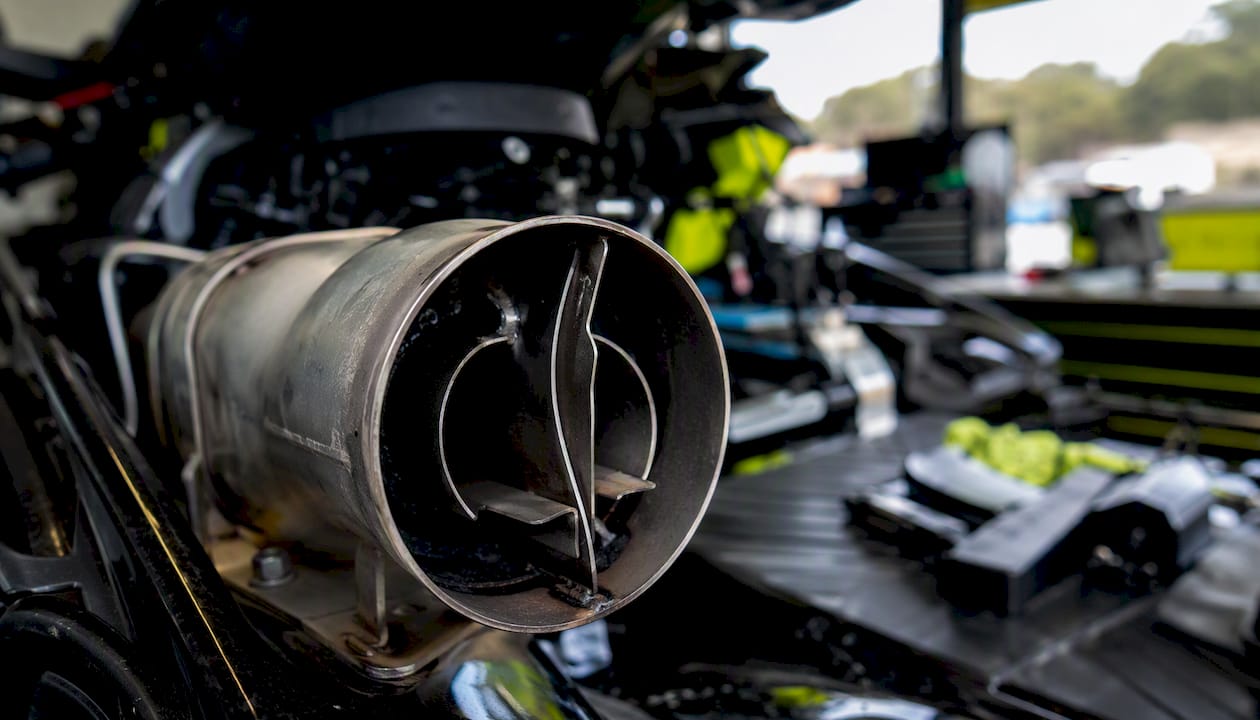
The interaction with the expansion chamber is critical. Patented PWC exhaust designs use water-trap containers, transfer pipes, and water-jacketed sections positioned between the muffler and engine to contain entrant water while using trapped-volume expansion to contribute to backpressure and noise attenuation. A blowback reducer works within that engineered system, not against it. Removing backpressure entirely disrupts pulse timing and can increase water ingestion risk during deceleration or in choppy water.
Pro Tip: Before your first test run after installing a reducer, confirm that all waterlock hose routing follows the manufacturer’s lift and angle specs. A hanging bend or oversized hose diameter can cause gas/water emulsion breakdown and spike backpressure even with a new reducer in place.
What you gain and what you risk with a blowback reducer
The benefits are real and measurable in race conditions. Reduced backfiring means cleaner deceleration. Crisper throttle response comes from eliminating the pressure spike that was interrupting cylinder filling. Reliability improves because the engine is no longer absorbing reverse-flow surges that stress gaskets and seals.
The trade-offs matter equally. Community technical reports consistently note that the waterbox provides backpressure and baffling that improve low-end torque. Reduce that backpressure too aggressively and you lose bottom-end pull, which hurts hole-shot performance and can cause bogging at partial throttle. Geometry errors also raise water ingestion risk.
| Factor | Standard setup | With blowback reducer |
|---|---|---|
| Low-end torque | Higher (waterbox backpressure intact) | Can decrease if backpressure is over-reduced |
| Top-end power | Limited by reverse-flow interference | Improved with correct pulse timing |
| Reliability | Vulnerable to reverse-flow gasket stress | Improved when fitment is correct |
| Emissions/compliance | Stock-compliant | Verify against class rules before racing |
Quick decision checklist:
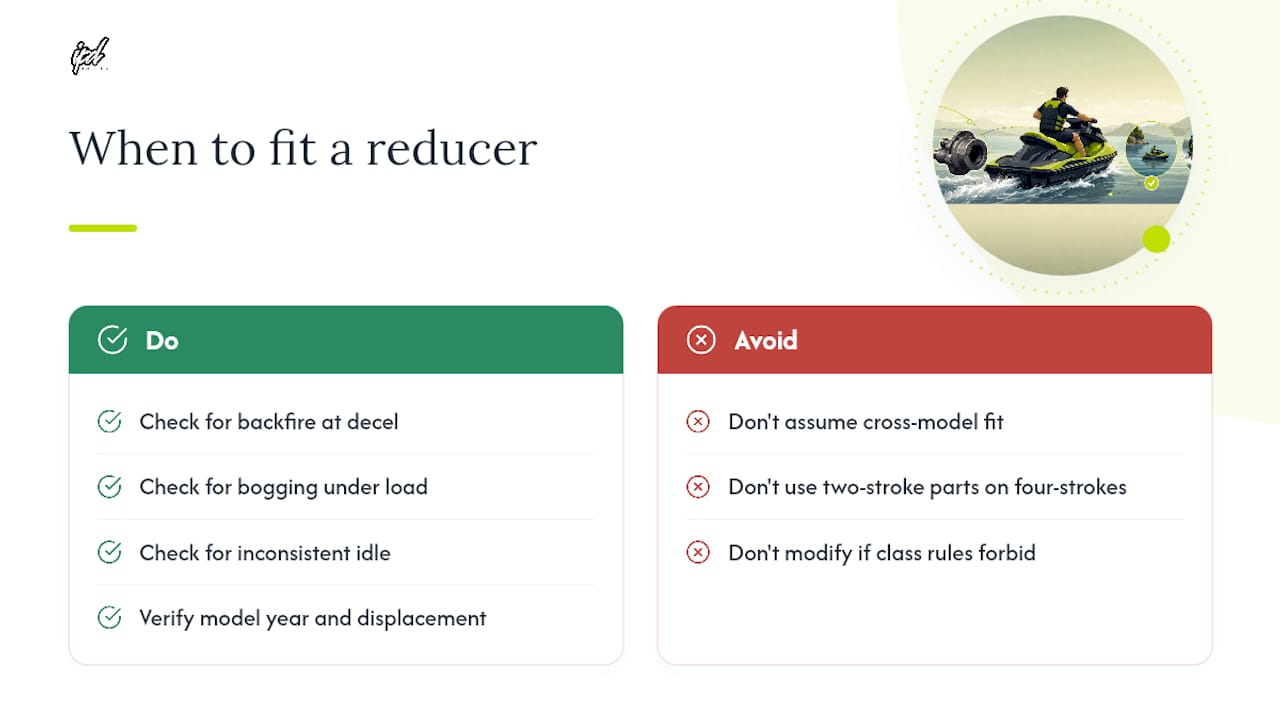
- Are you experiencing backfire, bogging, or water in the muffler? A reducer is worth evaluating.
- Is your waterbox baffle intact? Replace it first before adding a reducer.
- Does your racing class permit exhaust modifications? Confirm before purchase.
- Is your engine a two-stroke? Reducers are primarily designed for two-stroke applications.
When to consider a blowback reducer for your model
The clearest indicator is a pattern of symptoms: backfire at decel, bogging under load, inconsistent idle, or water found in the muffler after capsizing. Any one of these alone could have another cause. All four together point directly at exhaust reverse-flow.
Fitment is model-specific. Two-stroke engines (the primary target for blowback reducers) use expansion chambers and waterboxes that vary significantly across Sea-Doo, Yamaha, and Kawasaki platforms. A reducer sized for a Kawasaki 750 will not fit or perform correctly on a Yamaha SuperJet without adapter work. Always verify model year and engine displacement before ordering.
Four-stroke PWCs have different exhaust dynamics and generally do not use the same expansion-chamber pulse system. Blowback reducers designed for two-strokes are not a direct fit for four-stroke applications.
When not to change exhaust geometry: If your racing class enforces stock exhaust rules, or if your craft must pass emissions inspection, confirm compliance before any modification. Some sanctioning bodies treat waterbox modifications as a class violation.
Installation steps, timeline, and cost drivers
A typical blowback reducer installation on a two-stroke PWC follows this sequence:
- Model verification — confirm part number against model year, engine type, and existing exhaust configuration.
- Hull access — remove the seat and any panels needed to reach the exhaust path; on some hulls this is a 30-minute job, on others it requires partial engine tray removal.
- Waterlock inspection — check hose routing, lift height, and baffle condition before fitting the reducer. Per manufacturer guidance, excessive backpressure from incorrect lift or routing reduces engine power and can cause overheating or soot buildup.
- Reducer fitment — install with new gaskets; torque to spec and confirm no hanging bends in adjacent hoses.
- Test run and jetting check — run the engine at idle and partial throttle before full-speed testing. Expansion-chamber timing changes often require carburetor jetting adjustments.
- Dyno or water tune — for race applications, a dyno session confirms that pulse timing is optimized across the RPM range.
DIY installation is practical for riders comfortable with hull access and basic mechanical work. Jetting and expansion-chamber timing adjustments, however, benefit from a pro tuner with a dyno, particularly on modified engines where multiple variables interact.
Maintaining your blowback reducer and diagnosing problems fast
Routine checks after every season or 50 hours of use:
- Inspect baffle integrity inside the waterbox; a cracked or collapsed baffle changes backpressure immediately.
- Drain and inspect water-trap sections for corrosion or sediment buildup.
- Check all gasket seals at reducer joints; exhaust heat cycles gaskets quickly on high-output engines.
- Confirm hose routing has not shifted; a hose that has sagged into a hanging bend raises backpressure.
For troubleshooting, follow this flow: symptom appears → check all fittings and hose clamps first → inspect waterlock drain and trap → run a short idle test → if symptom persists, pull the reducer for visual inspection. A symptom that appears only at high RPM usually points to a tuning or jetting issue rather than a failed part. A symptom present at idle points to a seal, routing, or baffle problem.
Critical flush note: Always start the engine before connecting a garden-hose flush, and shut off the water before shutting down the engine. The waterlock is sized for the engine’s pump output, which is lower than household water pressure. Reversing that sequence can overwhelm the waterlock and cause hydrostatic lock.
How IPD Racing handles blowback reduction and race-ready fitment
IPD Racing’s fitment process starts with model verification before any part ships. The workflow covers:
- Confirming model year, engine type, and existing exhaust configuration against fitment charts
- Selecting the correct reducer or exhaust component from partner brands including Blowsion, Jet Works, and Impros/Hooker
- Cross-referencing athlete and race-team feedback from events like WCOT to validate real-world performance
- Providing installation notes and adapter guidance for non-standard configurations
The product lines cover a range of applications from recreational upgrades to full race builds. Fitment charts are available on each partner brand page.
Pro Tip: Small geometry adjustments, such as repositioning the waterbox outlet angle or correcting hose lift by even a few inches, often resolve severe blowback without touching the expansion chamber or sacrificing low-end torque. Check routing geometry before ordering a new reducer.
An editorial perspective on blowback reducers and PWC tuning
Most riders who come to IPD Racing with blowback complaints have already tried one of two things: they removed the waterbox entirely expecting a power gain, or they bought a reducer without verifying fitment. Both approaches create new problems. Removing the waterbox eliminates the baffling and water-trapping geometry that protects the engine from reverse-flow surges. A reducer fitted to the wrong model year changes pulse timing in ways that can cost more low-end torque than the backfiring was worth.
The smarter path is to treat blowback reduction as a tuning decision, not a parts swap. Verify the waterbox condition first. Confirm hose routing geometry. Then select a reducer matched to your specific model and riding goals, and plan for a jetting check after installation. That sequence consistently produces better results than chasing symptoms with parts alone.
Get race-proven blowback reduction parts at IPD Racing
IPD Racing stocks performance exhaust and engine upgrade parts from Blowsion, Jet Works, Impros/Hooker, and RIVA Racing, all with model-specific fitment verification before purchase. Before you order, have your model, year, engine type, and current symptoms ready. That information lets the IPD Racing team confirm the right part and flag any adapter or routing requirements specific to your hull.
For riders who want tuning guidance alongside parts, the PWC tuning best practices guide covers jetting, expansion-chamber timing, and post-install test procedures. Visit the IPD Racing shop to browse by brand or model and get fitment support before checkout.
Sources
- Purpose of the waterbox? | Personal Water Craft Forum
- Waterlock and Water/Gas separator manual (WhisperPower WP-WL & WP-WGS)

