

Jet Ski Neoprene Boots Compared: Top PWC Picks 2026
For most PWC riders, the best all-around choice is a moderate-thickness neoprene boot with a stiff, non-marking rubber sole and a secure zipper-plus-gusset closure. That single spec covers the majority of US riding conditions and riding styles from recreational touring to competitive racing.
Who this fits:
- Racing and aggressive freestyle riders: moderately thick construction with a pre-curved, stiff sole and dedicated drainage panels
- Recreational touring and mixed-use riders: thin to moderate neoprene with balanced sole stiffness and good drainage
- Warm-weather and casual riders: thin neoprene or synthetic quick-dry footwear where breathability outweighs insulation
The core trade-off: More neoprene thickness means better cold-water insulation and impact protection, but also more bulk in the footwell and a longer break-in period. Match your thickness to water temperature first, then dial in sole stiffness for your riding style. Check the temperature guidance in the section below and confirm fit with the socks you plan to wear before ordering.
Table of Contents
- How do different riding styles change which neoprene boot you need?
- Key features to compare in neoprene jet-ski boots
- How do you choose the right thickness and style for your water temperature?
- Practical sizing tips and how to break in new boots correctly
- Representative in-market models and which riders they suit
- What do neoprene boots typically cost, and how long do they last?
- How to clean, dry, and store neoprene boots so they last
- What experienced PWC racers actually prioritize in a boot
- Key Takeaways
- The feature most riders underestimate when buying boots
- IPD Racing traction and foothold upgrades pair well with your boots
- Sources and further reading
How do different riding styles change which neoprene boot you need?
The right boot depends almost entirely on how you ride and where you ride. Racing demands stiff soles and locked-down ankle support. Touring rewards drainage and comfort. Warm-weather casual riding can get by with lightweight synthetic footwear. Cold-water commuting needs maximum insulation.
| Rider Use Case | Neoprene Thickness | Sole Type | Closure | Primary Priority |
|---|---|---|---|---|
| Racing / aggressive freestyle | 5mm | Stiff, pre-curved TPR or rubber | Marine-grade zipper + gusset | Ankle support, sole stiffness, drainage |
| Mixed touring / all-around | 3–4mm | Moderate stiffness, non-marking | Zipper + Velcro or gusset | Balance of comfort, drainage, durability |
| Warm-weather casual | 1.5–3mm or synthetic | Flexible rubber, heel-to-toe grip | Drawcord or lace | Breathability, quick-dry, light weight |
| Cold-water commuting | thickest neoprene | Firm, non-marking outsole | Heavy-duty zipper + gusset | Insulation, seam quality, waterproofing |
Racers and freestyle riders should prioritize sole stiffness above all else. Repeated toe-and-heel pivoting on a tray puts real load on the forefoot, and a soft bootie compresses under that load, creating fatigue and instability. Touring riders can trade some stiffness for a softer, more comfortable ride. Casual riders in warm water often do fine with a lightweight synthetic shoe, though they sacrifice ankle protection.
Key features to compare in neoprene jet-ski boots
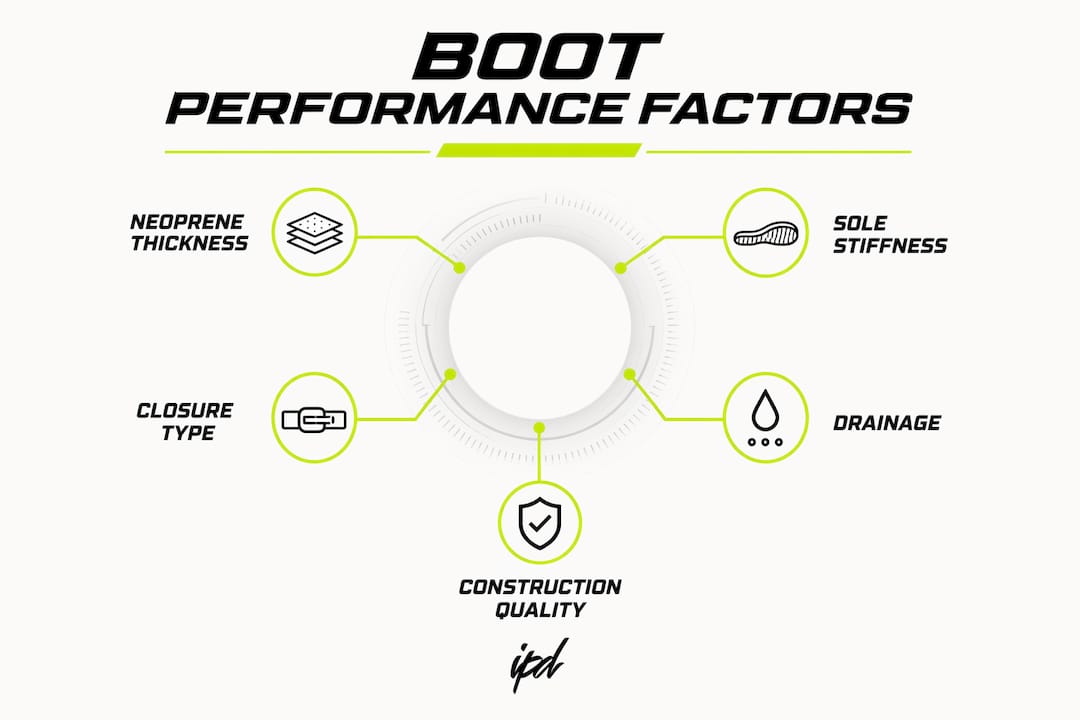
Not every spec on a product page matters equally. These are the features that actually separate a good boot from a poor one on the water.
Sole type and traction
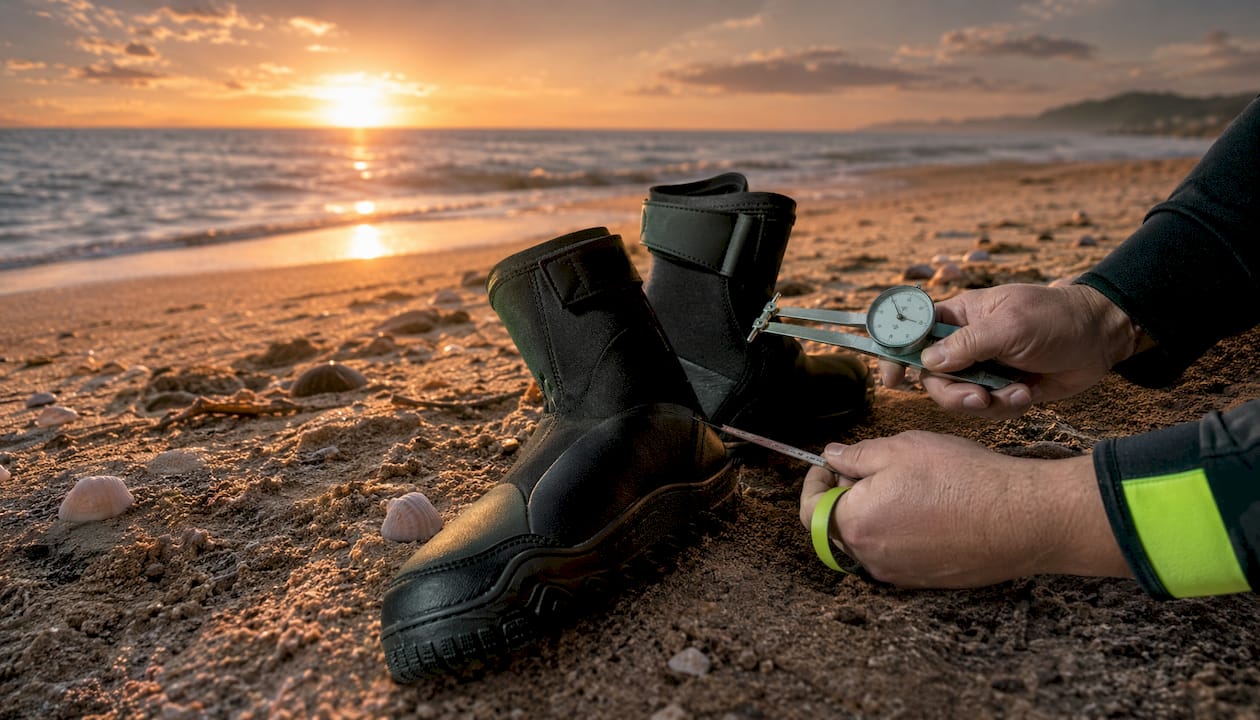
The outsole is the most performance-critical component. Look for a TPR (thermoplastic rubber) or vulcanized rubber compound with a non-marking tread pattern. A wrap-up sole that extends slightly up the toe and heel adds abrasion protection during entry and exit. Stiff soles reduce foot fatigue during aggressive pivoting; softer soles suit casual cruising. Non-marking soles are standard practice on US boat decks and docks.
Neoprene thickness and insulation
3mm–5mm neoprene covers the vast majority of PWC use cases. Thinner neoprene (3mm) works well in warmer water and keeps bulk low. 5mm provides meaningful insulation in cooler conditions and adds impact protection. Going above 5mm is rarely necessary unless you ride in genuinely cold water below 50°F, and it noticeably reduces barefoot feel and mobility in tight footwells.
Closure systems
- Front zipper with neoprene gusset: Most common on purpose-built PWC boots; keeps water out and holds the boot securely during aggressive riding
- Zipper plus Velcro strap: Adds a secondary lock at the ankle; useful for riders who find standard zippers shift under load
- Drawcord or lace systems: Common on casual water shoes; easier entry but less ankle lock
Drainage and ventilation
Air-mesh side panels and flow-through sole channels outperform simple pin-drain designs significantly. Boots with only small pin drains trap water and promote mildew on long riding days. If you ride for more than a couple of hours at a stretch, drainage engineering matters as much as insulation.
Construction quality
Double-glued and blind-stitched seams are the benchmark for quality neoprene construction. They resist water infiltration and hold up under repeated flexing. Reinforced toe and heel caps protect against impact and abrasion during boarding and dismounting. Check for non-corrosive zippers, especially if you ride in saltwater.
How do you choose the right thickness and style for your water temperature?
Start with water temperature, then adjust for riding style. This two-step process eliminates most of the confusion in a top jet ski neoprene boots comparison.
Temperature bands and thickness guidance:
- Above 75°F (warm): 1.5–3mm neoprene or a synthetic quick-dry shoe. Breathability and drainage matter more than insulation.
- 65–75°F (temperate): 3mm neoprene is the standard choice. Enough insulation for comfort without excess bulk.
- 50–65°F (cool): 4–5mm neoprene. You want real thermal protection here, and seam quality becomes critical.
- Below 50°F (cold): 5mm or thicker, with double-glued blind-stitched seams and a heavy-duty zipper. Consider pairing with neoprene socks for added warmth.
How riding style modifies the choice:
Racing and freestyle riding push toward stiffer soles regardless of temperature. A 3mm race boot with a stiff pre-curved sole is a better choice for a warm-water racer than a 5mm soft bootie. Touring riders in temperate water can prioritize drainage and comfort over sole stiffness. Casual riders in warm water often get more value from a lightweight synthetic shoe with good grip than from a full neoprene boot.
Thickness alone does not determine warmth. Seam construction matters equally. A poorly sealed 5mm boot leaks cold water continuously, negating the insulation entirely.
Sizing with socks: If you plan to wear neoprene or Lycra socks, size up to accommodate them. Sizing down to compensate for liners creates pressure points and discomfort, particularly across the forefoot and at the ankle.
Practical sizing tips and how to break in new boots correctly
Sizing mistakes are the most common reason riders return neoprene boots. A few straightforward rules prevent most of them.
Sizing rules:
- Measure foot length and width; do not rely on your street shoe size alone, as neoprene boots often run differently from athletic footwear
- If you plan to wear neoprene socks, put them on before measuring and size accordingly
- Wide-foot riders should check width specs before ordering; many standard neoprene boots run narrow
- Avoid sizing down to “force” a snug fit; initial snugness in a well-made boot is intentional and will ease with break-in
Common mistakes to avoid:
- Ignoring arch support needs, especially for riders with high arches who spend hours on the water
- Assuming EU sizing converts directly; always check the brand’s own US size chart
- Ordering without confirming the retailer’s return policy, particularly for online purchases
Break-in tips:
Start with short rides of 30–45 minutes before committing to a full day on the water. Wet the boots thoroughly before your first session; neoprene softens and conforms when wet. After each session, rinse and allow to air-dry naturally. Avoid using heat sources to accelerate drying, as direct heat degrades neoprene and adhesive bonds. Flex the boots by hand during drying to maintain pliability.
Pro Tip: Stand on a flat, dry surface and check that your ankle feels locked without pinching, and that your toes can flex freely. If the ankle shifts laterally or the toe box compresses your toes, the fit is wrong regardless of how the boot feels on the shelf.
Hands-on reviews consistently note that race boots feel snug initially but provide the right support once wet and under load. That initial tightness is a design feature, not a defect.
Representative in-market models and which riders they suit
These are well-known, US-available models that illustrate the main categories in any neoprene boot comparison. Each one represents a different set of priorities.
| Model | Best For | Neoprene Thickness | Sole Type | Closure | Drainage | US Availability |
|---|---|---|---|---|---|---|
| Sea-Doo Neoprene PWC Boots | Cold-water protection, general PWC use | 5mm | Molded non-slip outsole | Heavy-duty non-corrosive zipper | Standard | Yes — major US retailers and Sea-Doo dealers |
| Jettribe GRB 3.0 | Racing, aggressive freestyle | Not publicly listed | Pre-curved, stiff; wrap-around abrasion shell | Marine-grade zipper | Mesh flow-through panels | Yes — specialty PWC retailers |
| Jobe Neoprene Boots | Touring, all-around PWC riding | Not publicly listed | Stiff rubber outsole | Zipper | Extra water drain panels | Yes — water sports retailers |
| O’Neill Wetsuit Boots | General water sports, touring | 3mm–5mm options | Flexible rubber | Zipper | Standard | Yes — surf and water sports retailers |
| Body Glove Neoprene Boots | Recreational, warm-weather use | 3mm | Flexible rubber | Zipper or pull-on | Standard | Yes — major US sporting goods retailers |
| Columbia Drainmaker III | Casual warm-weather, dock use | None (synthetic) | Flexible rubber, multi-directional drain ports | Lace | Drain ports throughout | Yes — major US retailers |
Sea-Doo neoprene boots are built from 90% neoprene and 10% nylon with double-glued, blind-stitched seams, a molded non-slip outsole, and flexible rubber toe and heel protection caps. The non-corrosive zipper makes them a solid choice for saltwater riders. Available through Sea-Doo dealers and the Aqua Sport section at IPD Racing.
Jettribe GRB 3.0 is the go-to for racers who need pre-curved soles, arch support, wrap-around abrasion protection, and mesh flow-through drainage panels. The marine-grade zipper holds under aggressive riding loads.
Jobe neoprene boots include an inner neoprene sock for added warmth, a reinforced heel, extra drain panels, and a stiff rubber outsole. They sit in the touring and all-around category, balancing grip and drainage without the race-boot stiffness penalty.
O’Neill and Body Glove both offer neoprene boots widely available across US surf and sporting goods retailers. O’Neill’s wetsuit boot lineup covers 3mm–5mm options suited to general water sports and PWC touring. Body Glove’s 3mm recreational boots work well for warm-weather riding where insulation is secondary to comfort.
Columbia Drainmaker III is not a neoprene boot. It is a synthetic water shoe with multi-directional drain ports and a flexible rubber sole, included here as the representative casual/warm-weather option. It lacks ankle support and neoprene insulation, but for flat-water summer riding in warm conditions, it performs well and dries fast.
US buying tip: For correct sizing and returns, purchase from retailers with clear US return policies. Specialty PWC retailers often carry a wider range of sizes and can advise on fit with liners.
What do neoprene boots typically cost, and how long do they last?
Price and durability track closely with construction quality and intended use.
Typical price bands:
- Budget ($20–$50): Thin neoprene or synthetic water shoes, basic rubber soles, minimal drainage engineering. Fine for light casual use in warm water. Body Glove and Columbia Drainmaker III sit in this range.
- Mid-range ($50–$120): Purpose-built PWC boots with better seam construction, non-marking soles, and improved drainage. O’Neill and Jobe neoprene boots typically fall here.
- Premium ($120–$200+): Race-grade boots with pre-curved soles, marine-grade zippers, mesh flow-through panels, and reinforced abrasion shells. Jettribe GRB series and Sea-Doo’s premium neoprene boots occupy this tier.
Durability by use case:
Recreational touring boots used a few times per season can last several years with proper care. Race boots take significantly more abuse from repeated pivoting and footwell contact, so expect a shorter lifespan even though they are built more durably. The construction quality in premium boots is designed to handle that load; budget boots used for racing will fail faster.
Signs it is time to replace your boots:
- Sole delamination or separation from the neoprene upper
- Seam failures, particularly at the toe box or heel
- Persistent mildew odor that does not clear after thorough cleaning and drying
- Loss of insulation or noticeable water infiltration through the neoprene body
- Zipper failure or corrosion that prevents a secure closure
Value tip: buy the best sole and seam construction you can afford if you ride aggressively. For light casual use, a budget water shoe is a reasonable choice. The grip, fit, drainage, and durability combination that reviewers consistently prioritize is most reliably delivered in the mid-range and premium tiers.
How to clean, dry, and store neoprene boots so they last
Proper care after each session extends boot life significantly and prevents the mildew and seam failures that end boots prematurely.
After every saltwater session: Rinse boots thoroughly with fresh water immediately after use. Salt crystals accelerate neoprene degradation and corrode zippers. Flush the interior as well as the exterior.
Drying correctly: Turn boots upside down or prop them open to allow airflow through the interior. Avoid direct sunlight for extended periods; UV exposure degrades neoprene over time. Never use a clothes dryer, heat gun, or place boots near a heater. Air-dry in a shaded, ventilated area.
Storage: Store boots flat or supported in their natural shape. Folding or compressing them for storage causes permanent creasing in the neoprene and can deform the sole. Keep them away from petroleum products, which degrade rubber compounds.
Cleaning: A mild soap solution works for routine interior cleaning. For persistent odor, an antimicrobial spray designed for neoprene or wetsuits is effective. Check manufacturer guidance before machine washing; some boots tolerate a gentle cold cycle, others do not.
Pro Tip: For minor sole separation at the toe or heel, a neoprene contact cement applied to both surfaces and clamped for 24 hours is a reliable field fix. For significant delamination or seam failure, a wetsuit repair specialist can extend boot life considerably at a fraction of replacement cost.
What experienced PWC racers actually prioritize in a boot
The gap between what looks good in a spec sheet and what racers actually care about is worth understanding before you spend money on premium footwear.
Sole stiffness is the feature racers cite most consistently. Aggressive riding requires a stiffer, thicker sole; softer booties lack the stability for repeated toe-and-heel pivoting and wear out faster under race-style loads. A pre-curved arch that matches the natural foot position reduces fatigue over a full race day. Racers also prioritize a dedicated liner system: many premium race boots are designed to be used with thin neoprene or Lycra socks, and without those liners the shell may not provide the snugness needed for precise footwork.
“Drainage efficiency is a top comfort driver on long active days. Boots with only pin drains trap water and promote mildew, while designs with air-mesh side panels and flow-through channels keep feet noticeably drier.” — Watercraft Journal, Jobe neoprene boot review
The sizing nuance that catches many racers off guard: premium race boots assume liner use, so a boot that feels slightly large without socks is often correctly sized for use with a thin neoprene sock. Buying without accounting for the liner and then sizing down is one of the most common and avoidable mistakes in this category.
Thicker neoprene increases warmth but reduces barefoot feel and can add bulk in tight footwells. Racers in warm water often prefer a 3mm race boot over a 5mm touring boot precisely because the thinner shell gives better feedback through the tray. That trade-off is worth understanding: warmth and protection come at a cost in sensitivity and footwell clearance.
Key Takeaways
The best neoprene boot for PWC riding matches neoprene thickness to water temperature, sole stiffness to riding intensity, and fit to the socks you plan to wear.
| Point | Details |
|---|---|
| Match thickness to temperature | Use 3mm for water above 65°F, 4–5mm for 50–65°F, and thickest neoprene below 50°F. |
| Sole stiffness drives racer performance | Aggressive riding and pivoting require a stiff, pre-curved sole; soft booties compress under load. |
| Size for your liner | Premium race boots are designed for use with neoprene or Lycra socks; size accordingly to avoid pressure points. |
| Drainage design matters | Air-mesh panels and flow-through channels outperform pin-drain designs on long riding days. |
| IPD Racing for traction upgrades | IPD Racing carries foothold and traction products that complement boot grip for racers and freestyle riders. |
The feature most riders underestimate when buying boots
Most riders shopping for neoprene boots spend the most time comparing thickness and price. Those matter, but sole construction is the spec that actually separates a boot that holds up through a season of aggressive riding from one that fails at the toe box after a few months.
The reason is mechanical. Every time a rider pivots on the tray, the forefoot flexes against a stiff rubber outsole. A sole that is bonded well and built with wrap-around abrasion protection distributes that load across a larger surface area. A sole that is only glued at the perimeter peels from the inside out, and by the time the separation is visible, the structural integrity is already gone. Double-glued, blind-stitched seams at the sole junction are not a luxury spec; they are the difference between a boot that lasts one season and one that lasts three.
The same logic applies to zipper selection. Non-corrosive marine-grade zippers cost more to manufacture, and that cost shows up in the price tier. A corroded zipper on a saltwater boot is not a minor inconvenience; it means the boot cannot close securely, which defeats the entire purpose of the closure system.
For riders buying online, the return policy deserves as much attention as the spec sheet. Neoprene boots fit differently from athletic shoes, and the only reliable fit test is standing on a flat surface and checking ankle lock and toe mobility. Buy from US retailers with clear return windows.
IPD Racing traction and foothold upgrades pair well with your boots
Neoprene boots handle foot protection and insulation. What they cannot do is compensate for a slick tray or poorly positioned footholds. That is where aftermarket traction and foothold upgrades from IPD Racing come in.
IPD Racing carries footholds, hull traction parts, and handling upgrades that work alongside your boots to give racers and freestyle riders a more controlled platform. Better foothold positioning reduces the lateral movement that even a well-fitted boot cannot prevent on its own. Grip tape and traction pads add surface friction that complements the non-marking sole on your boots rather than replacing it. These are not substitutes for proper footwear; they are the next layer of the performance setup. For riders building out a complete race-ready gear list, IPD Racing’s race-proven PWC performance upgrades cover the hardware side of that equation. IPD Racing ships to US customers and stocks parts for Sea-Doo, Yamaha, Kawasaki, and other major PWC platforms. Browse the full catalog at ipdracing.com to find traction and foothold options matched to your specific watercraft.
Sources and further reading
These are the primary sources used in this guide, selected for hands-on credibility and technical specificity.
- Sea-Doo Neoprene Boots — Seadoogear.com: Official product spec sheet; the authoritative source for construction details including seam type, neoprene blend, and zipper spec.
- Jettribe GRB 3.0 Race Boots — Engine Elite Pro: Product listing with detailed spec breakdown for a leading race boot; useful for sole and drainage feature comparison.
- Real Review: Slippery Wetsuits’ Liquid Race Boot — Watercraft Journal: Hands-on PWC-specific boot review covering ankle stability, drainage, and reinforcement trade-offs between casual and race footwear.
- Real Review: Jettribe GRB 2.0 Race Boots — Watercraft Journal: Detailed review covering liner/sock sizing nuance and break-in behavior for premium race boots.
- Real Review: Jobe Neoprene Boots — Watercraft Journal: Hands-on review with specific commentary on drainage design and long-day comfort.
- Best Shoes for Jet Ski — ShoesFeast: Practical neoprene thickness guidance and climate-based selection advice.
- 7 Best Water Shoes for Jet Ski — Footwind: Roundup with real-world testing criteria including grip, drainage, and durability rankings.
- Works H2O PWC Riding Boots — IPD Racing: IPD Racing’s coverage of advanced boot features including engineered drainage and anti-slip soles.
- Jet Ski Racing Safety Gear List — IPD Racing: IPD Racing’s complete race-ready gear reference; useful context for where boots fit in a full safety setup.

