
PWC Tow-In Surfing Explained: What Beginners Need to Know
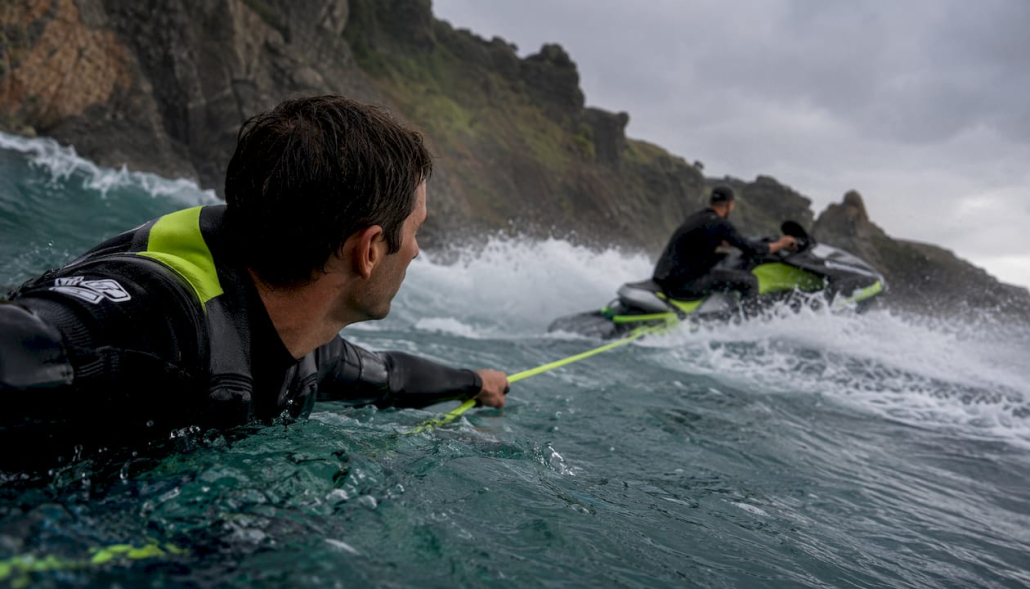
PWC tow-in surfing is a technique where a surfer is pulled into a wave by a personal watercraft (jet ski) using a tow rope, specifically to catch waves too large or fast to paddle into by hand. Once the surfer matches the wave’s speed, they release the rope and ride. The PWC then repositions immediately as a rescue vessel.
Here’s what you need to know at a glance:
- Three core roles: surfer, PWC driver (who doubles as rescuer), and a spotter or support observer
- Core gear: a PWC fitted with a rescue sled, a quick-release tow rope, a tow-in board with foot straps, impact vest, helmet, leash, and communication devices
- U.S. regulatory flag: PWC operation falls under state boating law and U.S. Coast Guard equipment standards; Hawaiʻi requires tow-in-specific certifications through the Division of Boating and Ocean Recreation (DOBOR) before you can legally participate
- Safety-first principle: tow-in teams function as search-and-rescue units; rescue capability is built into every session, not treated as optional
Table of Contents
- How does PWC tow-in surfing actually work?
- What gear do you need for a safe tow-in session?
- How do tow-in teams handle safety and rescue?
- What are the U.S. legal requirements for tow-in surfing?
- Where did tow-in surfing start, and where is it practiced in the U.S.?
- How do you get started with tow-in surfing?
- How should you set up a PWC for tow-in support?
- Key Takeaways
- Why the rescue role changes everything about tow-in
- IPD Racing parts for your tow-in PWC build
- Useful sources for further reading
How does PWC tow-in surfing actually work?
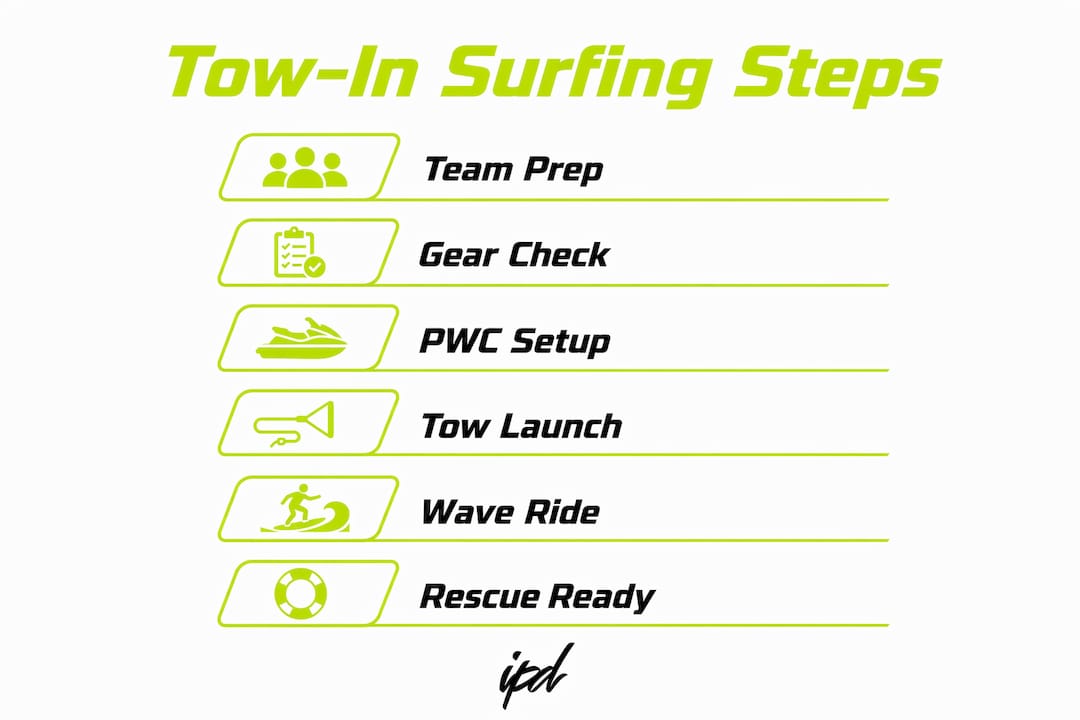
Understanding the sequence makes the whole system click. Here are the steps in a standard tow-in session:
- Staging and positioning. The PWC and surfer enter the water well outside the break. The driver studies the wave sets, identifies the target wave, and positions the craft to intercept the swell at the right angle.
- Tow-rope takeoff. The surfer grabs the tow handle, the driver accelerates, and the rope goes taut. The PWC pulls the surfer up to wave speed, typically faster than any paddler can achieve.
- Matching wave speed. The PWC accelerates the surfer until the surfer’s board speed matches the wave’s forward momentum. Timing here is everything: too early and the surfer misses the wave; too late and the wave catches them off-balance.
- Rope release and drop-in. At the precise moment the surfer feels the wave lift the board, they release the tow handle. From that point, the ride is self-powered.
- PWC repositioning. The driver immediately clears the impact zone, watches the ride, and prepares for extraction. If the surfer wipes out, the driver moves in without hesitation.
- Post-ride recovery. The surfer signals readiness (or the driver spots a wipeout), the rescue sled deploys, and the surfer is pulled clear of the break before the next wave arrives.
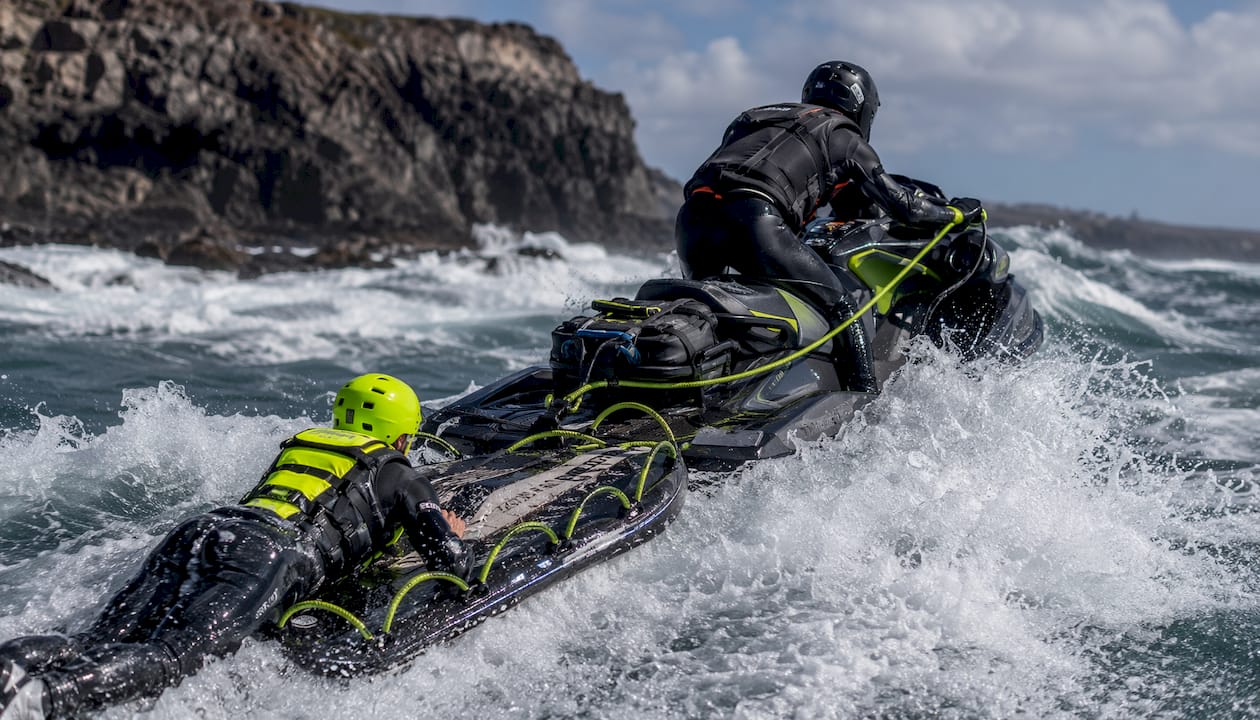
The PWC driver’s primary job is not to tow — it’s to rescue. Towing is the setup; extraction is the mission. Experienced drivers anticipate wave sets and position the craft to act as a rescue unit the instant a wipeout occurs.
Team roles at a glance
Surfer: reads the wave, controls the drop-in, signals the driver, and holds on through the tow sequence.
PWC driver/rescuer: manages speed and angle during the tow, clears the zone after rope release, monitors the ride, and executes extraction using the rescue sled.
Spotter: positioned on shore or on a support craft, the spotter watches for incoming sets, communicates hazards by radio, and coordinates timing between the driver and surfer.
What gear do you need for a safe tow-in session?
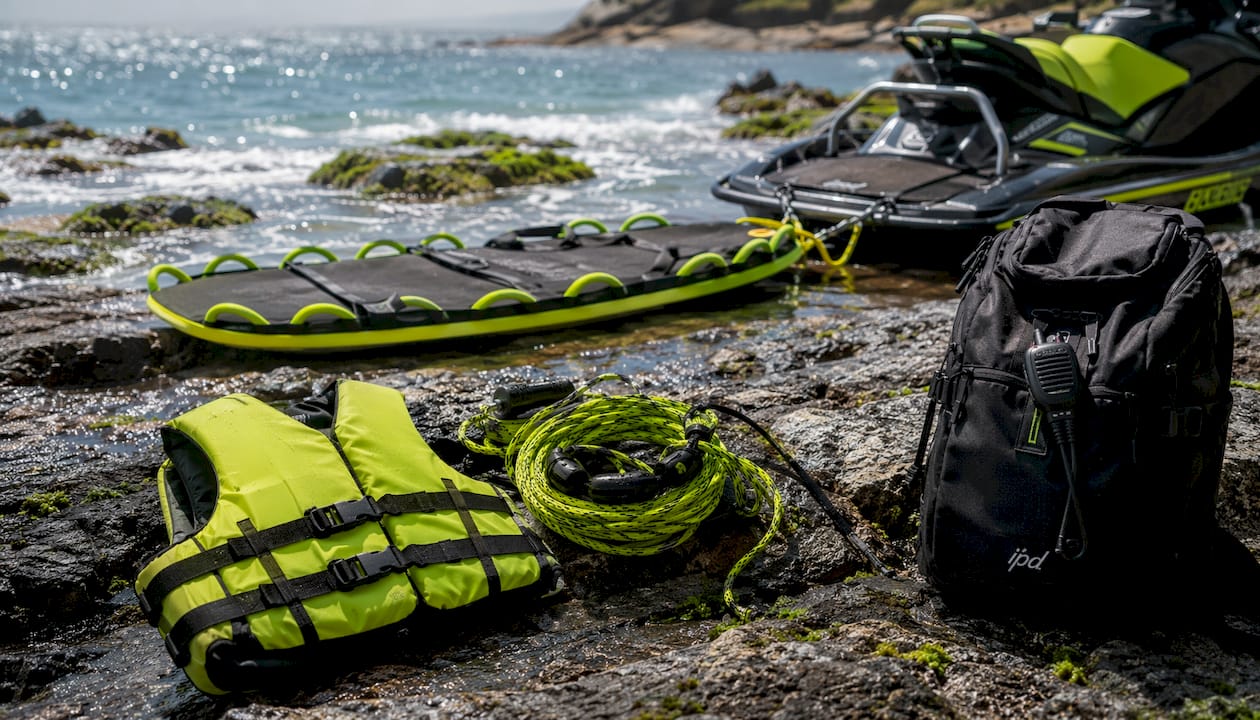
Essential tow-in equipment covers both mandatory safety items and recommended redundancy gear. The table below breaks down what each item does and why it matters.
| Item | Mandatory or Recommended | Purpose / Real-World Use |
|---|---|---|
| PWC with rescue sled | Mandatory | Primary tow and extraction platform; sled deploys for immediate surfer recovery |
| Quick-release tow rope | Mandatory | Allows surfer to drop the rope cleanly; driver can also cut tension in an emergency |
| Tow-in board (high volume, foot straps) | Mandatory | Foot straps keep the surfer locked in at high speed; higher volume aids stability on big swells |
| Impact vest | Mandatory | Absorbs trauma from wipeouts and water impact at speed |
| Helmet | Mandatory | Protects against board strikes and reef impact |
| Leash | Mandatory | Keeps the board attached after a wipeout; prevents a loose board from becoming a hazard |
| Communication devices (radio/walkie) | Mandatory | Enables real-time coordination between driver, surfer, and spotter |
| First-aid kit | Mandatory | On-water treatment for lacerations, impact injuries, and hypothermia |
| Dive fins | Recommended | Help a downed surfer swim clear of the break if extraction is delayed |
| Bow tow-line | Recommended | Recovers a stalled PWC; critical redundancy for offshore sessions |
| Spare engine/repair kit | Recommended | Engine failure in big surf is a serious emergency; basic spares reduce downtime |
| GPS/EPIRB | Recommended | Offshore sessions require position tracking and emergency signaling capability |
Pro Tip: Inspect your quick-release mechanism before every session. Salt water and UV exposure degrade the release hardware faster than most riders expect. A stuck release in a critical moment can drag a surfer into the impact zone. Test the pull force on dry land, rinse the mechanism after every use, and replace any component showing corrosion or stiffness.
How do tow-in teams handle safety and rescue?
The risks in tow-in surfing are real and specific. Hold-downs from multiple waves in a set, impact trauma from the board or reef, PWC collisions in the break zone, and hypothermia in cold-water locations like Mavericks are all documented hazards. The safety framework that experienced teams use addresses each one directly.
The rescue-first mindset means the driver never watches passively. After the surfer releases the rope, the driver’s attention shifts entirely to extraction readiness. Radio communication between driver and spotter keeps the driver informed of incoming sets so they can time the approach without entering the impact zone prematurely.
The rescue role is the most critical element of tow-in surfing. Teams operate as search-and-rescue units, not simple driver-and-surfer pairs. Every piece of gear, every positioning decision, and every communication protocol exists to support that extraction function.
Here’s how a standard wipeout-to-extraction sequence works in practice. The surfer falls on a large wave. The driver, already positioned outside the impact zone, reads the wipeout and accelerates toward the surfer’s last known position. The spotter confirms location by radio. The driver approaches from the channel side, deploys the rescue sled, and the surfer grabs on. The driver accelerates clear of the break before the next wave in the set arrives. Total elapsed time from wipeout to extraction in a well-drilled team: seconds, not minutes.
Pro Tip: Driver training is the single highest-leverage investment in tow-in safety. A surfer can improve their riding over time, but a driver who hesitates during extraction, misjudges a set, or lacks local knowledge of the break puts both people at risk. Practice extraction drills in controlled conditions before committing to big surf.
What are the U.S. legal requirements for tow-in surfing?
PWC operation in the United States falls under state boating law and U.S. Coast Guard equipment standards. Tow-in surfing adds another layer: many states and localities impose zone restrictions, operator age minimums, and equipment mandates that go beyond standard PWC rules. Hawaiʻi has the most developed regulatory framework in the country.
Hawaiʻi DOBOR requires that both the operator and the surfer hold a Boating Safety Certification, a Thrill Craft Certification, and a Tow-in Surfing Certification before participating. Certification can authorize certain permissions, including operating during National Weather Service high-surf warnings in designated regions.
Before any tow-in session in the U.S., verify the following:
- PWC registration: your craft must be registered in the state where it operates; state registration requirements vary, so confirm current rules with your state’s boating authority
- Operator education: most states require a boating safety certificate for PWC operators; some require additional thrill craft or PWC-specific endorsements
- Local zone restrictions: many surf breaks prohibit PWC use entirely or restrict tow-in to specific corridors and hours; check with local harbor masters and ocean safety offices
- Tow-in-specific permits: Hawaiʻi DOBOR issues tow-in certifications through an approved education pathway; other states may have analogous requirements or outright bans in certain zones
- Equipment compliance: U.S. Coast Guard rules govern required safety equipment on PWC; state rules may add to that list for tow-in use specifically
The WCC Ocean Safety Education Course at Windward Community College is one example of an approved education pathway referenced by DOBOR for operators and surfers pursuing Hawaiʻi certification. Regulations also vary significantly between states; Washington state PWC rules, for instance, differ from Hawaiʻi’s in both scope and enforcement approach, which illustrates why checking your specific jurisdiction matters before you launch.
This article is general information, not legal advice. Confirm current rules with your state boating authority or DOBOR before participating in tow-in surfing.
Where did tow-in surfing start, and where is it practiced in the U.S.?
Tow-in surfing originated in the mid-1990s when big-wave pioneers began using PWC to access swells that exceeded what any paddler could catch. The technique extended the practical ceiling for big-wave riding well past the 30-foot barrier that had previously defined the outer limit of paddle surfing.
Two U.S. locations define the discipline:
- Peahi (Jaws), Maui, Hawaiʻi: the wave that put tow-in on the map. Jaws breaks in open ocean with faces that can reach very large heights. DOBOR’s certification requirements apply directly here, and access is tightly managed during major swells.
- Mavericks, Northern California: a cold-water, deep-water reef break near Half Moon Bay that produces some of the heaviest waves in the continental U.S. Hypothermia risk is significant, and local ocean safety protocols are strict.
Many of the most consequential tow-in spots in the U.S. restrict or prohibit the practice outside of permitted windows. Safety, environmental protection, and conflict with other water users are the primary reasons. Before planning a session at any well-known break, contact the local harbor authority or ocean safety office directly.
How do you get started with tow-in surfing?
Tow-in is not a beginner’s entry point into surfing. It requires a foundation of PWC operation, ocean knowledge, and rescue competency before the tow rope ever comes out. Here’s a realistic progression:
- Complete a PWC operator education course. The U.S. Coast Guard and most state boating agencies recognize accredited boating safety courses. This is the legal baseline in most states and the prerequisite for everything that follows.
- Obtain a Thrill Craft or PWC-specific certification. Hawaiʻi requires this as a separate step. Other states may bundle it with general boating education or require it independently; check your state’s boating authority.
- Build ocean and rescue skills. Swim fitness, surf knowledge, and on-water rescue practice are non-negotiable. Many tow-in programs require candidates to demonstrate swim competency and basic rescue techniques before joining sessions.
- Enroll in a tow-in-specific course or guided program. Approved courses like the WCC Ocean Safety Education Course cover tow-in technique, rescue procedures, and equipment operation. Completing this with an experienced team is far safer than self-teaching.
- Start with guided sessions under experienced supervision. Your first tow-in sessions should be with a trained driver who knows the break, has practiced extractions, and carries the full equipment kit. Renting a PWC and hiring an experienced driver is a practical option before you invest in your own craft.
On costs: PWC rental rates, course fees, and gear costs vary by location and provider and are not publicly standardized. Budget for boating safety course fees, thrill craft certification fees, tow-in course fees, and basic safety gear as separate line items. A complete personal gear kit (board, vest, helmet, leash, communication) represents a meaningful investment before you factor in the PWC itself.
The safety preconditions to meet before your first session: strong open-water swimming ability, demonstrated PWC operation competency, familiarity with the specific break, and at least one practice extraction drill with your driver.
How should you set up a PWC for tow-in support?
A stock PWC can tow a surfer, but a properly configured craft is meaningfully more reliable and safer in a rescue scenario. PWC customizations for tow-in teams prioritize redundancy and rapid extraction over speed or acceleration tuning.
Key setup considerations:
- Rescue sled attachment points: the sled must mount securely and deploy quickly; inspect attachment hardware for corrosion and fatigue before every session
- Reinforced tow cleats: standard cleats are not always rated for the repeated load cycles of tow-in use; upgraded hardware reduces the risk of cleat failure under tension
- Handling upgrades: a ride plate and intake grate optimized for low-speed maneuverability help the driver position precisely in the channel and execute tight extraction runs; PWC handling upgrades designed for high-stress conditions translate directly to tow-in rescue work
- Cooling and engine reliability checks: big-surf sessions are high-demand; verify cooling system function, impeller condition, and fuel system integrity before launching
- Bow tow-line: a secondary line for recovering a stalled PWC; losing propulsion in the impact zone without a recovery option is a serious safety failure
Equipment upgrades improve reliability, but they do not replace trained rescue skills or certifications. A well-tuned PWC operated by an undertrained driver is more dangerous than a stock craft operated by someone who has drilled extractions and knows the break. Prioritize training first; tune the craft to support that capability.
Pro Tip: For tow-in-specific setup work, have modifications inspected by a qualified technician familiar with rescue rigging. Attachment point failures under load are difficult to predict from visual inspection alone. Professional installation and pre-session inspection are the standard in competitive tow-in teams.
Key Takeaways
PWC tow-in surfing requires a trained three-person team, mandatory rescue-grade equipment, and verified regulatory compliance before any session at a U.S. surf break.
| Point | Details |
|---|---|
| Core definition | A PWC tows a surfer into waves too large or fast to paddle; the driver immediately becomes the rescue unit after rope release. |
| Team structure | Three roles are required: surfer, PWC driver/rescuer, and spotter; no role is optional in big surf. |
| Mandatory gear | PWC with rescue sled, quick-release tow rope, tow board with foot straps, impact vest, helmet, leash, and communication devices are all required. |
| Regulatory compliance | Hawaiʻi DOBOR requires Boating Safety, Thrill Craft, and Tow-in Surfing certifications for both operator and surfer; check your state before launching. |
| IPD Racing setup support | IPD Racing carries PWC handling and performance parts relevant to tow-in reliability; use them after proper training and professional installation. |
Why the rescue role changes everything about tow-in
Most coverage of tow-in surfing focuses on the wave size, the speed, and the spectacle. That framing misses the point. The technique only works safely when the PWC driver is as skilled at extraction as they are at towing. A surfer who gets held down by a second wave while the driver is still repositioning from the first is in a genuinely dangerous situation, regardless of how good the tow board is or how well-tuned the engine runs.
The gear matters. A reliable PWC, a properly rigged rescue sled, and a quick-release system that actually releases under load are all real factors in whether an extraction succeeds. But gear is the floor, not the ceiling. The ceiling is the driver’s judgment, the team’s communication, and the hours of extraction practice they’ve put in before the big day.
From IPD Racing’s perspective, the PWC setup conversation is worth having precisely because reliability failures in big surf have consequences that go beyond a bad session. An impeller that cavitates at the wrong moment, a tow cleat that pulls free under load, or a cooling system that overheats during a long session are all preventable with the right parts and proper inspection. That’s where equipment expertise is genuinely useful. It’s not a substitute for training. It’s what makes a well-trained team’s equipment match their skill level.
IPD Racing parts for your tow-in PWC build
Tow-in surfing demands a PWC that performs when it counts. IPD Racing stocks performance and aftermarket parts for Sea-Doo, Yamaha, Kawasaki, and other major brands, covering the handling, engine reliability, and hull components that matter most in high-stress rescue and tow applications.
The parts that make the biggest difference in a tow-in setup are not always the flashiest ones. Ride plates, intake grates, reinforced hardware, and impeller upgrades directly affect how the craft handles at low speed in a channel, how quickly it responds during an extraction run, and how reliably it performs across a full session. Browse PWC performance upgrades at IPD Racing to find parts matched to your specific craft and use case. For a deeper look at what tuning choices matter most for reliability and handling, the PWC tuning best practices guide is a practical next step. Always have modifications installed and inspected by a qualified technician before taking a rigged craft into surf conditions.
Useful sources for further reading
These are the primary sources to consult when verifying rules, studying technique, or planning your certification pathway:
- Hawaiʻi DOBOR Tow-in Surfing FAQs: the authoritative source for Hawaiʻi certification requirements, approved education courses, equipment mandates, and zone-specific rules. If you plan to surf Jaws or any Hawaiʻi break, start here.
- Tow-in surfing overview on Wikipedia: a useful starting point for historical context, the mid-1990s origins of the technique, and an overview of how motorized assistance changed big-wave surfing.
- SurferToday: How jet ski drivers search and rescue big-wave surfers: a practical, rescue-focused breakdown of how PWC drivers operate as search-and-rescue units, with detail on positioning, timing, and extraction technique.
- WCC Ocean Safety Education Course: Windward Community College’s approved tow-in and thrill craft education course, referenced by DOBOR as part of the Hawaiʻi certification pathway.
Consult your state’s boating authority and local ocean safety office before attempting tow-in surfing at any U.S. location. Rules vary significantly between jurisdictions, and local knowledge of the break is as important as any certification.

