
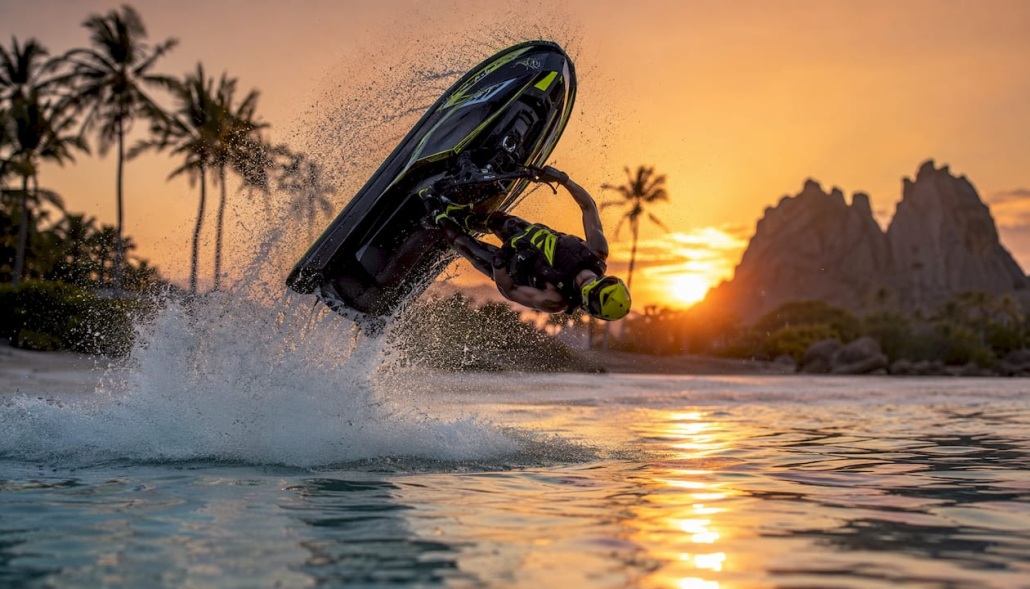
Jet Ski Barrel Roll Entry Guide: Master the Technique
A properly executed barrel roll on a PWC is achievable for skilled riders who follow a staged progression and a strict safety checklist. Success means completing a controlled 360° corkscrew rotation with recoverable forward momentum or landing in a manageable upright recovery after a partial rotation. Both outcomes count as progress.
Before your first attempt, lock in these non-negotiables:
- Lifejacket: Type III recommended for mobility and buoyancy during freestyle maneuvers
- Observer/spotter: A dedicated person on the water watching every run
- Open-water buffer: Clear distance from swimmers, docks, and other craft
- Kill-switch lanyard: Attached and tested before every session
95% of the barrel roll’s success depends on technique, not raw power or wave size. That figure, cited across freestyle trick instruction, is why drill-focused progression beats chasing bigger wakes.
Pro Tip: Counter-steering is the most counterintuitive input in the entire maneuver. As the PWC tilts, you push the handlebar in the opposite direction. Practice that motion at low speed before you ever attempt a full roll.
Table of Contents
- What Is the Barrel Roll Entry Technique, Step by Step?
- What skills and safety gear do you need before attempting a barrel roll?
- How do you build from beginner drills to a full barrel roll?
- Why do barrel rolls fail, and how do you fix the most common errors?
- Which PWC setup factors affect barrel roll performance?
- How do you land safely and recover after an incomplete rotation?
- Key Takeaways
- What experienced coaching actually teaches about barrel rolls
- IPD Racing has the parts to back your freestyle progression
- Useful resources for deeper study
What Is the Barrel Roll Entry Technique, Step by Step?
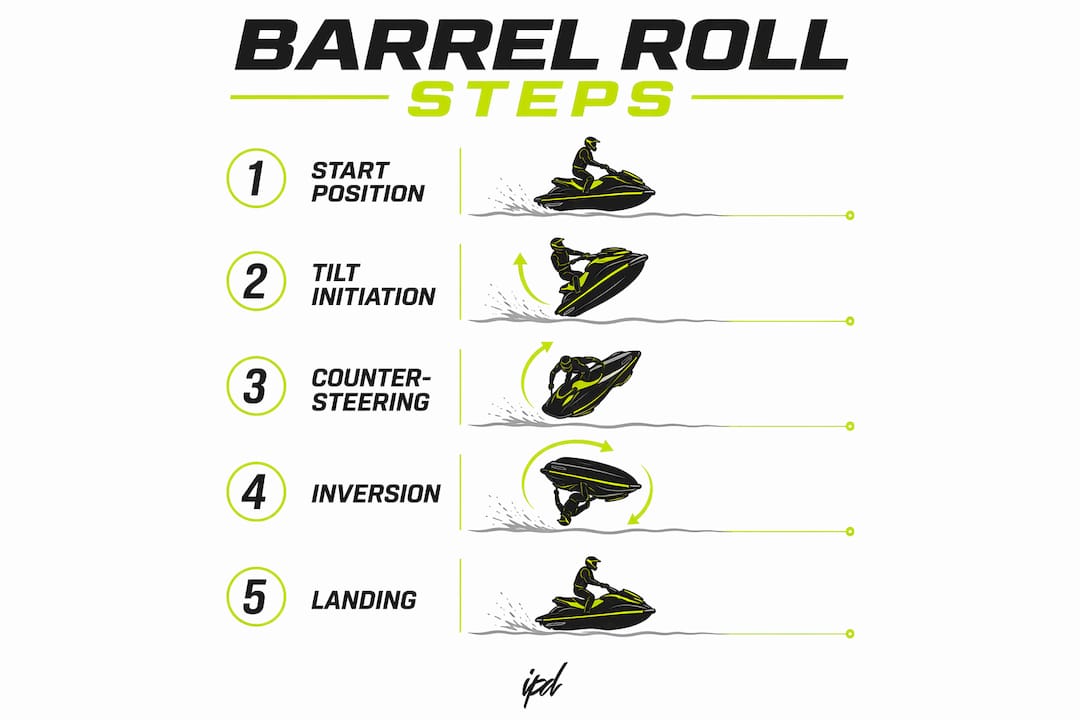
The barrel roll is an advanced jet ski maneuver that demands precise, time-sequenced inputs. Here is the full procedure:
- Approach speed: Build to a moderate speed suitable for initial attempts. Aim for the steepest section of the wake or wave face, not the rounded shoulder.
- Pre-hop decision: On small wakes, a pre-hop is required to generate vertical height and rotation momentum. On larger wakes (2–3 ft or more), wake momentum alone can carry the rotation without a pre-hop.
- 0.5–1.0 seconds before the crest: Initiate a slight turn toward your rotation side. Shift your upper body weight into that turn.
- At 45° tilt: Begin feeding throttle gradually. A gradual throttle increase mid-turn sustains rotation without over-spinning.
- At vertical: Apply counter-steer. Push the opposite handlebar firmly to control roll trajectory and prevent an uncontrolled flip.
- Mid-air posture: Keep knees bent, elbows close to your body, and look under the hull. Where your head goes, the craft follows.
- Foot placement: Keep both feet wedged in the footholds throughout. Never lose contact with the PWC mid-rotation.
- Exit cues: As the hull rotates back toward horizontal, straighten the bars, reduce throttle, and prepare your legs to absorb the landing.
Pro Tip: Record every practice run from a chase boat or shore camera. Reviewing your body position at the 45° tilt point reveals throttle and counter-steer timing errors faster than any verbal debrief.
What skills and safety gear do you need before attempting a barrel roll?
Baseline skills
You need these fundamentals locked in before attempting any aerial rotation:
- Consistent nose-stab U-turns with controlled inversion
- Solid 180° turns at varying throttle levels
- Reliable throttle and trim control in choppy conditions
- Surf and wake riding fundamentals, including reading wave shape
If you cannot invert consistently on slow U-turns, you are not ready for full aerial rolls.
Required safety gear
| Item | Specification |
|---|---|
| Lifejacket | Type III for freestyle mobility |
| Helmet | Water-sports certified, full coverage |
| Gloves | Grip-reinforced, water-resistant |
| Wetsuit or rash guard | Impact and abrasion protection |
| Kill-switch lanyard | Tested before every session |
U.S. legal and safety callouts
Practice only in open, permitted areas. The U.S. Coast Guard requires all PWC operators to wear a lifejacket and maintain safe distances from other vessels and swimmers. Follow all local navigation rules and posted no-wake zones. Check your state’s boating authority for any permit requirements before freestyle practice on public waterways.
Emergency protocol: Your spotter must have a radio or cell phone, know the nearest boat ramp, and understand how to right an inverted PWC safely. If you sustain a hard impact, stop the session and seek medical evaluation before continuing.
How do you build from beginner drills to a full barrel roll?
Progression is the only safe path. Skipping stages is the primary cause of dangerous, uncontrolled landings.
- Stage 1 — Nose-stab U-turn drills: Practice slow-speed U-turns focused on getting the nose down and the hull inverted. Goal: consistent 90°–180° inversion on demand. This is the foundation of every barrel roll.
- Stage 2 — Pre-hop timing on small wakes: Add a pre-hop to generate pop. Run 10–15 reps per session, focusing on the timing of the pop relative to the wake crest. Log each attempt.
- Stage 3 — Partial rotation drills: Target 50% rotation, then 75%, then 90%. Controlled head-first or side landings at this stage are normal and expected. Repeated upside-down landings are part of the learning curve, not a failure signal.
- Stage 4 — Full roll attempts: Move to progressively larger wakes only after achieving consistent controlled recoveries at the 90% mark. Approach speeds for initial attempts are commonly recommended in the 25–35 mph range, with higher speeds such as 30–40 mph referenced for advanced turning techniques, but you should only increase speed when your success rate justifies it.
Session structure: Limit full-rotation attempts to 20–30 minutes of focused work. Log speed, RPM range, rotation percentage, and landing quality after each run. Stop the session when fatigue appears or when two consecutive landings feel unsafe.
Pro Tip: Veteran riders caution against jumping to high-speed wakes before mastering upside-down orientation at low speeds. Master the nose stab first. Many experienced riders land upside down hundreds of times in drills before they ever chase a big wake.
- Do not increase wake size or speed until controlled recoveries are consistent
- On flat water, body positioning and looking under the hull matter most; in surf or wake contexts, handlebar input and wave momentum dominate
- Train both approaches independently before combining them
Why do barrel rolls fail, and how do you fix the most common errors?
Most failures fall into four categories:
- Under-rotation: Approach speed too low, or throttle not fed mid-turn. Fix: increase entry speed incrementally and practice the throttle-feed timing in Stage 2 drills.
- Over-rotation: Too much throttle too early. Fix: delay the throttle increase until the 45° tilt point and modulate rather than pin it.
- Nose dive: Weight too far forward at initiation. Fix: shift body weight to the rotation side earlier in the approach.
- Violent uncontrolled flip: Missing the counter-steer input. Failing to counter-steer as the PWC tilts is the single most common cause of dangerous, uncontrolled flips.
Troubleshooting checklist:
- Adjust where you hit the wake: the steepest section generates more vertical lift than the rounded shoulder
- Tighten grip and check foot placement in footholds before each run
- Vary knee bend depth to find the posture that keeps you connected to the craft through rotation
- Practice the counter-steer push motion at low speed, on flat water, before applying it at speed
When to abort a session: Stop immediately if weather or wake conditions deteriorate, if you feel physical fatigue, or after two consecutive unsafe landings. Mid-air loss of control means tuck your chin, protect your head, and let the water absorb the impact. Do not fight the landing.
Pro Tip: Practice the counter-steer motion in isolation. At low speed on flat water, tilt the PWC and push the opposite bar. Build that muscle memory before you ever attempt a full rotation.
Which PWC setup factors affect barrel roll performance?
Hardware choices have a direct effect on how predictably a PWC rotates and recovers.
| Component | Effect on Barrel Roll |
|---|---|
| Footholds | Maintain rider-to-craft contact through full rotation |
| Ride plate / trim | Controls hull angle and lift at the wake face |
| Intake grate | Affects pump efficiency and throttle response |
| Pump shoe | Influences thrust consistency mid-maneuver |
| Grip surfaces | Reduces foot slip during weight shifts |
Setup tips:
- Mount footholds at a position that allows full knee bend without losing foot contact at the top of the rotation
- Test trim adjustments in controlled drills before applying them at speed
- Inspect the intake grate and pump shoe before every freestyle session; debris or wear changes throttle response unpredictably
- Model and year differences in hull geometry affect how the craft responds to weight shifts. Test any setup change in a low-speed drill first
IPD Racing carries freestyle footholds and hull upgrades from brands focused on freestyle performance. Casey and the IPD Racing team also publish setup guidance covering handling parts and tuning that apply directly to roll consistency.
How do you land safely and recover after an incomplete rotation?
Landing procedure
- As the hull approaches horizontal, square the handlebars to the direction of travel.
- Reduce throttle to a controlled idle.
- Bend knees deeply to absorb impact. Keep your head up and eyes forward.
- Check steering response immediately after touchdown.
Post-landing checklist
- Throttle response: confirm it returns to idle cleanly
- Steering: verify full left-right travel without binding
- Hull: visually check for breaches or damage at the nose and sides
- Footholds: confirm they are still secure
- Rider: assess for impact injuries before the next run
For inverted landings: Signal your spotter immediately. Do not attempt to right the craft alone in open water. Your spotter should approach from the stern, check for fuel leaks or engine flooding, and assist with righting the PWC using the designated righting procedure for your model. Do not restart the engine until the craft has been inspected.
Key Takeaways
Mastering a jet ski barrel roll requires staged progression, consistent counter-steering practice, and proper safety gear before any full-rotation attempt.
| Point | Details |
|---|---|
| Skill prerequisites first | Master nose-stab U-turns and consistent 180° inversions before attempting aerial rotations. |
| Safety gear is non-negotiable | Type III lifejacket, water-sports helmet, gloves, and a tested kill-switch lanyard are required for every session. |
| Counter-steering controls the roll | Push the opposite handlebar as the PWC tilts; skipping this input causes uncontrolled flips. |
| Progress by rotation percentage | Move from 50% to 75% to 90% rotation in drills before attempting a full 360° roll off larger wakes. |
| IPD Racing setup support | Footholds, ride plates, and pump upgrades from IPD Racing directly affect roll consistency and rider control. |
What experienced coaching actually teaches about barrel rolls
The conventional wisdom says “just get more air.” That advice sends riders to bigger wakes before they have earned it, and bigger wakes do not fix bad technique. They amplify it.
The real sequence is slower and less exciting: hundreds of nose-stab U-turns, dozens of partial rotations at controlled speeds, and careful logging of what worked and what did not. Riders who skip that groundwork tend to land the same dangerous way repeatedly, because the error is in the body mechanics, not the wake size. A larger wake just gives a flawed input more time to go wrong.
Counter-steering is where most riders lose the most time. It feels wrong to push away from the direction you are rotating, and that hesitation is what turns a manageable partial roll into a violent flip. The fix is not courage. It is repetition at low speed until the motion is automatic.
The progression framework in this guide reflects what actually works in coached freestyle practice: build the inversion reflex first, add rotation incrementally, and only then chase the full aerial. Riders who follow that sequence tend to land their first full roll with far less drama than those who skip ahead.
IPD Racing has the parts to back your freestyle progression
Consistent barrel rolls depend on more than technique. The right hardware makes the difference between a setup that fights you and one that works with your inputs.
IPD Racing stocks the freestyle performance parts that directly affect roll control: footholds that keep you connected through full rotation, ride plates and pump upgrades that stabilize hull angle at the wake face, and intake grates that preserve throttle response when it matters most. Every product is selected for riders who take their PWC performance seriously, from recreational freestyle to competitive events. Always follow U.S. safety regulations and your local waterway rules when modifying your craft. Browse the IPD Racing shop or check the setup guides to find the right parts for your model and riding style.
Useful resources for deeper study
- Barrel roll technique and pre-hop discussion — peer reports on wake size, pre-hop timing, and learning curve expectations
- Freestyle trick progression overview — technique-dependence context and trick difficulty rankings
- Flat water backflip tutorial by Václav “Iceman” Žáček — professional PWC athlete walkthrough of body positioning, pre-pulse technique, and safety protocols applicable to barrel roll training
- Jet ski surf conditions explained — how wave shape and size affect trick practice
- Jet ski trick rotation mechanics — rotational error analysis and correction
- Safety gear checklist for freestyle riders — full equipment reference
When using video resources: Watch specifically for the rider’s body position at the 45° tilt point and the moment counter-steer is applied. Cross-reference what you see with your own logged practice data. Timing errors that are invisible in real time become obvious at 0.25x playback speed.

