

Why Watercraft Maintenance Matters for Boat & PWC Owners
Regular watercraft maintenance protects your safety, keeps your engine reliable, preserves performance, and lowers your long-term ownership cost. Skip it, and small problems compound fast.
- Fewer breakdowns on the water, where help is never close
- Lower lifetime cost through preventive care vs. reactive repairs
- Better resale value backed by documented service history
- Consistent performance from a clean hull, tuned engine, and healthy fuel system
- Safer trips with functioning bilge pumps, safety gear, and electrical systems
The numbers make the case plainly. A worn impeller costs roughly $40 to replace. Let it fail and cause overheating, and it can lead to a $3,000–$5,000 engine overhaul. That multiplier effect runs through every deferred task on a boat or PWC. Preventive maintenance programs help reduce operating costs significantly while retaining more of the vessel’s resale value.
Table of Contents
- What happens when you skip watercraft maintenance?
- Essential maintenance checklist for boats and PWCs
- How often should you maintain your boat or PWC?
- PWC-specific maintenance: what jet ski owners need to do
- Which maintenance tasks should you prioritize first?
- Maintenance as an investment in your time on the water
- Key Takeaways
- The maintenance habit most owners build too late
- Get the right parts for your PWC at IPD Racing
- Useful sources and further reading
What happens when you skip watercraft maintenance?
Neglected maintenance rarely produces one isolated failure. It produces cascading ones.
- Engine overheating: An impeller that isn’t inspected wears down, loses flow, and lets the engine cook. Seized engines are the most common and most expensive result.
- Electrical corrosion: Salt, moisture, and ignored terminals corrode wiring and kill bilge pumps, ignition systems, and navigation lights.
- Fuel-system blockages: Stale fuel left in the system over winter gums carburetors and injectors. Failing to stabilize fuel is a primary cause of spring engine failures.
- Hull and core damage: Water intrusion through unchecked fittings or cracks saturates fiberglass cores, leading to structural repairs that dwarf the cost of a seasonal inspection.
Skipping the after-trip freshwater rinse alone can lead to $200–$800 in hardware replacement and $500–$2,000 in gel coat oxidation removal. A bilge pump that fails in rough water is a life-safety event, not a repair inconvenience. Safety-critical systems including fuel lines, life-saving equipment, and electrical panels should be inspected by a qualified marine technician when in doubt.
Essential maintenance checklist for boats and PWCs
Boat checklist
After every trip:
- Freshwater flush on outboard or sterndrive cooling passages
- Bilge pump test and bilge-out check
- Quick hull and gear inspection for dings, cracks, or line entanglement
- Battery terminal wipe and secure connection check
Monthly/seasonal:
- Oil and gear lube change per manufacturer interval
- Fuel/water separator filter inspection and replacement
- Zinc anode inspection (replace when 50% depleted)
- Propeller check for dents, cracks, and fishing line
- Electrical connections cleaned and treated with corrosion inhibitor
- Safety gear inventory: life jackets, flares, fire extinguisher, navigation lights
PWC checklist
- Drain and flush cooling passages after every ride, especially in saltwater
- Inspect jet pump and impeller for wear, debris, or cavitation damage
- Confirm lanyard and kill switch function before every launch
- Check trailer lights and wheel bearings before each trip
Pro Tip: Log each service in a phone note or a free app like Google Keep. Thirty seconds after every trip builds a maintenance record that supports warranty claims and adds real dollars to your resale price.
How often should you maintain your boat or PWC?
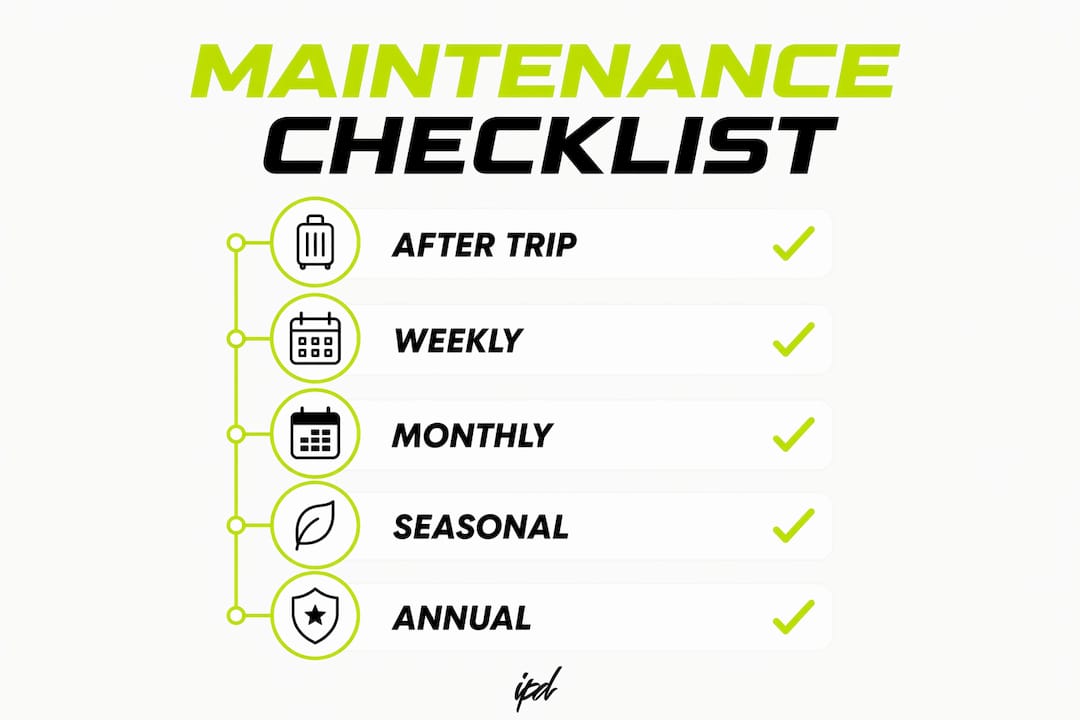
Grouping tasks into four rhythms makes the schedule predictable and far less likely to slip.
| Frequency | Key Tasks | Ballpark Cost |
|---|---|---|
| After every trip | Freshwater flush, bilge check, hull scan | — |
| Monthly | Oil check, filter inspect, anode check, electrical wipe | — |
| Seasonal transition | Full fluid change, impeller inspect, fuel stabilization, safety gear audit | — |
| Annual | Full service, compression test, trailer service, winterization | — |
Winterization deserves special attention in northern U.S. climates. Fogging cylinders and stabilizing fuel aren’t optional steps. Owners who skip them routinely face catastrophic failures on the first spring startup. Budget the annual service window the same way you’d budget a registration renewal.

PWC-specific maintenance: what jet ski owners need to do
PWCs operate in a uniquely punishing environment. The jet pump ingests debris, saltwater accelerates corrosion, and the compact hull leaves little margin for ignored wear.
- Flush cooling passages with fresh water after every saltwater or brackish-water ride
- Inspect the impeller for chips, cracks, or wear scoring; check the jet ski cooling system for blockages
- Remove the battery for off-season storage and keep it on a maintenance charger
- Add fuel stabilizer before any storage period longer than 30 days
- Test the lanyard and kill switch before every launch
- Store the PWC level or slightly nose-up; never on its side
- Use a fitted cover to block UV, debris, and moisture
- Inspect and replace spark plugs per the manufacturer’s interval
- Walk the hull for cracks, stress marks, or gelcoat chips after every session
- Pull and inspect the drain plug; confirm the bilge is clear before launching
- Check trailer lights, tire pressure, and wheel bearing condition before every tow
Post-saltwater flushing and the pre-ride lanyard check are the two habits that prevent the most common PWC failures and safety incidents.
Which maintenance tasks should you prioritize first?
When time or budget is tight, rank tasks by consequence, not convenience.
- Water intrusion and bilge (5 minutes): A failed bilge pump or open fitting sinks boats. Check first, every time.
- Fuel system and battery (10 minutes): Stale fuel and dead batteries strand more boats than any other cause.
- Cooling system and impeller (15 minutes): The $40-vs.-$5,000 multiplier makes this the highest-ROI mechanical check.
- Electrical connections and corrosion (10 minutes): Corroded terminals cause ignition failures, bilge failures, and fire risk.
- Safety gear audit (5 minutes): Expired flares, flat life jackets, and discharged extinguishers are a legal and life-safety issue.
One rule of thumb covers most decisions: if a failure risks water entering the vessel or the engine overheating, do it first.
Maintenance as an investment in your time on the water
Consistent, scheduled upkeep is what separates owners who spend weekends on the water from those who spend them on the phone with a service shop. Practically, that means two things beyond the checklist.
Covers and protection: A properly fitted watercraft cover blocks UV degradation, keeps debris out of the engine compartment, and extends gelcoat life measurably. Material choice matters: marine-grade polyester or solution-dyed acrylic outperforms generic tarps for UV resistance and breathability.
Tuning and performance: Routine maintenance and PWC tuning best practices work together. Clean fuel systems, fresh plugs, and a healthy impeller are the foundation for any performance gain. Chasing power on a neglected machine produces unreliable results and accelerates wear.
For safety-critical work, consult a qualified marine technician and keep the owner’s manual onboard. Documented service history supports warranty claims and materially improves resale value in the U.S. market.
Key Takeaways
Routine watercraft maintenance prevents the cascading failures that turn a $40 impeller into a $3,000–$5,000 engine overhaul and keeps every trip safe and predictable.
| Point | Details |
|---|---|
| Prioritize cooling and impeller | A worn impeller can cascade into a $3,000–$5,000 engine overhaul; inspect it every season. |
| Flush after every saltwater ride | Skipped rinses lead to $200–$800 in hardware replacement and $500–$2,000 in oxidation repairs. |
| Keep a service log | Documented history supports warranty claims and raises resale value in the U.S. market. |
| Follow the four-rhythm schedule | After-trip, monthly, seasonal, and annual tasks keep maintenance predictable and affordable. |
| IPD Racing for parts and guidance | IPD Racing’s maintenance and repair resources help PWC owners find the right parts and service information by model. |
The maintenance habit most owners build too late
Most owners come to routine maintenance after a breakdown, not before. The pattern is consistent: a missed impeller check, an overheated engine, a $3,000–$5,000 repair bill, and then suddenly a meticulous service log appears. The frustrating part is that the habits that prevent that scenario take less than 30 minutes after each trip.
Start with the freshwater flush and a quick bilge check. Add a phone note with the date. That’s the whole system at the beginning. The checklist grows naturally once the habit is in place, and the cost of staying ahead of failures stays low. Owners who treat maintenance as a fixed part of the ride rather than an optional follow-up spend more time on the water and less money at the shop.
Get the right parts for your PWC at IPD Racing
IPD Racing stocks performance and replacement parts for PWC owners across the full range of maintenance needs, from wear items like impellers and spark plugs to engine rebuild components for when a machine needs more than routine service. The catalog covers recreation, racing, and freestyle builds, and you can shop by model to find parts confirmed for your specific watercraft. Whether you’re replacing a worn component found during a seasonal inspection or sourcing parts for a full top-end rebuild, IPD Racing has the inventory and the technical content to support the work. Browse the full catalog at ipdracing.com and get the right part before the next ride.
Useful sources and further reading
Consult your boat or PWC owner’s manual first for model-specific torque specs, fluid types, and service intervals. These resources provide additional depth:
- America’s Boating Club: The Importance of Regular Boat Maintenance for Safety — safety-focused overview from a recognized U.S. boating organization
- Catalyst Marine Services: Boat Maintenance Schedule — detailed monthly, seasonal, and annual task breakdowns with cost context
- Ignition Marine: Boat Maintenance Tips — preventive vs. reactive maintenance framing from a marine service provider
- Starnapp: Preventive Boat Maintenance — operating cost reduction data and resale value guidance
- Blazer Boats: Boat Maintenance — seasonal maintenance guidance including winterization best practices
- JetDrift: Jet Ski Battery Storage — PWC-specific battery care for off-season storage

