

What Is Jet Ski Free-Riding: Rider’s Complete Guide
Jet ski free-riding is the practice of independently operating your personal watercraft within a designated zone under guide supervision, giving you full control over speed, turns, and your riding line. Unlike guided tours where you follow an instructor at a set pace, free-riding lets you carve, accelerate, and explore on your own terms. Locations like Biscayne Bay in Miami and Clearwater Beach in Florida have made this style popular by offering structured rental sessions that balance rider autonomy with safety oversight. If you want real control on the water without the constraints of a follow-the-leader format, free-riding is the riding style to know.
What is jet ski free-riding vs. a guided tour?
Free-riding means you control throttle, turns, and line independently within a designated zone, while a guide supervises from a distance. A guided tour is the opposite model: you ride directly behind an instructor, match their speed, and follow their exact route. Free-riding gives you the wheel, so to speak, while still keeping you inside a managed area.
The distinction matters for skill development. Guided tours are ideal for complete beginners who need a reference point for speed and direction. Free-riding accelerates learning because you make real decisions in real time, including when to throttle up, when to slow down, and how to handle turns.
Here is how the two formats compare in practice:
- Guided tour: Riders follow the guide in single-file formation at a controlled pace. Speed and route are set by the instructor. Ideal for first-timers with zero watercraft experience.
- Free-ride zone: Riders operate independently within a marked or supervised area. Throttle, direction, and line are entirely your choice. A guide monitors from nearby but does not dictate your path.
- Supervision level: Both formats include supervision, but free-riding supervision focuses on zone compliance and safety rather than pace-matching.
- Water conditions: Free-ride zones run on protected water like Biscayne Bay rather than open ocean, reducing exposure to heavy boat traffic and unpredictable swells.
- Skill requirement: Free-riding suits riders who have completed at least one basic orientation or have prior watercraft experience.
The guided autonomy model is what separates free-riding from both fully unguided open-ocean riding and rigid tour formats. You get freedom within a framework designed to keep everyone on the water safe.
How do free-riding jet ski techniques differ from typical riding?
The single most important technique in free-riding is throttle control, and it works nothing like driving a car. A jet ski steers through thrust, not a mechanical rudder. When you release the throttle completely, you lose steering effectiveness and the ski continues in its current direction with no ability to correct course.
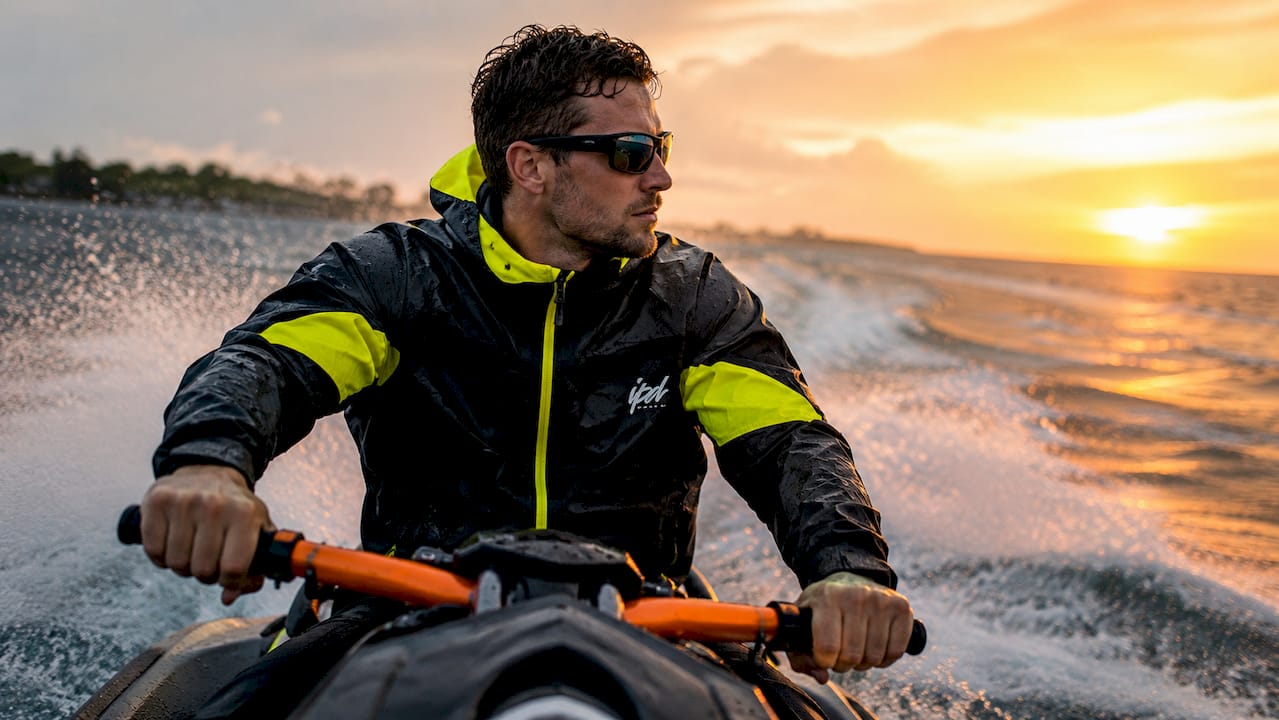
This surprises nearly every new rider. Car muscle memory tells your brain to lift off the gas when you want to slow or turn. On a jet ski, that instinct reduces your control at exactly the wrong moment. The correct technique is to maintain partial throttle through a turn so the thrust keeps the steering nozzle responsive.
Pro Tip: Spend the first 10–15 minutes of any free-ride session practicing gradual turns at moderate speed. Get comfortable with how much throttle you need to hold through a corner before pushing your pace.
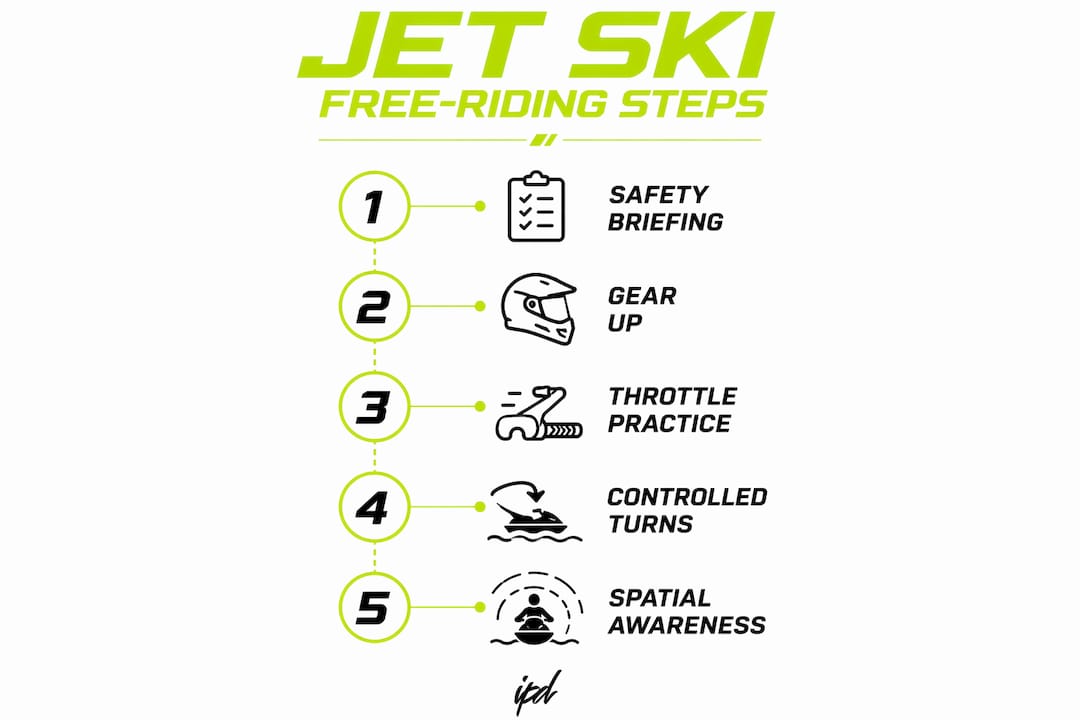
New riders often release throttle when turning, which worsens control rather than improving it. Experienced free-riders modulate throttle continuously, feathering it through corners and applying more power on straightaways. This is the core skill that separates a confident free-rider from someone who feels out of control.
Body position also plays a role. Leaning into turns and keeping your weight centered over the footwells improves stability at speed. Riders who sit too far back lose front-end grip on the water. Riders who lean too far forward during acceleration risk losing balance when the bow rises. Staying centered and relaxed is the baseline position for all freestyle jet ski body positioning.
Free-riding technique also includes spatial awareness. You are responsible for your own line within the zone, which means reading the water ahead, anticipating wakes from other riders, and adjusting speed before a situation becomes urgent. This is a skill that develops quickly with practice but requires active attention from the first session.
What safety rules apply to jet ski free-riding?
Safety in free-riding is not optional and not informal. Federal and state rules require all riders to wear USCG-approved life jackets from the moment the engine starts until it shuts off. This applies in no-wake zones, during slow maneuvering, and at full speed. There are no exceptions based on swimming ability or experience level.
Beyond life jackets, the following safety requirements apply in virtually every free-ride zone:
- Safety lanyard: Attach the engine cut-off lanyard to your wrist or life jacket before starting. If you fall off, the lanyard pulls free and kills the engine, preventing a runaway ski.
- No-wake zones: Reduce speed to a slow, non-planing pace in marked no-wake areas. Violating these zones creates hazards for other boaters and can result in fines.
- Safe following distance: Maintain at least 100 feet of separation from other riders, swimmers, and fixed objects. Closing distance at speed leaves no reaction time.
- Zone boundaries: Stay within the designated free-ride area. Crossing into open navigation channels or restricted zones creates legal liability and genuine collision risk.
- Hazard awareness: Scan ahead continuously for buoys, anchored boats, swimmers, and shallow water markers.
Safety compliance in a free-ride zone extends beyond gear. Predictable riding lines, consistent speed, and respectful spacing protect every rider in the area. Erratic behavior, such as sudden stops or sharp cuts near other skis, is the leading cause of incidents in shared watercraft zones. Reviewing a jet ski safety gear checklist before your session is a practical habit that experienced riders build early.
Where can you experience free-riding and what should you expect?
Free-riding sessions are available at rental operators across the United States, with the most established programs concentrated in Florida, New York, and coastal Texas. Each location offers a slightly different experience based on water conditions, zone size, and session structure.
| Location | Water Type | Session Format | Notable Feature |
|---|---|---|---|
| Biscayne Bay, Miami | Protected bay | Guided free-ride zone | Calm water, skyline backdrop |
| Clearwater Beach, FL | Inshore Gulf | 30-minute freestyle ride | Rider-controlled pace and style |
| New York Harbor area | Sheltered zones | Supervised free-ride | Urban waterway experience |
| Coastal Texas | Intracoastal waters | Rental with zone supervision | Flat water, wide open zones |
A typical session starts with paperwork, a safety briefing, and a supervised launch. Operators cover safety rules, hand signals, and zone boundaries before riders ever touch the throttle. Launches usually happen from established docks or marinas, with guides present at the water’s edge.
Once on the water, most riders spend the first few minutes getting comfortable with throttle response and turning radius. After that, the session opens up. Riders carve wide arcs, practice speed control, and explore the zone at their own pace. Some operators offer 30-minute sessions; others offer 60-minute options for riders who want more time to develop technique.
Rental operators provide life jackets and basic safety gear. Riders who want to improve their watercraft accessories setup for personal skis can add items like neoprene gloves, board shorts with padding, and proper footwear for better grip and comfort. The briefing at the start of each session is not a formality. Pay attention to it. The hand signals and zone markers described there are the tools you use to communicate with the guide during your ride.
Key Takeaways
Jet ski free-riding is defined by rider-controlled throttle and line within a supervised zone, making throttle discipline and safety compliance the two skills that determine your experience on the water.
| Point | Details |
|---|---|
| Core definition | Free-riding means controlling your own throttle, turns, and line within a supervised zone. |
| Throttle is steering | Releasing throttle fully removes steering control; maintain partial power through all turns. |
| Life jackets are mandatory | USCG-approved life jackets must be worn from engine start to engine off, no exceptions. |
| Protected water zones | Free-ride sessions run on calm, protected water like Biscayne Bay, not open ocean. |
| Briefings are functional | Pre-ride safety briefings cover hand signals and zone rules you will actively use during the session. |
Why the “guided autonomy” model is the right way to learn
The framing I keep coming back to is this: free-riding is a guided autonomy model, not a free-for-all. That distinction changed how I think about skill development on the water. Most riders who struggle with jet skis are not struggling with speed. They are struggling with the absence of a reference point. Guided tours solve that by giving you one. Free-riding solves it differently by forcing you to build your own.
The throttle discipline lesson is the one I see riders resist most. Everyone wants to go fast before they have learned to modulate. The riders who progress fastest are the ones who spend the first session deliberately practicing slow, controlled turns rather than chasing top speed. That patience pays off quickly.
Spatial awareness is the other skill that separates good free-riders from riders who just survive their sessions. Knowing where other skis are, reading wake patterns before they reach you, and adjusting your line 10 seconds before a problem develops. These are habits, not instincts. They build with repetition inside a supervised zone, which is exactly why the free-ride format exists.
My honest recommendation: choose a free-ride session over a guided tour for your second time on the water, not your first. Use the first session to understand how the machine responds. Use the second to start making your own decisions. That sequence builds confidence faster than any other approach I have seen.
— Casey
IPD Racing has the parts to back your riding
Riders who move beyond rental sessions and onto their own personal watercraft need parts that match their ambitions. IPD Racing supplies performance components for every riding style, from recreation to freestyle, backed by technical knowledge built inside the PWC community.
Whether you are upgrading handling components, sourcing a ride plate for better control, or building out a complete performance setup, the IPD Racing shop carries what you need. The catalog covers Yamaha, Kawasaki, and other major platforms with parts selected for real-world riding performance. Visit the IPD Racing shop to find components that match your ski and your riding goals.
FAQ
What is jet ski free-riding in simple terms?
Jet ski free-riding is riding your own watercraft independently within a designated zone, controlling your own speed and direction, while a guide supervises from nearby for safety.
Do I need experience to try free-riding?
At least one basic orientation session is recommended before free-riding. Riders with no prior watercraft experience are better served by a guided tour first.
Is a life jacket required during free-riding?
Yes. Federal and state rules require all riders to wear a USCG-approved life jacket any time the engine is running, including in no-wake zones and during slow maneuvering.
Why does releasing the throttle reduce control on a jet ski?
A jet ski steers through thrust from its water jet nozzle. Releasing the throttle cuts thrust, which removes steering effectiveness and causes the ski to coast in its current direction without the ability to turn.
What are the best locations for jet ski free-riding in the U.S.?
Biscayne Bay in Miami, Clearwater Beach in Florida, and sheltered harbor zones in New York are among the most established free-ride locations, all chosen for calm, protected water conditions.

