

Racing Jet Ski Trim Explained for Competitive Racers
Racing jet ski trim is the adjustment of the jet nozzle angle to control hull pitch and directly influence speed, acceleration, and handling on the racecourse. Most racers focus on horsepower, but trim position is a decisive factor that can determine the outcome in close races along with rider skill, launch timing, and line choice. The industry standard term for electronic trim control is the Variable Trim System, or VTS. Understanding how to set and adjust trim correctly separates competitive racers from riders who simply have fast machines. This guide covers the mechanics, the hardware, and the practical techniques that make trim a real performance tool.
How does racing jet ski trim affect acceleration and handling?
Trim works by changing the angle of the jet pump nozzle, which shifts the direction of thrust and alters how the hull sits in the water. Trimming the nozzle up lifts the bow, reduces the wetted surface area of the hull, lowers drag, and increases top speed in calm or manageable water conditions. Trimming down pushes the bow lower, increases hull contact with the water, and improves stability at the cost of some top speed.

For the hole shot, trim down is the correct setting. Setting trim all the way down stabilizes the hull during the initial acceleration phase and improves thrust delivery off the line. Pairing that low trim position with your body weight shifted forward keeps the bow from rising too aggressively and wasting energy. That combination produces a cleaner, faster launch than horsepower alone can deliver.
Over choppy water, trim management becomes even more critical. A bow that rides too high in rough conditions catches air, loses traction, and forces the pump to cavitate. Keeping trim slightly lower in chop keeps the hull planted and the pump loaded with water. Trim interacts with rider position and launch timing to manage bow rise and maintain hull planing across variable water conditions.
- Trim up: Reduces drag, raises bow, increases top speed on flat water
- Trim down: Stabilizes hull, improves hole shot, better control in chop
- Mid trim: Balanced setting for mixed conditions and technical courses
- Body weight forward with trim down: Best combination for launch acceleration
Pro Tip: On a long straight with flat water, trim up progressively as speed builds. Do not set trim up at the start. Let the hull plane first, then raise the nozzle to shed drag and pick up top end.
VTS vs. physical trim tabs: what is the difference?
The two main trim systems on racing and performance jet skis work differently and serve different purposes. Knowing which system your craft uses changes how you approach setup and adjustment.
The Variable Trim System is an electronic system that adjusts the jet pump nozzle angle in real time using a button on the handlebars. VTS gives the rider immediate control over hull pitch without stopping or making mechanical changes. It is the standard trim control on Sea-Doo performance and racing models. VTS changes where the thrust vector points, which directly shifts the bow up or down and alters handling responsiveness, especially in turns.
Physical trim tabs are mechanical flaps mounted on the hull. Sea-Doo Switch models use a bolt and shock system with six adjustable positions. These tabs increase the running surface and add stability by mechanically changing the angle of hull flaps. They are particularly effective when the craft carries a heavy load or when a racer needs a fixed, predictable planing characteristic without relying on electronic input.
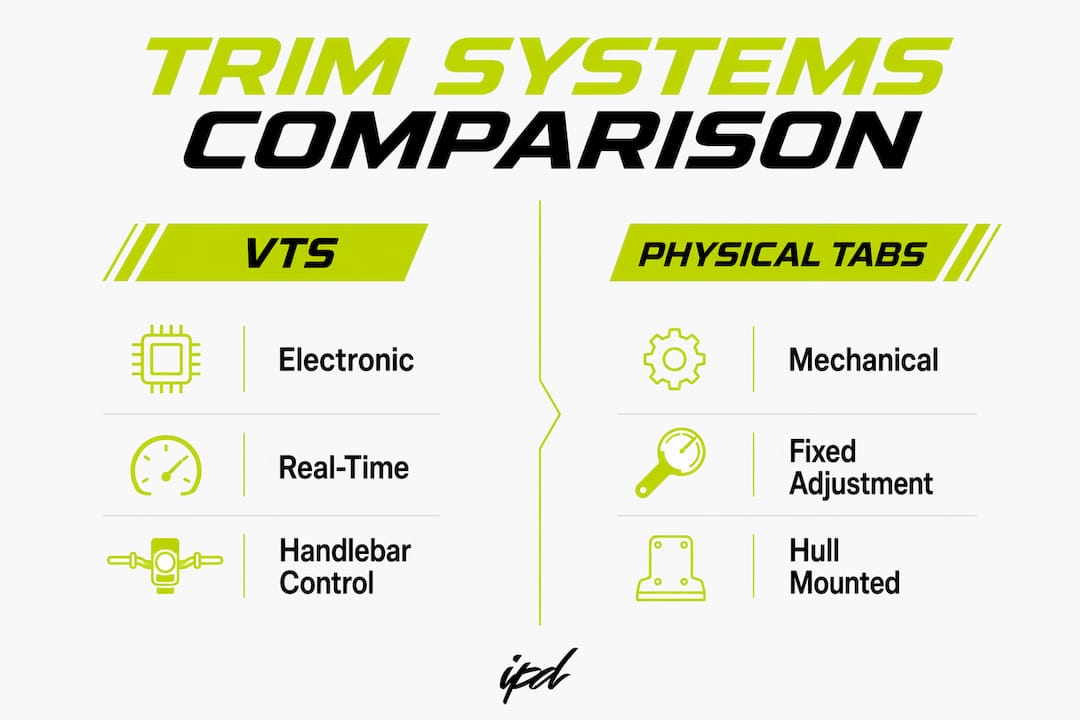
| Feature | VTS (Variable Trim System) | Physical trim tabs |
|---|---|---|
| Adjustment method | Electronic, handlebar button | Manual, bolt/shock positions |
| Speed of change | Real time during riding | Requires stopping to adjust |
| Primary effect | Nozzle angle, thrust vector | Hull flap angle, running surface |
| Best use case | Dynamic racing conditions | Fixed load, stability tuning |
| Typical platform | Sea-Doo performance models | Sea-Doo Switch, pontoon-style PWC |
The practical difference for racers is control timing. VTS lets you react mid-race to changing water or course conditions. Physical tabs lock in a baseline setup before the race starts. Many serious racers use VTS as their primary tool and treat physical tabs as a hull stability baseline when applicable.
Pro Tip: If your craft has VTS, map out your trim positions before race day. Know which button click corresponds to your hole shot setting, your flat water top speed setting, and your chop management setting. Guessing during a race costs time.
How do rider technique and trim settings decide race outcomes?
Trim position alone does not win races. Close races between mismatched horsepower jet skis can be won or lost based on trim position and rider execution combined. A rider on a lower horsepower machine with correct trim and clean technique will beat a faster machine with poor setup more often than most racers expect.
Launch timing is the first critical interaction point. The moment you apply full throttle, your trim position determines whether the bow rises cleanly or bogs. Trim down at launch, body forward, and a clean throttle application produce the fastest hole shot. Riders who trim up too early lose hull contact, the pump unloads, and acceleration stalls.
Line choice amplifies trim decisions. On a tight course with multiple turns, a racer who trims down slightly through corners maintains better steering response because the nozzle stays loaded and directional. Trim affects nozzle positioning and governs steering effectiveness at different speeds. A rider who trims up aggressively before a turn reduces steering authority exactly when precision matters most.
“Trim position, combined with rider skill and launch timing, can overcome a horsepower disadvantage and influence race results.” — IPD Racing research summary
- Pre-launch: Trim all the way down, weight forward
- Mid-straight: Gradually trim up as hull planes and speed builds
- Approaching a turn: Reduce trim to maintain nozzle load and steering control
- Choppy sections: Drop trim to keep hull planted and pump loaded
- After a turn: Reapply throttle with trim neutral, then trim up as speed returns
What are practical steps for adjusting racing jet ski trim?
Dialing in trim for race conditions is a process, not a single setting. Start with a baseline and refine it through practice runs on the actual course or similar water.
- Set trim to full down before launch. This is your starting point for every race. Full down trim stabilizes the hull and maximizes initial thrust delivery.
- Apply throttle smoothly and shift weight forward. Aggressive throttle with weight back causes bow rise that trim alone cannot fully correct.
- Trim up incrementally on the straight. Once the hull is fully planed and speed is building, press trim up in small increments. Stop when you feel the bow start to feel light or steering gets vague.
- Read the water ahead. If chop is coming, drop trim before you hit it. Incorrect or inconsistent trim adjustment during races causes loss of speed and poor handling, especially over choppy water.
- Return to neutral or low trim before turns. Steering depends on nozzle load. Trim up in a turn reduces your ability to direct the craft precisely.
- Evaluate aftermarket components. Parts like pump wedges and trim extensions adjust nozzle angle and can raise the nose of the ski for improved planing. Pump wedges and trim extensions are aftermarket options that affect nozzle angle and hull pitch beyond what stock VTS provides.
Your intake grate and ride plate also interact with trim. A performance intake grate improves water flow to the pump, which makes trim adjustments more responsive. A well-fitted ride plate keeps the hull stable at high trim angles. Check the race prep checklist from IPD Racing to confirm your full setup is dialed before adjusting trim in isolation.
Pro Tip: Record your trim settings and lap times during practice. Write down the water conditions, your trim positions at each stage of the course, and your result. Patterns emerge quickly. Racers who track this data improve trim setup faster than those who rely on feel alone.
Key Takeaways
Correct trim position, matched to water conditions and rider technique, produces faster lap times than horsepower upgrades alone on most race courses.
| Point | Details |
|---|---|
| Trim down for hole shot | Full down trim with weight forward delivers the fastest, most stable launch acceleration. |
| Trim up for top speed | Raising the nozzle on flat water reduces hull drag and increases straight-line speed. |
| VTS vs. trim tabs | VTS adjusts nozzle angle in real time; physical trim tabs set a fixed hull stability baseline. |
| Rider technique multiplies trim | Correct launch timing and line choice amplify the gains from proper trim settings. |
| Aftermarket parts extend range | Pump wedges and performance ride plates expand trim adjustment beyond stock VTS limits. |
Trim matters more than most racers admit
My honest observation after watching competitive PWC racing for years is that trim gets treated as a secondary concern. Racers spend serious money on engine work and then show up to the start line with default trim settings. That is a real mistake.
The interaction between trim, body position, and throttle timing is where races actually get decided on technical courses. A rider who has mapped their VTS positions to specific course sections and water conditions has a genuine advantage that does not show up on a dyno sheet. I have seen lower horsepower machines consistently beat faster setups because the rider understood trim and the other did not.
My recommendation for any racer serious about results: spend one full practice session doing nothing but trim experiments. Run the same section of water at different trim positions and note the difference in feel and time. The data you collect in that session will be worth more than most bolt-on parts. Trim technology on modern Sea-Doo and Yamaha platforms is capable of more than most racers use. The nozzle modification options available today extend that range further for racers who want to push beyond stock settings.
— Casey
Performance trim parts and setup support at IPD Racing
IPD Racing stocks performance components that directly affect trim behavior and hull pitch for competitive racing setups.

From Variable Trim System components and pump wedges to performance ride plates and intake grates, IPD Racing carries the parts that make trim adjustments more effective. The full catalog covers Sea-Doo, Yamaha, and Kawasaki platforms, including the Yamaha 4-Stroke Superjet and the SXR 1500. If you need guidance on which components match your racing class and setup goals, the PWC Doctor service at IPD Racing provides specialist tuning support. Get your trim setup right before race day.
FAQ
What is trim on a racing jet ski?
Trim is the adjustment of the jet pump nozzle angle to control hull pitch. Trimming up raises the bow and reduces drag; trimming down lowers the bow and improves stability and acceleration.
What is the best trim setting for a hole shot?
Set trim all the way down and shift your body weight forward at launch. This combination stabilizes the hull and maximizes thrust delivery during initial acceleration.
How does VTS differ from physical trim tabs?
VTS adjusts the nozzle angle electronically in real time using a handlebar button. Physical trim tabs are mechanical hull flaps set manually before riding, primarily affecting planing stability and running surface.
Can trim adjustments compensate for less horsepower?
Yes. Correct trim position combined with proper launch timing and line choice can overcome a horsepower disadvantage in close races. Rider execution and trim setup together determine outcomes more than raw power in technical conditions.
What aftermarket parts affect jet ski trim performance?
Pump wedges, trim extensions, performance ride plates, and intake grates all influence how effectively trim adjustments translate to hull behavior and speed on the water.

