

Jet Ski Freestyle Competition Scoring: 2026 Guide
Jet ski freestyle competition scoring evaluates riders on five core criteria: execution, trick difficulty, style, amplitude, and overall impression. Judges from sanctioning bodies like the International Jet Sports Boating Association (IJSBA) assess each run using standardized scoring scales, then apply panel averaging methods to produce a fair final score. The system rewards riders who combine technical precision with creativity, not just raw power or trick count. Understanding how judges think gives competitors a direct edge in planning their runs and selecting their tricks.
What are the main judging criteria in jet ski freestyle competitions?
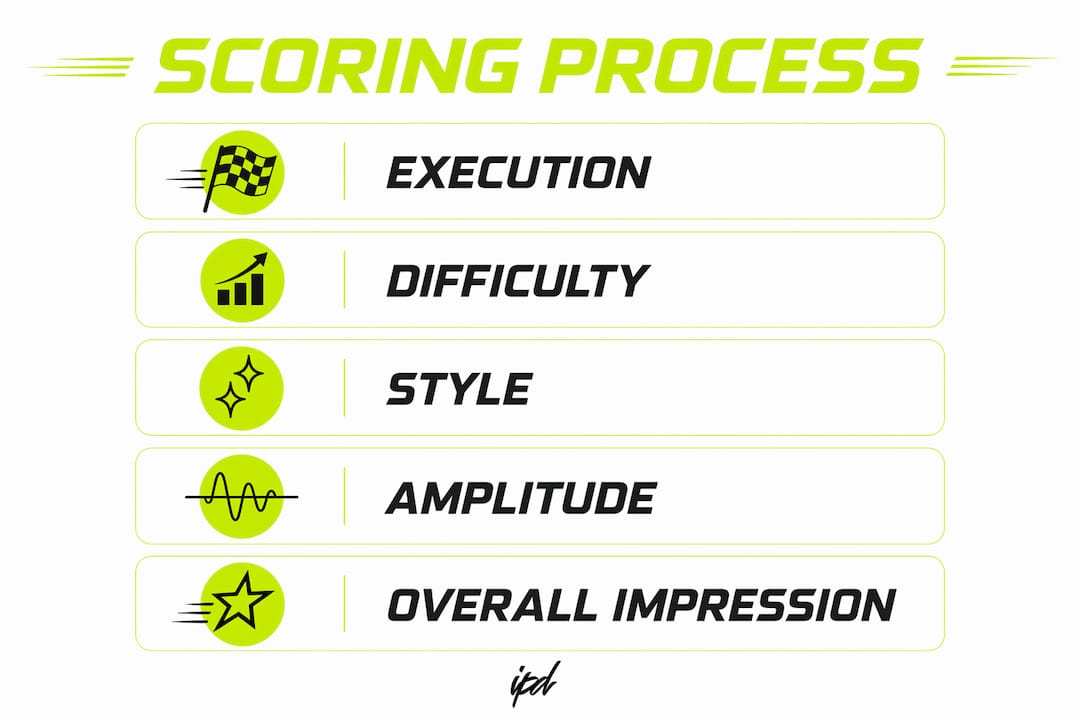
Freestyle events score runs on five distinct criteria, each carrying real weight in the final result. No single element dominates. Judges balance all five to produce a score that reflects the full quality of a run.
The five criteria work as follows:
- Execution: Clean landings, controlled body position, and smooth throttle management define execution quality. A trick landed with wobble or a rough water entry costs points even if the difficulty rating is high.
- Difficulty: Trick complexity, rotation degrees, and the number of combined maneuvers determine difficulty. Execution quality multiplied by trick difficulty is the core formula judges use to rank performances.
- Style: Fluidity between tricks, body posture, and creative sequencing all factor into style. Two riders can land the same trick, and the one with cleaner body lines scores higher.
- Amplitude: Height off the water and distance traveled during aerials directly affect amplitude scores. Bigger air with controlled landings signals both skill and confidence.
- Overall impression: This criterion captures the run as a whole. A well-structured run with varied tricks, strong combos, and consistent energy scores higher than a run with one standout moment surrounded by filler.
Combos carry extra weight in the overall impression category. Linking two or three tricks in sequence without a reset demonstrates control and planning. Judges notice when a rider builds momentum through a run rather than treating each trick as a standalone event.
Pro Tip: Plan your run as a story with a beginning, middle, and climax. Judges respond to runs that build in intensity, not runs that peak early and fade.
How are freestyle jet ski runs scored and tabulated?
The scoring process follows a structured panel system designed to remove bias and reward consistency. Judges use scoring scales typically ranging from 0–100, with each judge scoring independently before scores are combined.
The standard tabulation method works like this:
- A panel of judges watches the full run without conferring with each other.
- Each judge assigns a score based on the five criteria.
- The highest and lowest scores from the panel are dropped. Six-judge panels drop the top and bottom scores and average the remaining four.
- The averaged middle scores produce the final run score.
- In multi-run formats, the best single run score typically counts as the competitor’s final result.
This drop-and-average method protects competitors from one outlier judge skewing the result in either direction. It also reduces the impact of a judge who may have missed a moment in the run.
Here is how jet ski freestyle scoring compares to scoring methods in related freestyle sports:
| Sport | Panel size | Score range | Drop method |
|---|---|---|---|
| Jet ski freestyle | Typically 3–5 judges | 0–100 | High and low dropped |
| Freestyle skiing (Olympic) | 6 judges | 0–100 | High and low dropped |
| Wakeboarding | 5 judges | 0–100 | High and low dropped |
The parallel with freestyle skiing is direct. All three sports use subjective panel scoring with the same drop method to protect fairness. Jet ski freestyle judging criteria align closely with these established freestyle sport standards, which gives the system credibility and consistency across events.
Pro Tip: Watch your replay footage with the scoring criteria in mind. Score your own run before you see the judges’ result. The gap between your self-assessment and the official score tells you exactly where your blind spots are.
What are the 2026 IJSBA rule updates affecting scoring?
The IJSBA released its 2026 rulebook with targeted changes that directly affect how competitors approach freestyle events. The most significant update for competitive riders is the 185 psi compression limit for the Ski Lites class, effective at the 2026 World Finals. This rule keeps the class skill-focused and prevents expensive engine builds from deciding outcomes.
Key 2026 updates competitors need to know:
- Ski Lites compression cap: The 185 psi limit reduces the power advantage of heavily modified engines. Riders who relied on raw horsepower to generate amplitude now need to develop better technique to maintain their scores.
- Engine displacement ranges: Riders use 4-stroke engines from 1,000cc for agility to 1,600cc for powerful aerials. The 2026 rules push competitors toward the lower end of that range in restricted classes.
- Equipment eligibility checks: Sanctioning bodies conduct pre-event tech inspections. Non-compliant equipment results in disqualification, not just a score penalty.
- Rulebook review requirement: IJSBA updates rules annually. Competitors who skip the rulebook review risk running illegal setups without knowing it.
The compression limit has a direct scoring implication. Riders who previously generated big amplitude through engine power now need to generate it through technique, specifically through better approach angles and throttle timing. That shift actually rewards the judging criteria more accurately. Amplitude earned through skill scores better than amplitude earned through horsepower alone. Reviewing the 2026 competitor guide before your first event is a practical first step.
How can competitors maximize their freestyle scores?
Score improvement starts with fundamentals, not with learning new tricks. Rushing into complex tricks without mastering speed and water reading produces lower scores and risks equipment damage. Judges see sloppy technique immediately, and it costs points across multiple criteria simultaneously.
Practical steps to raise your scores:
- Master throttle control first. Top performers treat the jet ski as an extension of their body, using subtle weight shifts rather than jerky power bursts. Smooth throttle modulation improves execution scores on every trick in your run.
- Read the water before your run. Competitors use polarized sunglasses to read water texture and anticipate wake angles. Better water reading improves jump height and landing stability, which directly affects amplitude and execution scores.
- Select tricks strategically. Build your run around two or three high-difficulty tricks you can land cleanly, then fill the rest with well-executed mid-difficulty moves. A clean mid-difficulty trick scores better than a crashed high-difficulty attempt.
- Tune your equipment for the run, not for the spec sheet. Nozzle modifications and surf fin adjustments change how the craft responds during tricks. Equipment that matches your riding style improves control scores.
- Avoid common scoring mistakes. Repeating the same trick twice, losing amplitude in the second half of your run, and failing to link combos all reduce your overall impression score.
Pro Tip: Film every practice session from the judge’s viewing angle, not from the water level. Judges see your run from the shore or a raised platform. What looks big from water level may look flat from that angle.
Experienced competitors balance technical difficulty with style to maximize overall impression scores rather than chasing raw difficulty alone. A run with a 9/10 difficulty score and a 6/10 execution score loses to a run with a 7/10 difficulty score and a 9/10 execution score in most scoring systems. Clean beats complex every time when the margin is that wide.
Key Takeaways
Jet ski freestyle competition scoring rewards riders who combine clean execution, strategic trick selection, and strong overall impression across a structured five-criteria judging system.
| Point | Details |
|---|---|
| Five core judging criteria | Execution, difficulty, style, amplitude, and overall impression all carry weight in the final score. |
| Panel drop-and-average method | High and low scores are dropped; the remaining scores are averaged to produce a fair result. |
| 2026 IJSBA compression rule | The 185 psi Ski Lites limit shifts the scoring advantage toward technique over raw engine power. |
| Clean execution beats raw difficulty | A well-executed mid-difficulty trick scores higher than a crashed high-difficulty attempt. |
| Equipment tuning affects scores | Nozzle and fin modifications that match your riding style directly improve control and execution scores. |
Why scoring trends favor the technical rider now
Watching freestyle competition evolve over the past several years, one shift stands out clearly. Judges are rewarding technical precision more consistently than they reward spectacle alone. Riders who build runs around clean combos and controlled amplitude are outscoring riders who attempt maximum difficulty with inconsistent landings. That is not a subjective observation. It shows up in the scoring math when you track results across multiple IJSBA events.
The 2026 compression rule reinforces this trend. When engine power is capped, the gap between riders narrows on raw amplitude. What separates scores at that point is execution and style, the two criteria that reflect pure riding skill. Competitors who have been training technique alongside trick difficulty are positioned well for this environment.
The practical advice I give to any competitor reviewing their scores is this: look at your execution marks first, not your difficulty marks. Most riders who plateau in scoring are not running out of tricks to learn. They are running tricks they have not fully mastered yet. Fix the execution floor on your current trick list before adding anything new. Your overall impression score will climb faster than you expect.
— Casey
IPD Racing has the parts to back your freestyle build
Competing at the top level of freestyle requires more than technique. The right equipment setup makes a measurable difference in how your craft responds during tricks, combos, and landings.
IPD Racing carries performance parts and freestyle-specific accessories built for competitors who take their scoring seriously. From performance parts and accessories across all major PWC brands to specialized components for freestyle builds, the IPD Racing shop covers the full range of competitive needs. Whether you are setting up a new craft or refining an existing build for the 2026 season, IPD Racing has the inventory and the technical knowledge to support your setup. Visit the shop and find the components that match your class and riding style.
FAQ
What criteria do judges use in freestyle jet ski competitions?
Judges evaluate execution, trick difficulty, style, amplitude, and overall impression. Each criterion contributes to the final score, with execution and overall impression carrying significant weight.
How are jet ski freestyle scores calculated?
A panel of judges scores each run on a 0–100 scale. The highest and lowest scores are dropped, and the remaining scores are averaged to produce the final result.
What is the IJSBA 2026 compression rule for freestyle?
The IJSBA set a 185 psi compression limit for the Ski Lites class, effective at the 2026 World Finals. The rule is designed to keep competition focused on rider skill rather than engine modifications.
Does trick difficulty always produce a higher score?
No. Execution quality multiplied by trick difficulty determines scoring impact. A crashed high-difficulty trick scores lower than a cleanly landed mid-difficulty trick in most judging systems.
How does equipment setup affect freestyle scoring?
Equipment tuning, including nozzle modifications and surf fin adjustments, changes how the craft handles during tricks. A setup matched to your riding style improves control and directly supports higher execution scores.

