
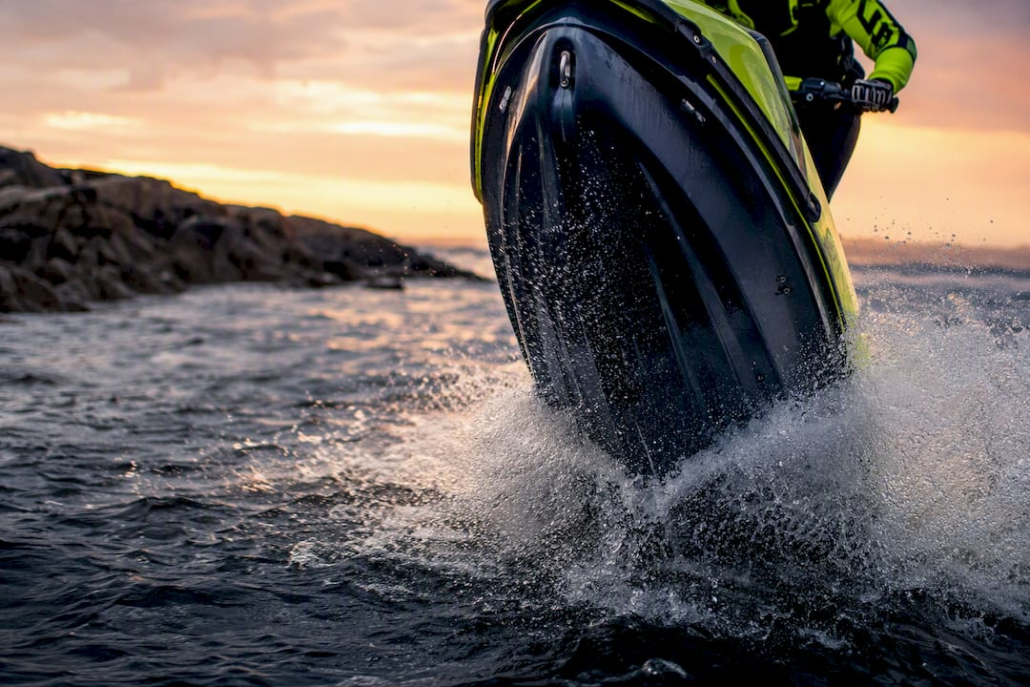
Why Jet Ski Nose Rocker Matters for Freestyle Tricks
Nose rocker matters for freestyle because it increases the hull’s leverage to lift the bow and cuts the resistance a ski fights when rotating into a flip or barrel roll. More rocker means faster pop, quicker rotation initiation, and more forgiving airtime on aerial tricks. The trade-off is real: aggressive rocker sacrifices top speed and high-speed tracking, since less hull stays in contact with the water at a given trim angle.
- More rocker: easier pop, faster rotation, better trick initiation
- More rocker: less top speed, more sensitivity in rough water
- Less rocker: flatter, faster, more stable, but harder to snap into rotation
At IPD Racing, Casey has spent years tuning hulls for riders chasing consistent flips instead of raw speed, and that field experience shapes every recommendation below.
Key Takeaways
Nose rocker increases nose lift and reduces rotation resistance, giving freestyle riders faster pop and easier flip initiation at the cost of top-speed stability.
| Point | Details |
|---|---|
| Rocker drives trick initiation | More bow curve means less wetted surface and easier nose lift for pops and flips. |
| Trade-off is real | Aggressive rocker reduces high-speed stability and top-end tracking. |
| Pair rocker with hull mods | Transom chops and sponsons work together with rocker to keep the hull controllable. |
| Test incrementally | Change one variable at a time and log rotation speed, pop height, and landing stability. |
| Match parts to your setup | IPD Racing’s sponson and handling parts support each stage of the tuning sequence. |
Table of Contents
- How Nose Rocker Changes Pop, Rotation, and Wetted Surface
- How Do Sponsons and Transom Length Interact With Rocker?
- How To Tune Rocker Safely and Test Incrementally
- Riding Technique for High-Rocker Hulls
- Quick In-Water Test: Did Your Rocker Change Work?
- A Freestyle Tuner’s Take on Getting Rocker Right
- IPD Racing Parts That Support Your Rocker Tuning
- Sources
How Nose Rocker Changes Pop, Rotation, and Wetted Surface
Rocker profile describes the curve of the hull bottom from bow to stern, measured as how much the nose lifts relative to a flat baseline. Wetted surface is simply how much of that hull bottom stays in contact with the water while you’re riding. The two are connected: increase the rocker curve, and you reduce wetted surface at the bow, which changes how the ski responds to throttle and body weight.
Think of the hull as a lever; for more details on how hull behavior affects performance in waves, see our explanation of yacht sea keeping ability. A pronounced rocker gives you more leverage to lift the nose because less bow surface is fighting water resistance. That’s why a more pronounced rocker increases maneuverability and pop for tricks, while flatter hull sections trade that agility for straight-line speed and stability. You feel this the moment you chop the throttle into a flip attempt: a high-rocker hull answers almost immediately, while a flat-bottomed recreational hull needs more input to break free.
- Reduced wetted surface lowers drag but also reduces low-speed grip
- Aggressive rocker can push more spray and air into the pump inlet during aerated white water
- Cavitation risk rises when the intake grate sits shallower relative to the water surface after a rocker increase
That last point catches a lot of riders off guard. Increase rocker without adjusting intake positioning, and you can starve the pump of clean water mid-trick, right when you need consistent thrust to complete a rotation. IPD Racing’s guide on how PWC hull rocker affects performance breaks down that pump-timing relationship in more detail.
How Do Sponsons and Transom Length Interact With Rocker?
Nobody who rides freestyle seriously changes rocker in isolation. Rocker works as part of a system, and the hull mods around it decide whether that added lift turns into clean tricks or an unpredictable ride.
Shortening the transom, often called a rear chop, is the most common companion mod. Cutting 2 to 4 inches off the tail reduces the length of hull dragging behind the pivot point, which amplifies the nose-up tendency rocker already creates. Freestyle-specific hulls commonly run shorter than stock recreational skis specifically to pair with aggressive rocker profiles, and that combination is what lets lower-horsepower setups still pull off flips.
Sponsons and bondline shaping do the opposite job: they claw back the stability that rocker gives up. A wider bondline and tapered front sponsons help the hull hook into a wave face instead of skipping off it. One detailed rider account describes shortening a hull by 2 to 4 inches and adding prototype front sponsons to improve carving, stability, and backflip initiation over a stock layout.
- Rear chop amplifies rocker’s nose-up effect but shortens the pivot arm
- Front sponsons restore edge grip lost to reduced wetted surface
- Bondline tapering that follows the rocker curve helps prevent pearling on landing
Pro Tip: Change one variable at a time. If you chop the transom and add sponsons in the same session, you won’t know which mod actually fixed (or broke) your rotation.
How To Tune Rocker Safely and Test Incrementally
Changing rocker on an existing hull, or swapping to a high-rocker platform, works best as a staged process rather than a single overhaul.
Before you touch anything:
- Measure your current rocker line, transom length, and sponson angle, and write them down.
- Gather basic tools: angle gauge, tape measure, and a notebook or phone for logging runs.
- Confirm you have a spotter, a PFD, and calm, open water with no swimmers nearby.
Tuning sequence:
- Start with low-impact changes: steering throw and nozzle adjustments, which community build guides recommend before touching the hull.
- Test on flat water and log rotation speed and pop height.
- Make a small sponson adjustment, retest, and log results before moving on.
- Only then consider a transom chop or rocker-focused hull swap, testing after each change.
| Test Variable | What To Log |
|---|---|
| Pop height | Estimated feet of air on a consistent throttle chop |
| Rotation speed | Time to complete a backflip rotation |
| Landing stability | Clean vs. bow-first vs. porpoise on touchdown |
| Water conditions | Chop height and wind at time of test |
Log every run the same way, in the same conditions where possible, so you’re comparing tuning changes and not just comparing a calm day to a choppy one.
Riding Technique for High-Rocker Hulls
A high-rocker hull rewards different technique than the ski you grew up riding. Weight placement matters most at initiation. Move your weight rearward earlier than feels natural, since the reduced wetted surface at the bow means the nose comes up faster than a flatter hull ever would.
Throttle timing shifts too. A quick chop that worked on a stock hull can now over-rotate you on a high-rocker setup, so shorten the throttle input and focus on a cleaner, more decisive cut instead of a longer pull.
- Shift weight rearward slightly before you’d normally initiate on a flatter hull
- Shorten throttle chop duration to avoid over-rotation
- Choose wave bases with a defined face rather than mushy chop, since high-rocker hulls need something to push against
- Watch your approach speed. Too fast into a steep face can launch you higher than you planned
Casey’s notes on freestyle trick initiation and body position and balance drills walk through these adjustments with specific drills for riders making the switch from a recreational hull to a rocker-heavy freestyle setup.
Quick In-Water Test: Did Your Rocker Change Work?
Run this test in calm water before you take a new rocker setup anywhere near a wave ramp.
- Idle test: does the ski sit level, or does the bow float unnaturally high?
- Planing check: how quickly does it come onto plane, and does the bow chatter?
- Turning check: does it carve predictably or does the stern break loose early?
- Hop initiation: attempt a small hop and note how easily the nose lifts.
- Landing check: land it and watch whether the bow settles clean or dives.
Red flags that mean undo or refine the change: porpoising at cruising speed, an uncontrolled nose-dive on landing, or a stern that steps out under light turning. Small fixes usually solve these: adjust trim, tweak sponson angle a degree or two, or shift rider weight slightly rearward before retesting.
Pro Tip: If the ski porpoises at idle but rides fine once it’s on plane, the fix is almost always sponson angle, not rocker.
A Freestyle Tuner’s Take on Getting Rocker Right
I’ve watched riders chase a bigger flip by adding rocker and nothing else, then wonder why the ski suddenly feels twitchy at speed. Rocker without a matching transom or sponson change is half a mod. One session I remember involved a rider convinced his ski needed “more rocker” when the real issue was pump cavitation from a shallow intake grate after a hull swap. The fix wasn’t rocker at all.

Test one variable at a time, in calm water, with a spotter. Freestyle rewards patience in the garage more than it rewards guessing on the water.
IPD Racing Parts That Support Your Rocker Tuning
Once you know which direction your rocker tuning needs to go, the right hardware makes the difference between a guess and a repeatable setup. IPD Racing carries the handling and sponson upgrades that pair with a rocker change, along with hull components sized for the transom and bondline adjustments covered above.
If your tuning log points to a pump or intake issue after a rocker increase, IPD Racing’s performance parts catalog covers the handling hardware, sponsons, and hull upgrades that map directly to each stage of the testing sequence, from small sponson tweaks to a full transom chop. Browse by platform on the shop by model page to find parts fitted to your specific hull, and start your next tuning pass with hardware built for the job instead of a generic substitute.
Sources
- Freestyle Factory to begin production on backflip jet ski hull — IJSBA
- Mark Gomez’s Kommander Matrix freeride/freestyle ski — The Watercraft Journal
- How does the shape of a Jet Ski hull impact performance? — JetSkisParts Blog

