

Jet Ski Race Prep Checklist for Competitors
A jet ski race prep checklist is a systematic set of mechanical inspections, safety verifications, and rider readiness steps designed to put both machine and rider at peak performance on race day. Competitive PWC racing demands more than raw speed. A missed kill cord test or a skipped oil check can end your race before the starting horn sounds. This guide covers every critical step, from hull inspection to ECU tuning priorities, and includes a dedicated section on freestyle and backflip preparation for riders competing in stunt-based events. Whether you race a Yamaha SuperJet, a Sea-Doo RXP-X, or a stand-up freestyle craft, this checklist applies directly to your pre-race routine.
What does a complete jet ski race prep checklist include?
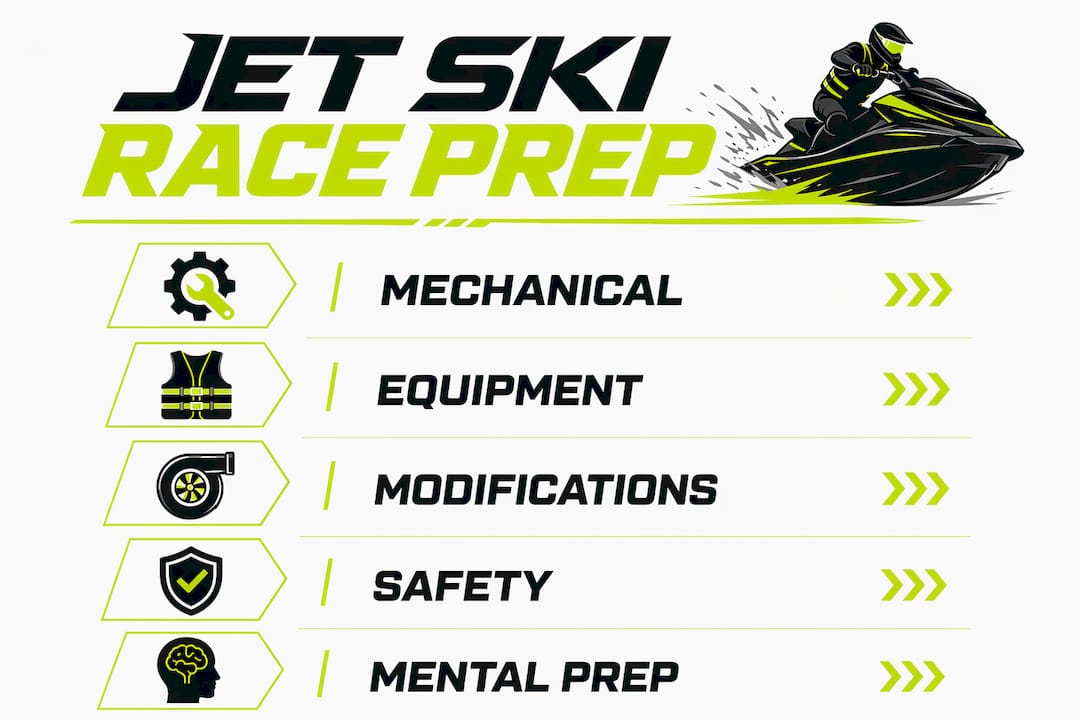
A complete race day checklist for jet skiing covers three categories: mechanical readiness, rider equipment, and performance tuning. Skipping any one of these categories creates a gap that race conditions will expose. Jet Gang Watersports recommends a minimum five-minute pre-launch checklist covering fuel, kill cord, and hull inspection as a baseline standard for all competitive riders. Five minutes is a small investment against a mechanical DNF or a safety incident on the water.
Mechanical checks: the non-negotiables
Start with fuel. The minimum half-tank rule exists because race conditions burn fuel faster than recreational riding. Verify the level visually, not just by gauge. Next, check oil and coolant levels and look at the oil itself. Milky engine oil signals water intrusion and requires professional service before the craft goes anywhere near a race course. A strong gasoline smell in the engine bay is a fire hazard, full stop.
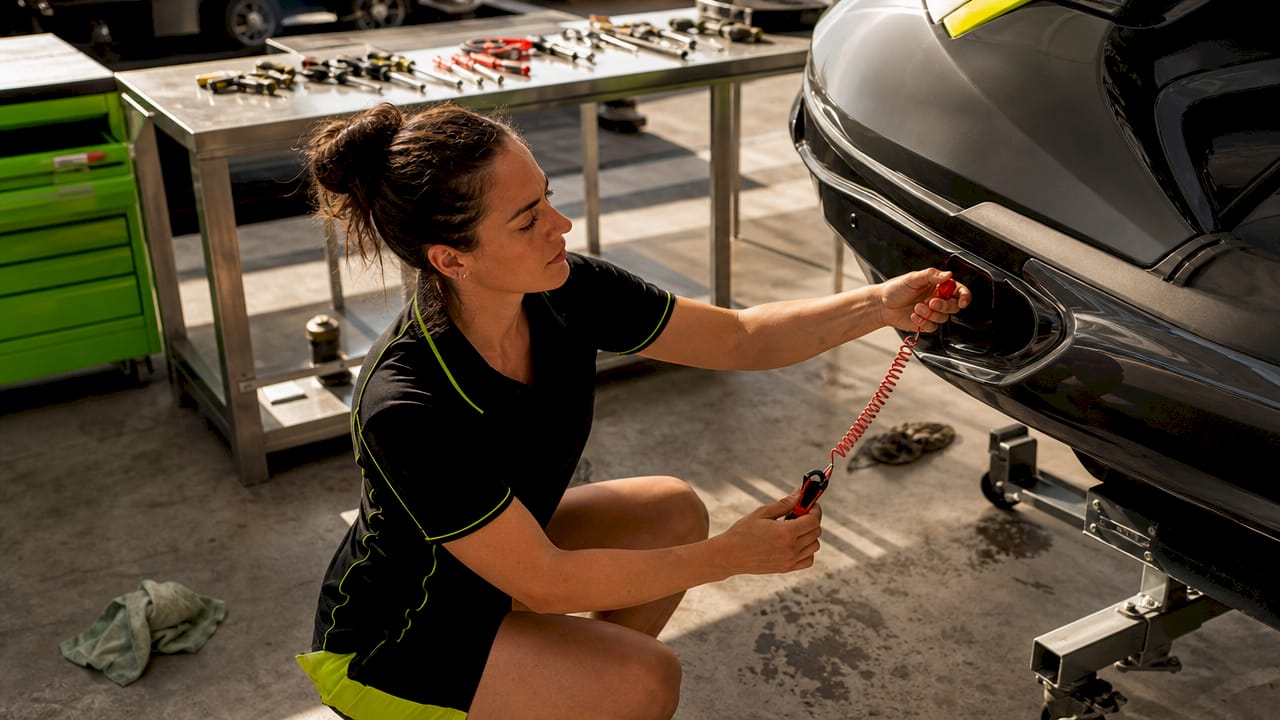
Hull and intake grate inspection comes next. Run your hand along the hull for cracks, and clear the intake grate of any debris. A clogged grate causes cavitation under load, which costs you throttle response exactly when you need it most.
| Mechanical Check | Race-Day Importance |
|---|---|
| Kill cord physical pull test | Prevents runaway craft; required before every launch |
| Fuel level (minimum half-tank) | Prevents fuel starvation during extended race heats |
| Oil appearance (no milky color) | Detects water intrusion before engine damage occurs |
| Hull and intake grate inspection | Eliminates cavitation and structural failure risk |
| Coolant level verification | Prevents overheating under sustained race throttle |
Pro Tip: Pro racers run this mechanical check sequence in the same order every single time. Consistent order prevents skipped steps under pre-race pressure.
What rider equipment is mandatory for jet ski races?
Pre-race preparation for jet ski competition requires Coast Guard-approved personal flotation devices, properly fitted helmets, and back braces as the core safety layer. Mandatory gear includes PFDs with correct fit, helmets certified for water sport impact resistance, and back braces for spinal protection during high-speed falls. A PFD that fits loosely will ride up on impact and fail to protect you. Check the fit before you get on the water, not at the dock.
Helmet selection matters more than most riders acknowledge. Not every helmet rated for motorsports is rated for water impact. Look for helmets specifically certified for PWC or water sport use. Impact vests worn over or under the PFD add a secondary layer of torso protection that standard life jackets do not provide.
Here is the complete must-have gear list for race day:
- Coast Guard-approved PFD, correctly fitted and fastened
- Water sport-certified helmet with face protection
- Back brace or impact vest for spinal and torso protection
- Wetsuit or rash guard appropriate for water temperature
- Closed-toe water sport footwear with grip soles
- Kill cord attached to wrist or PFD at all times
- Goggles or visor for eye protection at speed
Communication protocols are a separate but equally critical part of rider readiness. Formal hand signals agreed before launch help maintain safety and coordinated group riding during races. Signals for hazard, slow down, and stop should be confirmed with every rider in your group before the race starts. A pre-race float plan that identifies emergency contact information and a designated shore contact is standard practice among experienced competitors.
Pro Tip: Write your float plan on a waterproof card and leave it with your shore contact. If you do not return within the planned window, they know exactly who to call.
How should racers approach jet ski modifications for competition?
The correct modification sequence for jet ski racing equipment follows a strict priority order: handling upgrades first, pump and seal kits second, and power modifications last. Handling upgrades such as intake grates and sponsons should be prioritized before power modifications for better race control. Adding power to a craft with poor handling increases rider fatigue and lap times. Control comes before speed.
Intake grates, sponsons, and ride plates address cornering grip and acceleration traction. These parts are the foundation of a competitive setup. Once handling is dialed in, pump and seal kits reduce cavitation and deliver consistent throttle response through the entire power band. Only after both layers are in place does it make sense to pursue ECU tuning or free-flow exhaust systems.
| Modification Goal | Best Accessory Choice |
|---|---|
| Cornering grip and traction | Intake grates, sponsons, ride plates |
| Consistent throttle response | Pump and seal kits |
| Reduced cavitation under load | Impeller upgrades and wear ring kits |
| Power output increase | ECU tuning, free-flow exhaust systems |
| Freestyle leverage and control | Extended handlebars (2 to 4 inches) |
Extended handlebars of 2 to 4 inches are standard in freestyle competition to gain control leverage for aerial maneuvers. For closed-course racing, handlebar width affects body positioning through tight turns. Match your handlebar setup to your specific race format, not a generic recommendation. Riders competing on 4-stroke SuperJet platforms will find that handling upgrades have an outsized effect on lap consistency compared to power mods alone.
Pro Tip: Test each modification layer separately before race day. Adding intake grates, sponsons, and a new impeller all at once makes it impossible to identify which change affected handling.
What preparations are specific to freestyle and backflip competition?
Freestyle jet ski competition, including backflip events, requires a separate preparation checklist that goes beyond standard race-day protocols. Effective backflip preparation includes progressive drills totaling 30 minutes daily before attempting full flips. Freestyle performance builds on technique and balance, not raw power. Riders who skip the progressive drill phase and attempt full flips too early face a significantly higher injury rate and greater equipment damage.
Freestyle jet skis often include reinforced hulls, extended handlebars, and custom exhaust systems as competition-specific modifications. These are not optional upgrades for serious freestyle competitors. A reinforced hull absorbs repeated impact from failed attempts without cracking. Custom exhaust tuning supports the throttle response needed for consistent ramp speed.
The jet ski backflip approach steps follow a specific sequence:
- Confirm impact vest, water sport helmet, eye protection, and secured footwear are in place before entering the water.
- Run 30 minutes of low-speed jump drills to calibrate ramp approach and body position.
- Establish consistent ramp entry speed before increasing throttle for full rotation attempts.
- Practice throttle cut timing at the apex of the jump to control rotation speed.
- Focus on body position: lean back at launch, tuck knees, and spot the water on the way down.
- Attempt full flips only after completing at least three consistent half-rotation practice runs.
- Have a spotter or safety boat positioned and visible before every full flip attempt.
Freestyle flips often require 10 or more attempts with associated physical risk and mechanical damage. Preparation includes impact mitigation gear and a recovery plan for both rider and craft. Riders competing in freestyle nozzle modifications events should verify that all nozzle and steering components are torqued to spec before each session, since repeated impact loosens hardware faster than standard riding.
Pro Tip: Film every practice session from the side. Video review reveals body position errors that are impossible to feel in real time, and it tracks your progression accurately.
Key takeaways
A complete jet ski race prep checklist covers mechanical inspection, certified rider gear, a handling-first modification sequence, and sport-specific freestyle protocols to maximize both safety and performance.
| Point | Details |
|---|---|
| Mechanical checks are non-negotiable | Kill cord testing, oil inspection, and hull checks prevent race-ending failures. |
| Rider gear must be certified | Coast Guard-approved PFDs, water sport helmets, and back braces are mandatory minimums. |
| Modifications follow a strict order | Handling upgrades before pump kits before power mods reduces fatigue and improves control. |
| Freestyle prep requires progressive drills | 30 minutes of daily low-speed practice before full flip attempts reduces injury risk significantly. |
| Communication protocols save lives | Pre-agreed hand signals and a float plan are standard practice for competitive group riding. |
Why race prep discipline separates finishers from DNFs
I have watched riders with faster machines lose races because they skipped the basics. A kill cord that was never pull-tested. An intake grate packed with weeds from the launch ramp. These are not bad luck. They are preparation failures that a five-minute checklist would have caught.
The modification sequence is where I see the most consistent mistakes among newer competitors. Riders add a big-bore kit or a performance exhaust before they have addressed handling, and then they wonder why their lap times are not improving. Power without control costs you more time than it saves. I have seen this play out at watercross events repeatedly. The riders who run R&D Racing handling components before touching their power setup consistently outperform riders with more horsepower and less grip.
Mental preparation gets underestimated at every level below the pro circuit. A float plan is not bureaucratic overhead. It is the difference between a recoverable incident and a tragedy. Agree on hand signals with every rider in your group before you launch. No exceptions, regardless of experience level.
For freestyle competitors, the discipline required to stick to progressive drills when you want to attempt full flips is the hardest part of the preparation process. The 30-minute daily drill framework exists because it works. Riders who respect it progress faster and get hurt less. That is the data, and it matches what I have observed firsthand.
Develop your own checklist based on your craft, your race format, and your modification level. Then run it every single time without shortcuts.
— Casey
Get race-ready with Ipdracing
Ipdracing stocks the performance parts that make this checklist executable, from intake grates and sponsons to pump seal kits, ECU tuning components, and freestyle-specific hardware.
Whether you are building a closed-course race setup or preparing a freestyle craft for backflip competition, Ipdracing carries parts for Yamaha, Sea-Doo, and all major PWC platforms. The Ipdracing shop organizes inventory by category and model, so you can find the exact handling or power upgrade your build needs. Riders looking for curated performance alternatives can also check the top performance parts guide for 2026. Stock up before your next race and go to the line with confidence.
FAQ
What is the minimum pre-launch checklist for jet ski racing?
The minimum pre-launch checklist includes a physical kill cord pull test, fuel level verification at half-tank or above, oil and coolant inspection, and a hull and intake grate check. Jet Gang Watersports sets five minutes as the standard time for this routine.
What safety gear is required for competitive jet ski racing?
Required gear includes a Coast Guard-approved PFD, a water sport-certified helmet, a back brace or impact vest, and a kill cord attached to the rider at all times. Proper fit on all items is as important as the items themselves.
What is the correct order for jet ski performance modifications?
The correct sequence is handling upgrades first (intake grates, sponsons, ride plates), then pump and seal kits, then power modifications such as ECU tuning and exhaust systems. Adding power before handling control increases rider fatigue and reduces race performance.
How do you prepare specifically for jet ski backflip competition?
Backflip preparation requires 30 minutes of daily progressive drill practice on low-speed jumps before attempting full rotations. Mandatory gear includes an impact vest, water sport helmet, eye protection, and secured footwear, with a spotter or safety boat present for every full flip attempt.
How far apart should jet ski racers stay during a race?
Riders must maintain at least 200 feet of separation at 50 mph to prevent collisions during race conditions. Pre-agreed hand signals for hazard and slow-down situations provide an additional layer of collision prevention.

