
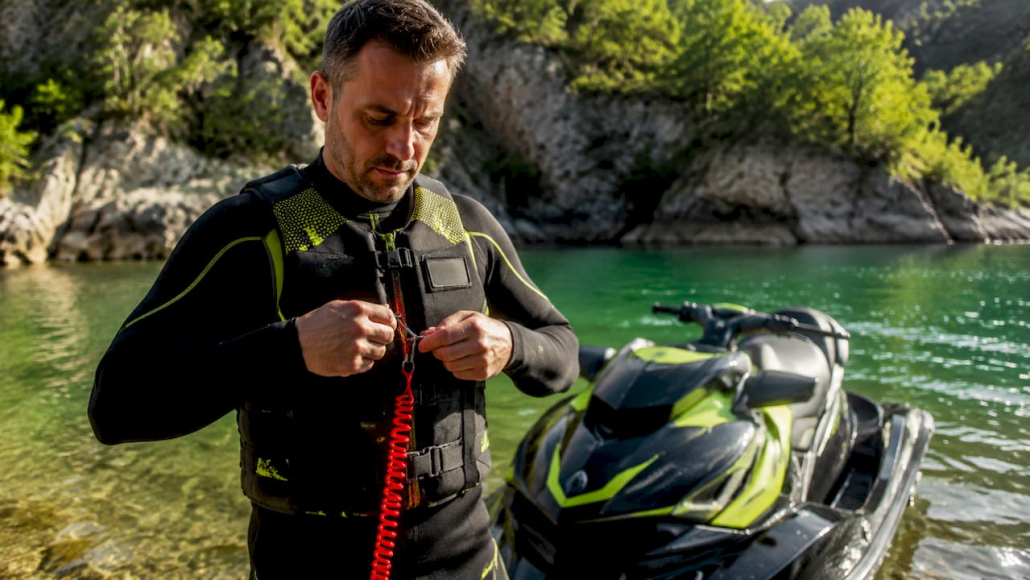
What Is a Jet Ski Safety Leash? Rider’s Guide
A jet ski safety leash, also called a kill switch lanyard, is a mandatory safety device that cuts the engine instantly when the operator is separated from the watercraft. Federal and industry standards require riders to clip the leash to their wrist or a U.S. Coast Guard-approved personal flotation device (PFD) any time the engine runs. Without it, an ejected rider faces a runaway machine with no one at the controls. Understanding how this device works, and how to use it correctly, is the foundation of responsible PWC operation.
What is a jet ski safety leash and how does it work?
A jet ski safety leash is defined as a short cord that connects the rider to the PWC’s kill switch, cutting engine power the moment the rider is thrown off. The industry term for this device is a kill switch lanyard or kill cord. Both terms refer to the same component, and you will see them used interchangeably across U.S. Coast Guard guidance and manufacturer documentation.
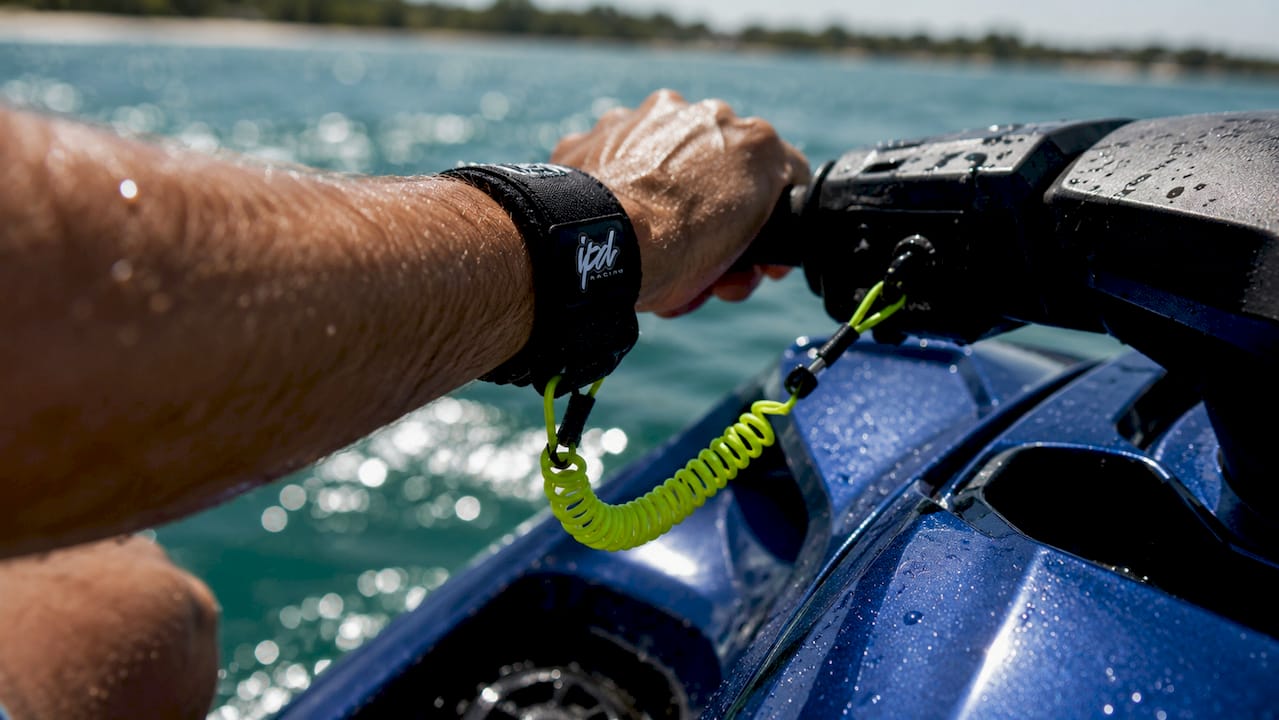
The kill switch operates through a simple electrical circuit. One end of the lanyard clips to a magnetic or mechanical plug seated in the kill switch housing on the handlebars. The other end attaches to the rider’s wrist or PFD. When the rider falls off, the cord pulls the plug free, breaking the circuit and cutting engine power immediately. The engine cannot restart until the plug is reinserted.
Electrical reliability depends entirely on the condition of the clip and plug. Corrosion or cracked plastic on the clip can cause the engine to cut out unexpectedly or prevent start-up altogether. That is why the kill cord is treated as a mechanical component, not just an accessory.
- Wrist attachment: A loop or cuff wraps around the wrist, keeping the cord within reach at all times.
- PFD attachment: The cord clips to a dedicated loop on a Coast Guard-approved life jacket, which is the preferred method for stand-up riding.
- Cord length: Long enough to allow normal riding movement, short enough to pull the plug on separation.
- Plug design: Magnetic plugs are common on newer models; older machines use a physical key-style insert.
Pro Tip: Before every ride, tug the lanyard gently while the engine idles to confirm the kill switch cuts power. This 10-second check confirms the circuit is live and the clip is seated correctly.
How to use a safety leash correctly
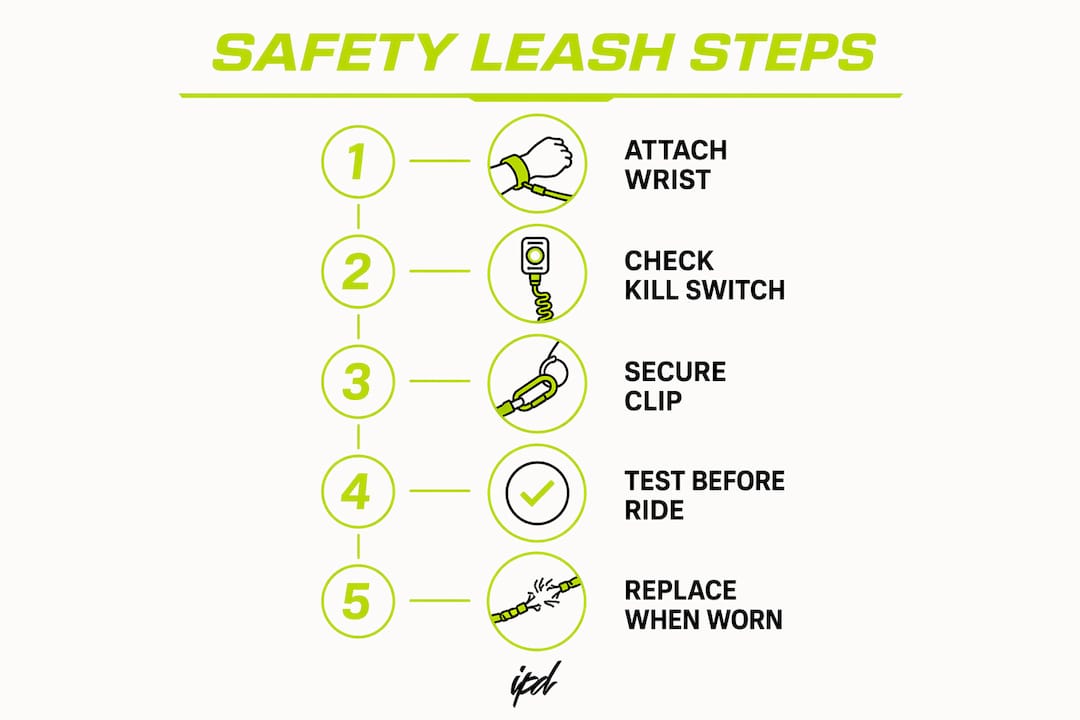
Correct use of a safety leash starts before the engine ever turns on. Clip the lanyard to your wrist or the dedicated loop on your PFD, then insert the plug into the kill switch housing. Confirm the clip is fully seated by giving it a firm press. Only then should you start the engine.
- Attach to wrist or PFD loop only. The leash attaches to the wrist or a PFD loop. Never attach it to clothing, a belt loop, or any point that could slip or tear free.
- Inspect the clip before riding. Check for cracks, corrosion, or a loose fit. A damaged clip is a failed safety device.
- Insert the plug fully. A half-seated plug can vibrate free during normal riding, triggering an unintended engine cut-off.
- Wear a properly fitted PFD. The dual safety system of a fitted Coast Guard-approved PFD combined with a kill cord is the gold standard for PWC safety. One device stops the machine; the other keeps you afloat.
- Never hand the leash to a passenger. The leash must stay on the operator. If the operator is ejected, the engine must stop regardless of what a passenger does.
- Re-attach after every remount. Riders who fall and reboard often forget to reattach the leash before restarting. Make it a habit every single time.
Pro Tip: If your PFD has a dedicated lanyard loop, use it instead of your wrist. The loop is positioned to pull the plug cleanly on ejection without the cord wrapping around your arm.
The importance of safety leash use goes beyond personal protection. A runaway jet ski traveling at speed can injure other riders, swimmers, or boaters in the area. Stopping the engine on ejection protects everyone on the water, not just the operator.
Why ankle attachment is dangerous
Attaching a jet ski leash to the ankle is a practice that causes severe injuries and contradicts every professional safety standard in the industry. The ankle is the wrong attachment point for two specific mechanical reasons.
First, when a rider is ejected at speed, the jet ski continues moving. An ankle-attached cord can wrap tightly around the leg as the machine spins or drifts, creating a tourniquet effect. Second, if the rider enters the water headfirst, an ankle tie can hold the foot near the surface while the body is pulled under. Both scenarios create drowning risk that wrist or PFD attachment does not.
| Attachment point | Engine cut-off | Entanglement risk | Recommended |
|---|---|---|---|
| Wrist | Yes | Low | Yes |
| PFD loop | Yes | Very low | Yes (preferred) |
| Ankle | Yes | High | No |
| Belt loop or clothing | Unreliable | Moderate | No |
Professional safety standards consistently identify ankle attachment as a complex entanglement hazard. The wrist and PFD loop are the only two attachment points that allow the cord to pull free cleanly on ejection without trapping the rider.
How to care for and maintain your safety leash
A safety leash requires the same routine maintenance as any other mechanical component on your PWC. Neglecting it leads to premature failure at the worst possible moment.
- Rinse with fresh water after every saltwater ride. Saltwater and heat exposure degrade rubber and metal components faster than any other factor. A 30-second rinse removes salt crystals before they corrode the clip.
- Store in a cool, dry location. UV exposure and heat cause the cord to stiffen and crack. Keep the leash out of direct sunlight and away from engine heat when not in use.
- Inspect the clip and cord before each ride. Look for cracks in the plastic housing, corrosion on metal contacts, and fraying or stiffness in the cord itself.
- Replace at the first sign of damage. A cracked clip or a cord with visible wear is not a functional safety device. Replace the lanyard immediately rather than riding with a compromised component.
- Test the kill switch function regularly. Clip in, start the engine, then pull the plug to confirm the engine cuts. This test takes seconds and confirms the entire circuit is working.
PWC safety equipment requires the same maintenance discipline as engine components. A leash that looks intact can still fail if the internal contacts are corroded or the cord has lost flexibility. Treat it as a critical part, not a throwaway accessory. For a broader look at safety gear maintenance, the IPD Racing racing safety gear guide covers storage and inspection protocols across a full kit.
Best practices and additional safety tips
Safe jet ski operation depends on a system of habits, not a single device. The kill cord is the most critical component, but it works best as part of a complete safety protocol.
- Always wear a U.S. Coast Guard-approved PFD. Fit it snugly so it cannot ride up on impact with water. A loose PFD provides significantly less protection than one fitted correctly.
- Never start the engine without the leash attached. Operating without the leash removes the only automatic engine cut-off the machine has. There is no backup system.
- Use quick-release mechanisms when available. Quick-release leash systems detach instantly on ejection without creating drag or entanglement. They are particularly useful for stand-up freestyle riding where falls are frequent.
- Know your local regulations. Many states and waterways have specific PWC safety gear requirements beyond federal minimums. Check local rules before riding in unfamiliar areas.
- Keep safety gear compact and accessible. PWC storage space is limited. Organize gear so the leash and PFD are the first items you reach, not the last.
Pro Tip: Clip the leash to your PFD before you even board the PWC. Attaching it on the water while balancing is harder and increases the chance of skipping the step entirely.
For riders building out a complete watercraft accessories setup, pairing a reliable kill cord with a well-fitted PFD and a pre-ride checklist covers the core safety requirements for both recreational and competitive riding.
Key takeaways
A jet ski safety leash is the single most critical mechanical safety device on any PWC, and correct attachment to the wrist or PFD is non-negotiable for safe operation.
| Point | Details |
|---|---|
| Core function | The leash cuts engine power instantly when the rider is separated from the PWC. |
| Correct attachment | Attach only to the wrist or a PFD loop. Ankle attachment creates serious entanglement risk. |
| Pre-ride inspection | Check the clip and cord for cracks or corrosion before every single ride. |
| Maintenance routine | Rinse with fresh water after saltwater use and store away from heat and sunlight. |
| Dual safety system | Pair the kill cord with a fitted Coast Guard-approved PFD for complete ejection protection. |
The leash stops the machine, not the rider
Most riders who skip the leash do not think they are taking a risk. They assume they will stay on the machine, or that the leash is just a formality. That assumption is the exact problem.
The kill cord is the most misunderstood safety device on personal watercraft. Riders often treat it as a tether that keeps them connected to the ski. It does not. Its only job is to stop the engine the moment the rider is no longer in control. That distinction matters because it changes how you think about wearing it. You are not wearing it to stay attached. You are wearing it so a 300-pound machine does not keep running at 60 mph after you fall off.
I have seen experienced riders remount after a fall and restart the engine without reattaching the leash. They do it because the habit was never built correctly in the first place. The fix is simple: make reattachment a physical rule, not a judgment call. Every remount, every time, no exceptions.
The other misconception worth addressing is that a good swimmer does not need the leash. Swimming ability is irrelevant. A runaway jet ski circling back toward a rider in the water is a threat that no swimming skill addresses. The leash stops that scenario before it starts.
My recommendation is to treat the kill cord the same way you treat your PFD: non-negotiable, every ride, regardless of conditions or experience level. Riders who build that habit early never have to think about it. It just becomes part of how they ride.
— Casey
Gear up with IPD Racing

Reliable safety gear starts with quality components. IPD Racing carries performance parts and accessories built for PWC riders across recreational, racing, and freestyle disciplines. From kill switch lanyards to full performance upgrades, the catalog covers what riders need to stay safe and ride at their best. Whether you are outfitting a stand-up ski or a sit-down runabout, IPD Racing stocks parts tested in real competition conditions. Browse the full selection and find the components that match your machine and your riding style.
FAQ
What does a jet ski safety leash do?
A jet ski safety leash cuts the engine immediately when the rider is ejected or separated from the watercraft. It connects the operator to the kill switch, so the engine stops automatically without any manual action.
Where should a safety leash be attached?
The leash attaches to the operator’s wrist or a dedicated loop on a U.S. Coast Guard-approved PFD. Ankle attachment is not safe and contradicts professional safety standards due to entanglement risk.### Is a jet ski safety leash required by law?
Federal and industry standards require the leash to be clipped to the operator at all times while the engine runs. Many states also have specific PWC safety gear laws that reinforce this requirement.
How often should I replace my jet ski leash?
Replace the leash at the first sign of cracked plastic, corrosion on the clip, or fraying in the cord. Even a visually intact leash should be tested before every ride to confirm the kill switch circuit functions correctly.
Can a passenger wear the safety leash instead of the operator?
No. The leash must stay on the operator at all times. If the operator is ejected, the engine must stop regardless of what a passenger does. Transferring the leash to a passenger removes this protection entirely.

