

What Is a Sit-Down PWC? Features, Uses, and More
A sit-down PWC is a motorized watercraft where the rider operates the vessel from a seated position, typically carrying 2 to 3 passengers and powered by an inboard jet-drive engine. The industry term for this style is “runabout,” though most riders simply call them sit-down personal watercraft. Brands like Yamaha WaveRunner, Sea-Doo, and Kawasaki Jet Ski all produce sit-down models, which is why brand names often cause confusion when buyers try to identify the actual type of craft they want. Understanding the distinction between rider position and brand name is the first step toward choosing the right PWC for your needs.
What is a sit-down PWC and how does it work?
A sit-down PWC is defined by its seated riding position, wider hull, and inboard engine system. The rider straddles a padded seat mounted above the hull, similar to sitting on a motorcycle, with handlebars for steering directly in front. Sit-down models typically seat 2 to 3 people, and some larger runabout configurations accommodate up to 4 riders. That passenger capacity alone separates them from stand-up models, which are strictly single-rider craft.
The propulsion system is the core mechanical feature that defines how a sit-down PWC moves. Inboard engines drive a pump-jet or hydrojet system, drawing water through an intake grate on the hull bottom and expelling it at high pressure through a steerable nozzle at the stern. Turning the handlebars redirects that nozzle, which is how the craft steers. There are no external propellers, which makes the design safer around swimmers and in shallow water.
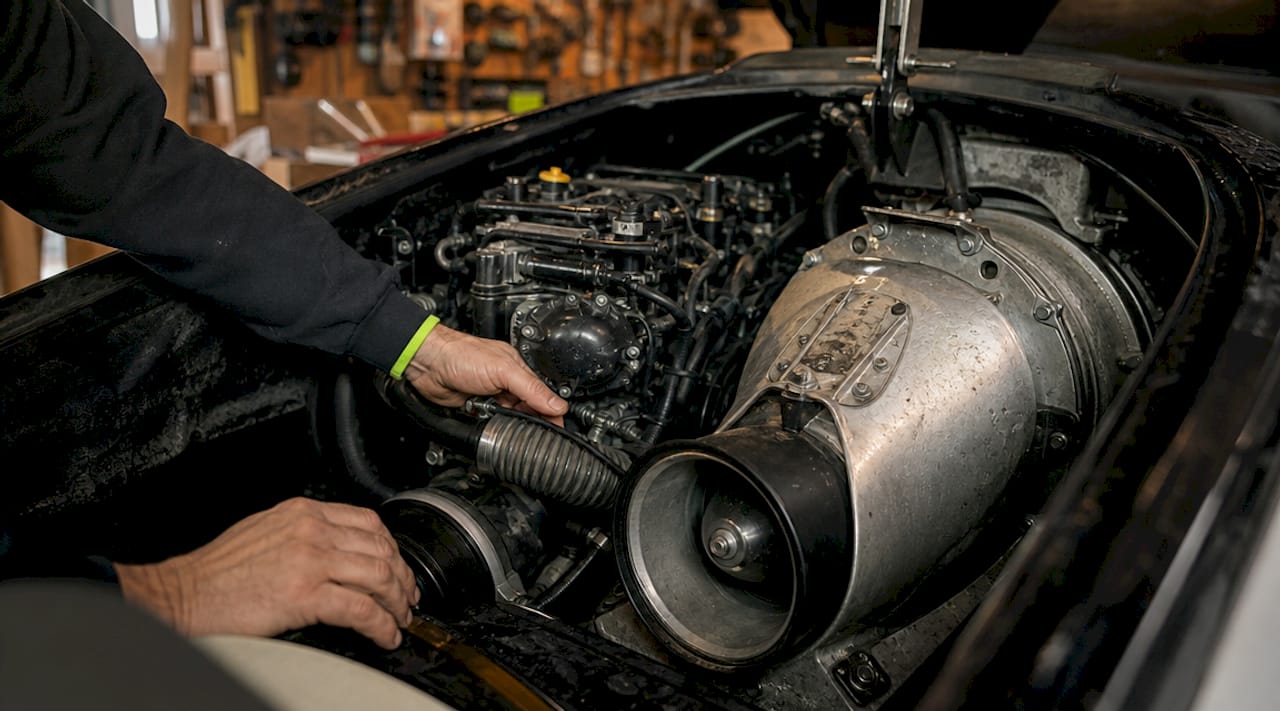
Engine size and hull design
Sit-down PWCs run larger 4-stroke engines with wider hulls built for stability rather than agility. Engine displacement on popular models ranges from roughly 900cc on entry-level units to over 1,800cc on performance-oriented runabouts. The wider hull lowers the center of gravity, which directly reduces the balance demands on the rider. That design choice is why sit-down models feel forgiving and predictable, especially for new riders.
Key design features of a sit-down PWC include:
- Padded multi-rider seating with ergonomic contouring for long-distance comfort
- Wide, stable hull with a deep-V or flat-bottom profile depending on intended use
- Extended swim platform at the stern for easy re-boarding after a swim
- Integrated storage compartments for gear, safety equipment, and personal items
- Tow hook or tow eye mounted at the stern for pulling water sports equipment
Pro Tip: When evaluating hull width on a sit-down PWC, wider is more stable but slightly less responsive in tight turns. If you plan to use the craft mostly for cruising or towing, prioritize hull width over agility.
What are the main uses and advantages of sit-down PWCs?
Sit-down PWCs are the most practical choice for recreational use, towing, and family outings on the water. Their stability and passenger capacity make them suitable for touring open water, lake cruising, and coastal exploration. A rider can cover long distances without the physical fatigue that comes with standing on a narrower craft. That comfort factor is a genuine advantage for anyone spending more than an hour on the water.
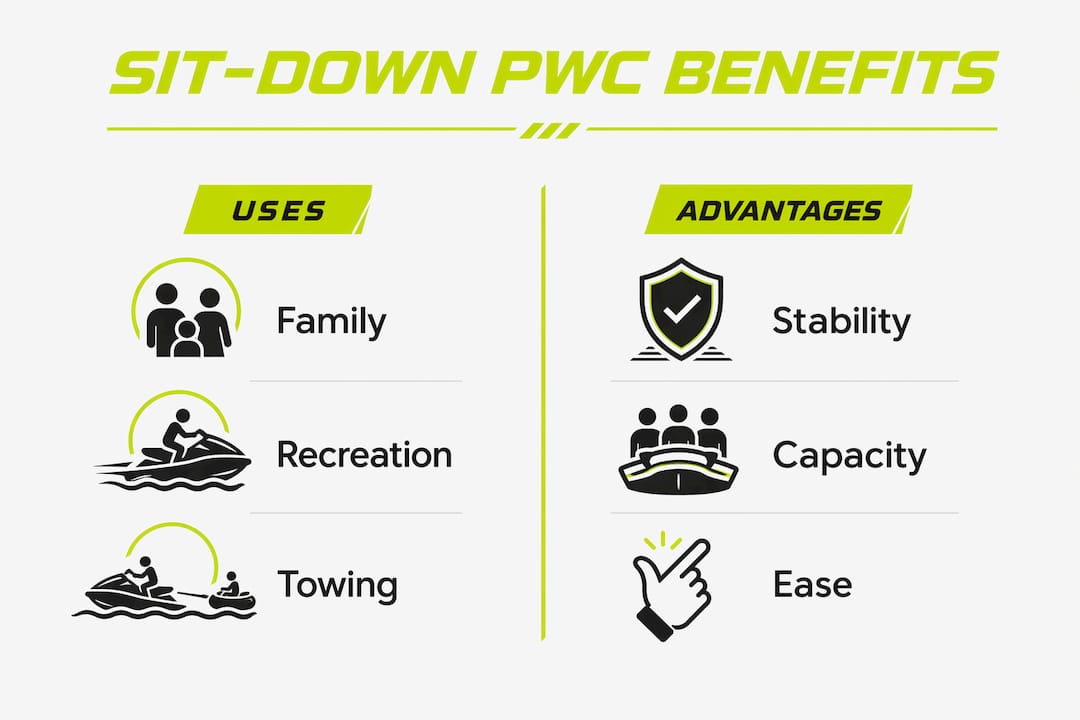
The towing capability of sit-down models sets them apart from virtually every other PWC type. Towing-ready features like extended swim platforms and dedicated tow hooks allow riders to pull wakeboarders, water-skiers, and towable tubes without any aftermarket modification. This versatility makes a single sit-down PWC a practical replacement for a small tow boat in many recreational settings.
Common practical uses for sit-down PWCs:
- Recreational cruising with one or two passengers across lakes, bays, and coastal waterways
- Towing water sports including wakeboarding, water skiing, and inflatable tubes
- Family outings where beginner riders or children ride as passengers
- Touring and exploration over longer distances where comfort matters
- Entry-level racing on closed-course circuits where runabout classes are offered
Pro Tip: Before towing a wakeboarder, confirm your sit-down PWC’s tow rating and engine output. Models below 110 horsepower may struggle to generate enough pull for adult riders at wakeboarding speeds.
The easier learning curve of a sit-down PWC also makes it the preferred choice for beginners. The seated position lowers the rider’s center of gravity, and the wider hull absorbs chop without requiring constant balance correction. Families with younger riders benefit from this stability, since a passenger can hold on to the rider rather than needing to manage their own balance independently.
How do sit-down PWCs compare with stand-up models?
The difference between sit-down and stand-up PWCs goes well beyond rider position. Stand-up models prioritize agility, tricks, and solo riding with narrower hulls and smaller engines, while sit-down runabouts focus on comfort, capacity, and towing. Choosing between them depends entirely on what you plan to do on the water.
Stand-up PWCs are the choice for freestyle competition and technical riding. They respond instantly to body weight shifts, which is what makes tricks possible but also what makes them physically demanding. Sit-down models do not offer that level of agility, but they compensate with stability, storage, and the ability to carry passengers. Performance goals should guide the choice between the two types, not brand preference or price alone.
| Feature | Sit-down PWC | Stand-up PWC |
|---|---|---|
| Rider position | Seated, motorcycle-style | Standing, balance-dependent |
| Passenger capacity | 2 to 4 riders | 1 rider only |
| Hull width | Wide, stable | Narrow, agile |
| Engine size | 900cc to 1,800cc+ (4-stroke) | Typically 800cc or less |
| Primary use | Cruising, towing, family recreation | Freestyle tricks, racing, solo riding |
| Learning curve | Beginner-friendly | Requires balance and skill |
| Towing capability | Yes, with tow hook and platform | Not designed for towing |
| Typical brands | Yamaha WaveRunner, Sea-Doo, Kawasaki Jet Ski | Kawasaki SX-R, Yamaha SuperJet |
The table above shows that neither type is objectively better. A rider focused on freestyle competition or stand-up racing will find a sit-down model too wide and too heavy for technical maneuvers. A family looking for a weekend on the lake will find a stand-up model impractical and physically exhausting. Matching the craft type to the actual use case is the decision that matters most.
What should you consider when choosing a sit-down PWC?
Choosing the right sit-down PWC starts with defining how many people will ride and what activities you plan to do. A two-person model with a 110-horsepower engine handles casual cruising well, but falls short if you regularly tow wakeboarders or carry three adults at speed. Larger runabout models with 180 to 300 horsepower provide the power margin needed for towing and performance riding.
Key factors to evaluate before purchasing:
- Passenger capacity: Confirm the rated capacity matches your typical group size, not just the maximum allowed
- Engine output: Higher horsepower directly improves towing performance and acceleration in choppy water
- Hull stability: Wider hulls handle rough water better; narrower sit-down models trade some stability for responsiveness
- Storage volume: Evaluate whether the onboard storage fits your gear, safety equipment, and personal items for a full day out
- Tow hook integration: Evaluating platform design for tow hook integration is critical if water sports towing is a priority
Pro Tip: Do not rely on brand names alone to identify a sit-down PWC. Confirming the seated riding position and passenger capacity is the most reliable way to verify you are buying the right type of craft, regardless of what the model is called.
Maintenance costs on sit-down models are generally higher than stand-ups due to larger engines and more complex hull systems. Budget for annual service intervals, impeller inspections, and hull maintenance. Models from Yamaha, Sea-Doo, and Kawasaki all have established dealer networks, which makes parts and service accessible. Checking parts availability for your specific model before purchase avoids frustration later.
One common misconception worth addressing: many buyers assume “Jet Ski” means any sit-down PWC. Jet Ski is a Kawasaki trademark. Sea-Doo belongs to BRP, and WaveRunner is Yamaha’s brand. Sit-down versus stand-up refers to rider position and model design, not brand ownership. Knowing this distinction helps you search for the right product and compare models across manufacturers without getting locked into one brand’s terminology.
Key takeaways
A sit-down PWC is the most practical and versatile personal watercraft type for recreational riders, families, and anyone who needs passenger capacity or towing capability.
| Point | Details |
|---|---|
| Definition and design | A sit-down PWC uses a seated riding position, wide hull, and inboard jet-drive engine for stability and capacity. |
| Passenger capacity | Most sit-down models carry 2 to 3 riders; some larger runabouts accommodate up to 4. |
| Primary advantages | Stability, beginner-friendly operation, towing capability, and multi-passenger comfort set sit-down models apart. |
| Stand-up comparison | Stand-up PWCs offer agility and trick potential but sacrifice capacity, comfort, and towing ability. |
| Buying guidance | Evaluate engine output, hull width, tow hook integration, and storage before purchasing any sit-down model. |
Why sit-down PWCs are the right starting point for most riders
I have spent years working with PWC enthusiasts across every skill level, from first-time buyers to competitive racers, and the question I hear most often is some version of “which type should I get?” My honest answer is almost always the same: start with a sit-down model unless you already know you want to compete in freestyle or stand-up racing.
The reason is simple. A sit-down PWC gives you room to grow. You can take a friend out on day one, learn the handling characteristics at your own pace, and then decide later whether you want to upgrade to a higher-performance engine or add aftermarket parts. Stand-up models demand skill from the first ride. There is no passenger seat to hold onto, no wide hull to catch you when you lean too far. That is a real barrier for most people who are new to the water.
What I tell buyers who are on the fence: test ride before you commit. Most dealers offering Yamaha WaveRunner or Sea-Doo models will let you do a short demo. Pay attention to how the hull feels in a turn and how quickly the craft responds to throttle. Those two sensations tell you more about fit than any spec sheet. If you are considering performance upgrades down the road, check out the ProWatercraft performance parts available through Ipdracing to understand what customization is possible on your target model.
The biggest mistake I see is buyers choosing a craft based on brand recognition rather than rider position and use case. A Kawasaki Jet Ski can be either a sit-down or stand-up model depending on the specific product line. Knowing what you actually need, seated comfort and capacity versus agility and tricks, cuts through that confusion immediately.
— Casey
Find the right sit-down PWC and gear at Ipdracing
Ipdracing carries performance products, parts, and accessories for sit-down PWC riders across every discipline, from weekend recreation to competitive racing. Whether you ride a Yamaha WaveRunner, Sea-Doo, or Kawasaki, the Ipdracing catalog covers engine upgrades, handling components, and maintenance parts built for your specific model.
Browse the full selection at the Ipdracing shop to find parts matched to your sit-down PWC. If you ride a Yamaha, the dedicated Yamaha product page breaks down compatible upgrades by model and engine type. The team at Ipdracing supports riders at every level, from first-time buyers comparing runabout models to experienced racers looking for the next performance gain.
FAQ
What is a sit-down PWC?
A sit-down PWC is a personal watercraft operated from a seated position, typically carrying 2 to 3 passengers and powered by an inboard jet-drive engine. The industry term for this style is “runabout,” and major brands include Yamaha WaveRunner, Sea-Doo, and Kawasaki Jet Ski.
How is a sit-down PWC different from a stand-up model?
Sit-down PWCs have wider hulls, larger engines, and multi-rider seating, making them stable and beginner-friendly. Stand-up models use narrower hulls and smaller engines designed for agility, tricks, and solo riding only.
Can a sit-down PWC tow a wakeboarder or water-skier?
Yes. Most sit-down PWCs include a tow hook and extended swim platform specifically for pulling wakeboarders, water-skiers, and towable tubes. Models with 130 horsepower or more provide the most reliable towing performance for adult riders.
Is “Jet Ski” the same as a sit-down PWC?
No. Jet Ski is a Kawasaki trademark that applies to both sit-down and stand-up models in their product line. The terms sit-down and stand-up describe rider position and hull design, not brand ownership.
Are sit-down PWCs good for beginners?
Sit-down PWCs are considered the most beginner-friendly personal watercraft type. The seated position lowers the center of gravity and the wide hull reduces balance demands, allowing new riders to focus on throttle and steering control rather than staying upright.

